
Supreme Court's Stance on 'Creamy Layer' Exclusion in SC/ST Reservations
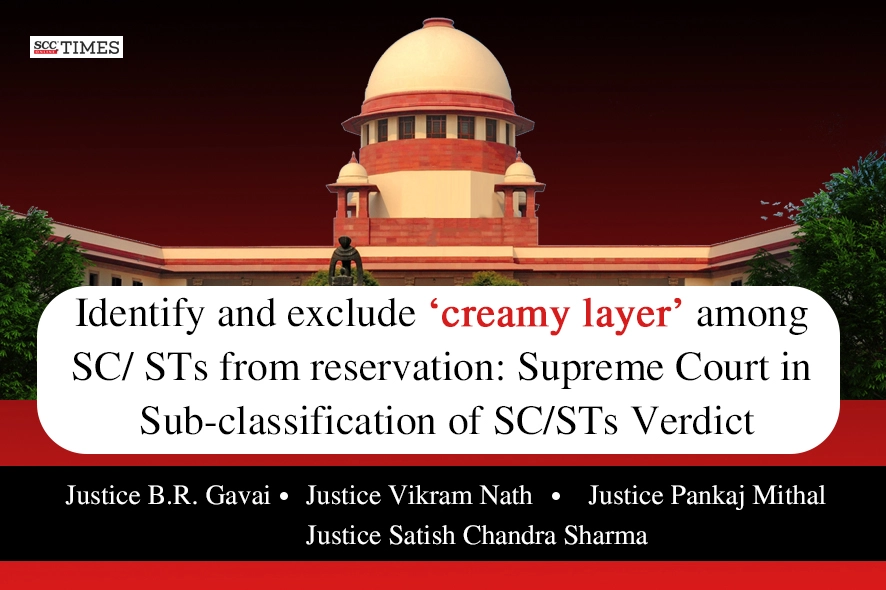
On 1 August 2024, the Supreme Court of India delivered a landmark verdict permitting sub-classification within Scheduled Castes (SC) and Scheduled Tribes (ST) for reservation purposes and directed exclusion of the 'creamy layer' among them from reservation benefits. The Court clarified that while the creamy layer doctrine has traditionally applied to Other Backward Classes (OBCs), it can be adapted to SC/ST categories with potentially different exclusion criteria. The Central Government opposed extending this doctrine to SC/STs, emphasizing that reservations for these groups are based on social and educational backwardness rather than purely economic status, and such policy decisions should rest with Parliament.
On this page
Key Facts
- On 1 August 2024, a seven-judge Constitution Bench of the Supreme Court delivered a verdict on SC/ST sub-classification.
- The majority of the bench (6:1) upheld the permissibility of sub-classification within SCs and STs to grant separate reservations to relatively more backward groups within these categories.
- Justice B.R. Gavai and several other judges held that the creamy layer principle, previously applied only to OBCs, is also applicable to SC/STs, though the criteria for exclusion may differ for these categories.
- The Ministry of Social Justice and Empowerment filed an affidavit on 6 August 2026 opposing extension of creamy layer exclusion to SC/STs, stating that reservations for these groups arise from social and educational backwardness, necessitating Parliament's policy decision supported by empirical studies.
- Reservation for SC/ST groups is constitutionally provided under Articles 15 and 16, addressing social and educational backwardness.
- Key landmark judgements referenced include Indra Sawhney v. Union of India (1992) and Ashoka Kumar Thakur v. Union of India (2008), which established the creamy layer doctrine for OBCs but not SC/STs.
Background & Context
The creamy layer doctrine originated with the 1992 Indra Sawhney case, excluding socially advanced groups within OBCs from reservation benefits to ensure affirmative action reaches genuinely backward groups. Traditionally, this principle was not applied to SC/STs, given their systemic social disadvantages. The 2024 Supreme Court judgment overruled the earlier E.V. Chinnaiah case (2005), which prohibited sub-classification within SC/STs, allowing nuanced intra-category affirmative action. The Ministry of Social Justice and Empowerment has argued against judicial imposition of creamy layer exclusion for SC/STs, maintaining it is a legislative policy matter requiring empirical evidence and parliamentary legislation.
Why This Matters for Exams / Exam Relevance
This issue is critical for exams focusing on Indian polity and law, as it illuminates constitutional interpretation regarding affirmative action, the interaction of social justice policies with constitutional provisions (Articles 15, 16, 341, and 342), and separation of powers between judiciary and legislature. Questions may pertain to landmark Supreme Court decisions, the evolving status of the creamy layer doctrine, and the legal framework for reservations under the Indian Constitution.
Points to Remember
- Supreme Court delivered the Constitution Bench verdict on 1 August 2024.
- The creamy layer doctrine was first introduced legally in the 1992 Indra Sawhney judgement for OBCs.
- Creamy layer exclusion for SCs and STs is newly affirmed as permissible, but criteria can differ from those for OBCs.
- Sub-classification within SC/ST categories has been permitted by the Supreme Court.
- The Ministry of Social Justice and Empowerment opposes extending creamy layer exclusion to SC/ST as a policy matter to be decided by Parliament.
- Reservations for SC and ST are constitutionally founded on social and educational backwardness under Articles 15, 16, 341, and 342.
- The Supreme Court emphasized the legislative domain of reservation policy and cautioned against courts redesigning quota rules.
- Justice Bela M. Trivedi dissented on sub-classification permissibility within SC/STs.
Sources & Further Reading
| Document / Website | Link |
|---|---|
| GKToday - SC/ST Creamy Layer Exclusion Case | Open GKToday - SC/ST Creamy Layer Exclusion Case ↗www.gktoday.in |
| SCC Online - Supreme Court Policy on Identifying Creamy Layer in SC/ST | Open SCC Online - Supreme Court Policy on Identifying Creamy Layer in SC/ST ↗www.scconline.com |
| Indra Sawhney v. Union of India - GKToday | Open Indra Sawhney v. Union of India - GKToday ↗www.gktoday.in |
| Ashoka Kumar Thakur v. Union of India - GKToday | Open Ashoka Kumar Thakur v. Union of India - GKToday ↗www.gktoday.in |
| Constitutional Provisions on SC/ST - Department of Personnel & Training, India | Open Constitutional Provisions on SC/ST - Department of Personnel & Training, India ↗dopt.gov.in |