
India Operationalises Inventory-Based Cross-Border E-Commerce Export Framework
On August 5, 2026, the Government of India implemented new regulations allowing foreign-funded e-commerce companies to engage in inventory-based exports of Indian-manufactured goods. Under the Foreign Trade Policy (FTP) 2023, the Directorate General of Foreign Trade (DGFT) issued Notification No. 27/2026-27 and Public Notice No. 25/2026-27 to operationalise this framework. E-commerce entities must register as Exporters-on-Record (EORs) using Form ANF 9A, source goods from Sellers-on-Record (SORs) based on confirmed export orders, and ensure comprehensive compliance with export documentation, regulatory requirements, and logistics. Administrative charges are capped at 10% of gross export rebates, with stringent payment timelines to sellers. This framework follows the July 23, 2026 DPIIT Press Note No. 3 amendment to the Foreign Direct Investment (FDI) policy, which enables inventory-based e-commerce exclusively for export purposes.
On this page
Key Facts
- On August 5, 2026, the DGFT under the Ministry of Commerce and Industry notified rules via Notification No. 27/2026-27 and Public Notice No. 25/2026-27 as part of FTP 2023.
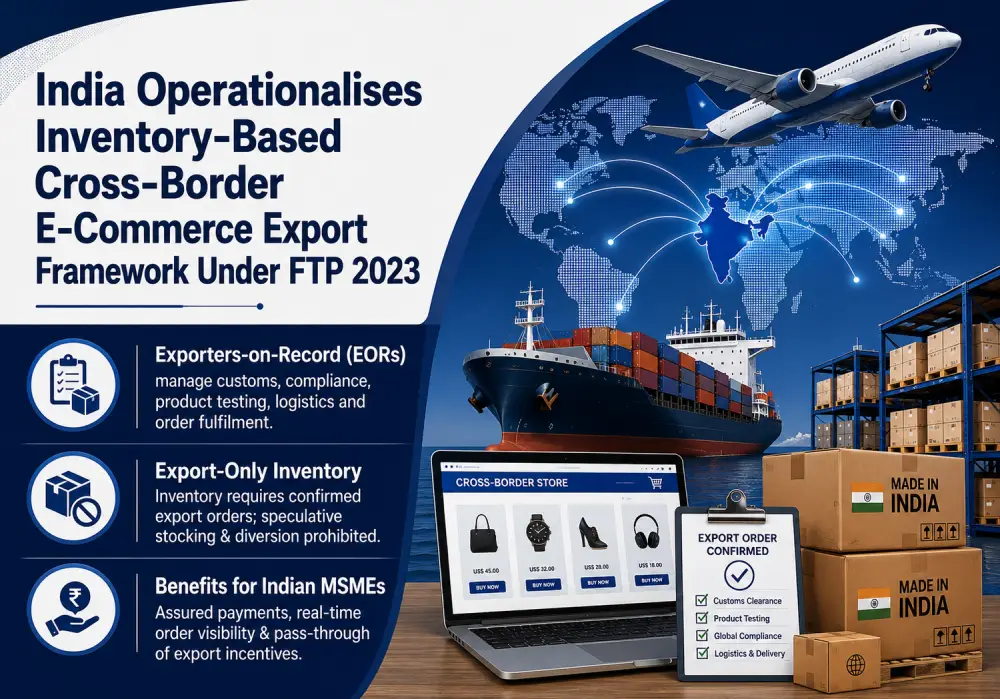
- This framework allows foreign-invested e-commerce firms to undertake export-only inventory-based operations through registered Exporters-on-Record (EORs).
- EORs procure goods solely against confirmed export orders from Sellers-on-Record (SORs), precluding speculative inventory buildup.
- Registration is mandatory via Aayaat Niryaat Form (ANF) 9A submitted to DGFT.
- EORs must maintain a digital repository integrating procurement, GST invoices, and export documentation for traceability and regulatory access.
- EORs are responsible for export documentation, customs formalities, compliance with destination country laws, product testing, certification, packaging, labeling, fulfillment, logistics, and reverse logistics.
- Administrative charges retained by EORs are capped at 10% of gross export rebates and refunds.
- Sellers must be paid within seven days of goods acceptance; export benefits must be disbursed to sellers within 30 days of receipt.
- The model is strictly for export purposes; domestic inventory-based e-commerce remains restricted.
Background & Context
Before this policy, foreign direct investment (FDI) in India's e-commerce was restricted to marketplace models where companies facilitated transactions but did not hold inventory. The July 23, 2026 amendment (DPIIT Press Note No. 3) introduced a targeted relaxation permitting inventory-based operations exclusively for exports, contingent on changes to Foreign Exchange Management regulations.
The August 5, 2026 DGFT notification operationalises this amendment, setting the regulatory and compliance framework to integrate Indian manufacturers and exporters into global supply chains via cross-border e-commerce.
Why This Matters for Exams / Exam Relevance
This policy change is critical for students preparing for civil services and trade-related examinations as it highlights recent regulatory reforms in India’s e-commerce and export frameworks. Understanding the distinctions between marketplace and inventory-based e-commerce models, government bodies involved (DGFT, DPIIT), related registration processes, and timelines for compliance are frequently tested topics. The integration of FDI policy changes with foreign trade regulations exemplifies India’s strategies to enhance export competitiveness in the digital economy.
Points to Remember
- Inventory-based export model launched on August 5, 2026, includes mandatory DGFT registration (ANF 9A) for Exporters-on-Record.
- Export inventory must be linked to confirmed overseas orders; speculative stock-holding is prohibited.
- EORs bear end-to-end responsibility for exports including documentation, compliance, and logistics.
- Administrative charges capped at 10% of gross export benefits; sellers must be paid promptly (within 7 days of acceptance).
- Framework is an implementation of DPIIT’s July 23, 2026 Press Note No. 3 amendment to FDI policy.
- Strictly for export-only inventory; domestic inventory-based e-commerce remains outside permissible scope.
Sources & Further Reading
| Document / Website | Link |
|---|---|
| Government Notifies Rules for Cross-Border E-Commerce Exports - GKToday | Open Government Notifies Rules for Cross-Border E-Commerce Exports - GKToday ↗www.gktoday.in |
| India to Ease FDI Rules for Inventory-Based E-Commerce Exports | Open India to Ease FDI Rules for Inventory-Based E-Commerce Exports ↗www.india-briefing.com |
| Government operationalises inventory-based cross-border e-commerce export framework - Firstpost | Open Government operationalises inventory-based cross-border e-commerce export framework - Firstpost ↗www.firstpost.com |