
Operation Trishul: India's Fugitive Tracking and Extradition Initiative
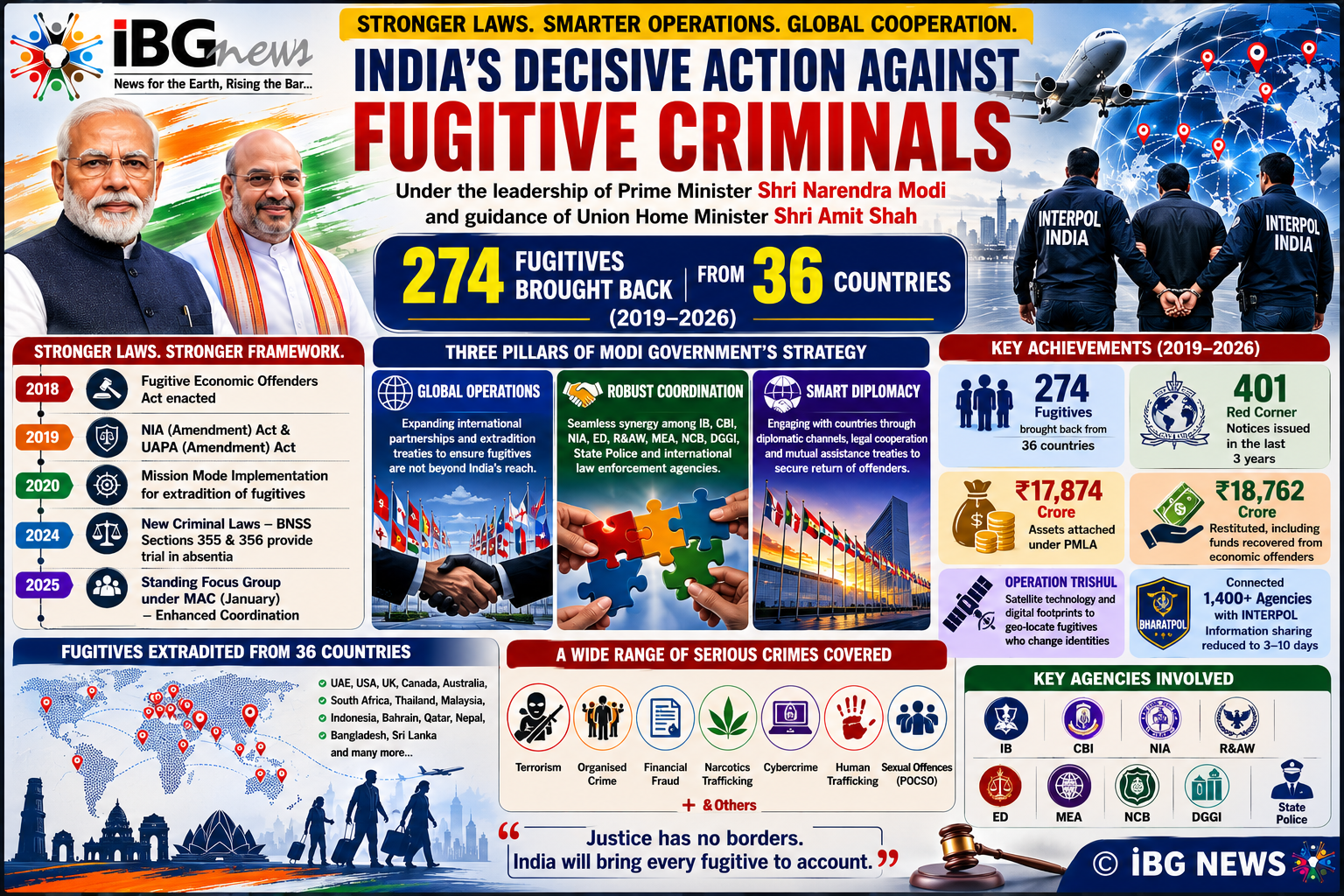
Since 2019, Operation Trishul has successfully facilitated the return of 274 fugitives to India from 36 countries. These individuals were wanted for serious crimes including terrorism, organised crime, narco-terrorism, sexual offences, financial fraud, murder, and human trafficking. The operation employs satellite imagery, surveillance inputs, and digital footprints to locate fugitives who change identities abroad. This multi-agency effort involves coordination among India’s Intelligence Bureau, Central Bureau of Investigation, Research and Analysis Wing, state police forces, and Interpol, highlighting India’s robust efforts in international law enforcement cooperation and fugitive extradition.
On this page
Key Facts
- Operation Trishul was launched in 2019 as an Indian government initiative to track and extradite fugitives from abroad.
- By August 2026, the operation successfully brought back 274 fugitives from 36 countries.
- The returned fugitives were wanted for terrorism, organised crime, narco-terrorism, sexual offences, financial fraud, murder, and human trafficking.
- In the year 2025 alone, 70 fugitives were extradited, and at least 45 fugitives were brought back by July 2026.
- The operation uses advanced technologies including satellite imagery, surveillance inputs, and digital footprint analysis to identify fugitives, especially those who change their names or identities abroad.
- Key agencies involved include the Intelligence Bureau (IB), Central Bureau of Investigation (CBI), Research and Analysis Wing (R&AW), various state police departments, and Interpol for international cooperation.
- The Prevention of Money Laundering Act, 2002, has been utilized extensively for attachment and recovery of proceeds of crime, with assets worth ₹917,874 crore attached and ₹918,762 crore recovered between 2019 and 2026.
- BHARATPOL was launched in January 2025 to connect over 1,400 state and central law enforcement units with Interpol, enhancing law enforcement coordination and fugitive tracking.
- The CBI established a Special Global Operations Centre to strengthen international coordination on fugitive matters.
- Extradition is a formal process of surrendering individuals from one state to another for prosecution or punishment, often facilitated by extradition treaties, mutual legal assistance, and intelligence sharing.
Background & Context
India faces significant challenges from fugitives who flee abroad to evade prosecution. Operation Trishul was designed to address this problem by enhancing coordination among domestic and international agencies.
This operation builds upon India’s existing legal framework, involving extradition treaties and the Prevention of Money Laundering Act (PMLA), and leverages international policing mechanisms such as Interpol’s notices and communication channels.
The multi-agency approach ensures comprehensive tracking, investigation, and legal action against fugitives involved in serious offenses. The establishment of the CBI's Special Global Operations Centre further enhances India's capability for cross-border fugitive management.
Why This Matters for Exams / Exam Relevance
Operation Trishul is significant for candidates preparing for exams on current affairs, governance, law enforcement, and international relations.
Understanding this operation aids in grasping India’s approach to tackling transnational crime, fugitive extradition, and international law enforcement cooperation.
Exam-focused topics include the initiative's launch year, the number of fugitives returned, the crimes targeted, agencies involved, legal frameworks like the PMLA, and the role of international organizations such as Interpol.
Points to Remember
- Operation Trishul was launched in 2019 to track and extradite fugitives from abroad.
- The operation brought back 274 fugitives by August 2026 from 36 countries.
- Major crimes targeted: terrorism, organised crime, narco-terrorism, sexual offences, financial fraud, murder, human trafficking.
- Key agencies involved include IB, CBI, R&AW, state police, and Interpol.
- The operation uses satellite imagery, surveillance inputs, and digital footprint tracking for identifying fugitives abroad.
- The Prevention of Money Laundering Act, 2002, is a critical legal tool used; assets worth ₹917,874 crore were attached and ₹918,762 crore recovered between 2019 and 2026.
- BHARATPOL launched in January 2025 connects over 1,400 law enforcement units with Interpol to facilitate information sharing.
- CBI’s Special Global Operations Centre coordinates international fugitive cases.
- Extradition involves formal surrender of persons by one state to another for prosecution or punishment, often through treaties and mutual legal assistance.
Sources & Further Reading
| Document / Website | Link |
|---|---|
| Operation Trishul brings back 274 fugitives | Open Operation Trishul brings back 274 fugitives ↗www.gktoday.in |
| Prevention of Money Laundering Act, 2002 | Open Prevention of Money Laundering Act, 2002 ↗legislative.gov.in |
| Interpol's role in international law enforcement | Open Interpol's role in international law enforcement ↗www.interpol.int |