
RBI Releases Updated List of Upper Layer NBFCs for 2026-27 with Revised Regulatory Framework
On 6 August 2026, the Reserve Bank of India (RBI) announced the updated list of Upper Layer Non-Banking Financial Companies (NBFCs) for the financial year 2026-27, increasing the list from 15 to 17 entities. This follows a revision in regulatory criteria in June 2026 that introduced a new absolute asset size threshold of ₹1 lakh crore to identify systemically important NBFCs under the Upper Layer. Major infrastructure finance companies and prominent entities like Tata Sons Private Limited are included. PNB Housing Finance Ltd. and Sammaan Capital Ltd. were excluded for not meeting the revised asset criterion but remain under enhanced regulation due to a five-year mandatory lock-in period. This update continues RBI's scale-based regulatory regime aimed at tighter supervision of large and systemically important NBFCs.
On this page
Key Facts
- RBI updated the Upper Layer NBFC list on 6 August 2026 for the financial year 2026-27.
- The list now contains 17 entities, up from 15 previously.
- Revised identification rule introduced in June 2026 sets an absolute asset size threshold of ₹1 lakh crore or more for Upper Layer classification.
- Newly added entities include REC Limited, Power Finance Corporation, Indian Railway Finance Corporation, and Housing and Urban Development Corporation.
- PNB Housing Finance Ltd. and Sammaan Capital Ltd. were excluded after failing to meet the asset size criterion but remain under regulatory oversight due to the mandatory five-year lock-in.
- Tata Sons Private Limited remains on the list, with its application to surrender Core Investment Company registration under examination.
- Upper Layer NBFCs are subject to enhanced supervision and stricter regulatory requirements compared to other NBFC layers.
- Private sector NBFCs in the Upper Layer must list their shares on stock exchanges within three years of identification as per RBI norms.
Background & Context
NBFCs are financial institutions registered under the Reserve Bank of India Act, 1934, but unlike banks, they do not accept demand deposits. To effectively regulate NBFCs based on their systemic importance and risk profile, RBI implemented a scale-based regulatory framework dividing NBFCs into Base Layer, Middle Layer, Upper Layer, and Top Layer categories.
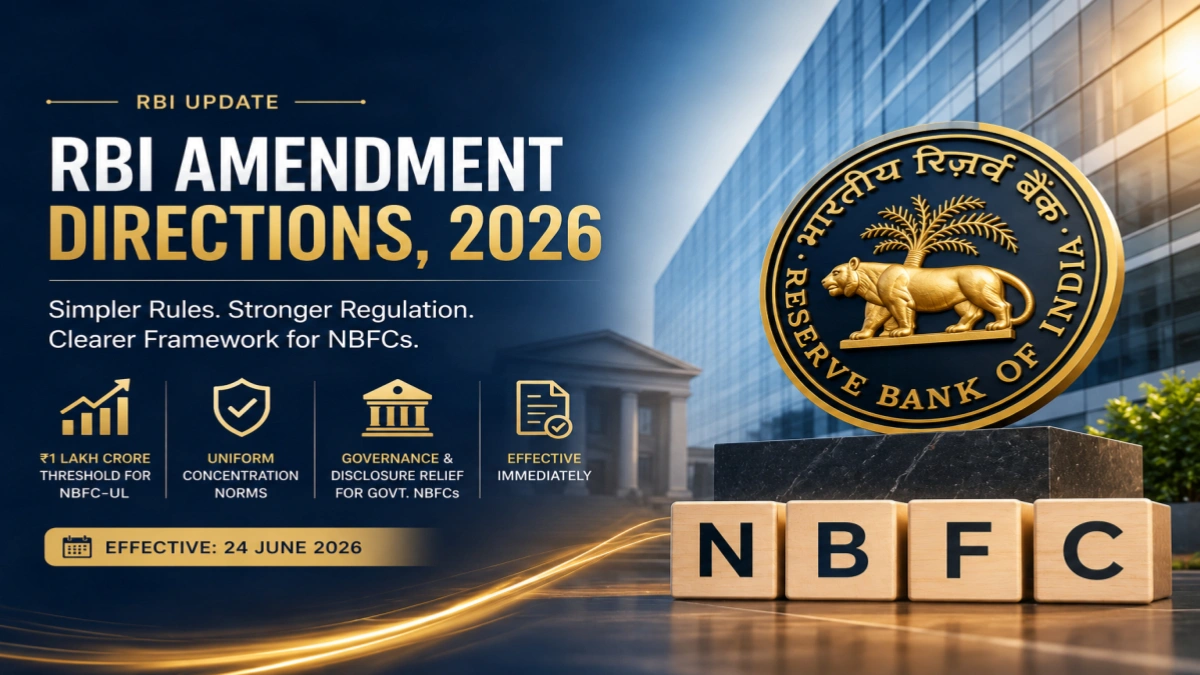
In June 2026, RBI simplified the identification of Upper Layer NBFCs by replacing the earlier complex parametric scoring system and top-ten asset ranking with a transparent asset threshold of ₹1 lakh crore on total assets. This threshold helps RBI identify systemically important NBFCs for tighter supervision.
Along with the asset threshold, RBI removed previous exemptions for government-owned NBFCs, allowing them to be classified into the Upper Layer if they meet the criteria, ensuring ownership-neutral regulation.
This structured approach facilitates proportionate regulation, safeguards financial stability, and avoids regulatory burden on smaller or less risky NBFCs.
Why This Matters for Exams
Understanding the RBI's scale-based framework and the criteria for categorizing NBFCs is important for candidates preparing for banking, finance, and economic regulatory sections in competitive exams. Knowledge of regulatory reforms such as the asset size threshold and the list of Upper Layer NBFCs reflects current policy and governance trends. Additionally, awareness of the role of Core Investment Companies and mandatory listing norms enhances conceptual clarity.
Points to Remember
- The revised Upper Layer NBFC framework took effect in fiscal year 2026-27, announced on 6 August 2026.
- An absolute asset size of ₹1 lakh crore is the principal criterion for Upper Layer classification.
- Seventeen entities qualified as Upper Layer NBFCs in 2026-27, including infrastructure finance companies and private sector firms.
- Exclusions due to asset criteria do not automatically release entities like PNB Housing Finance Ltd. and Sammaan Capital Ltd. from regulation due to a mandatory five-year supervision period.
- Tata Sons Private Limited’s status as a Core Investment Company remains under RBI’s examination following its application for deregistration.
- Private Upper Layer NBFCs are required to seek a stock exchange listing within three years to enhance transparency and investor protection.
Sources & Further Reading
| Document / Website | Link |
|---|---|
| RBI releases second list of upper layer NBFCs for 2026-27 | Open RBI releases second list of upper layer NBFCs for 2026-27 ↗www.gktoday.in |
| RBI Amendment Directions, 2026- Scale based regulatory framework | Open RBI Amendment Directions, 2026- Scale based regulatory framework ↗www.dpncindia.com |
| RBI proposes upper layer NBFCs to be defined by absolute asset size of ₹1 lakh crore+ | Open RBI proposes upper layer NBFCs to be defined by absolute asset size of ₹1 lakh crore+ ↗m.economictimes.com |