
SSC CGL Pre Syllabus 2026: Tier 1 & Tier 2 PDF
Understand the SSC CGL pre syllabus and complete Tier 2 requirements, with subject checklists, paper applicability, sectional timers, an illustrated PDF and original practice questions.
On this page
Verified on 6 October 2026.
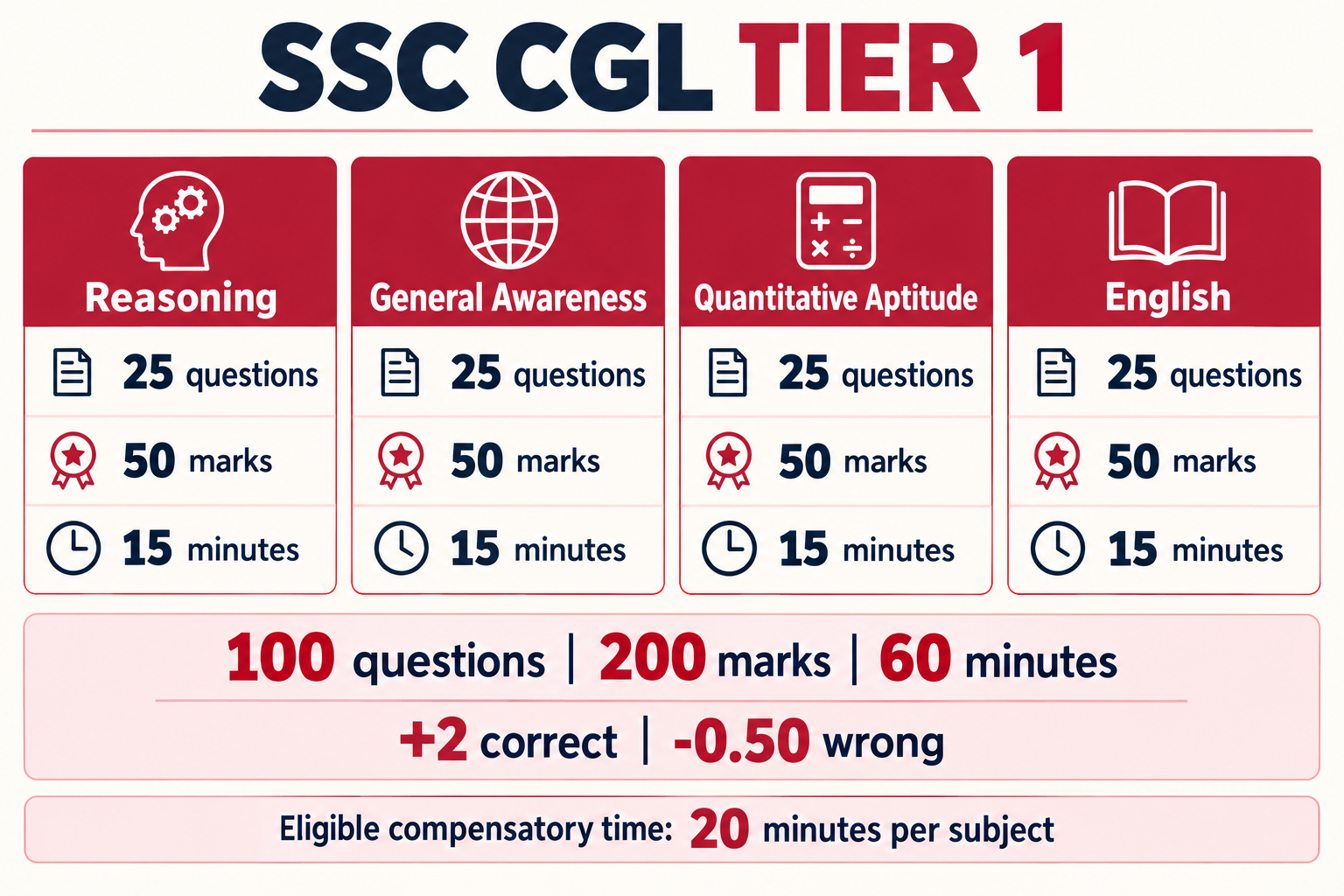
The SSC CGL pre syllabus covers four subjects: General Intelligence and Reasoning, General Awareness, Quantitative Aptitude, and English Comprehension. “Pre” is the common name for Tier 1 of the Staff Selection Commission’s Combined Graduate Level examination. For the 2026 cycle, Tier 1 has 100 questions for 200 marks, with 15 minutes for each subject. Each wrong answer costs 0.50 marks.
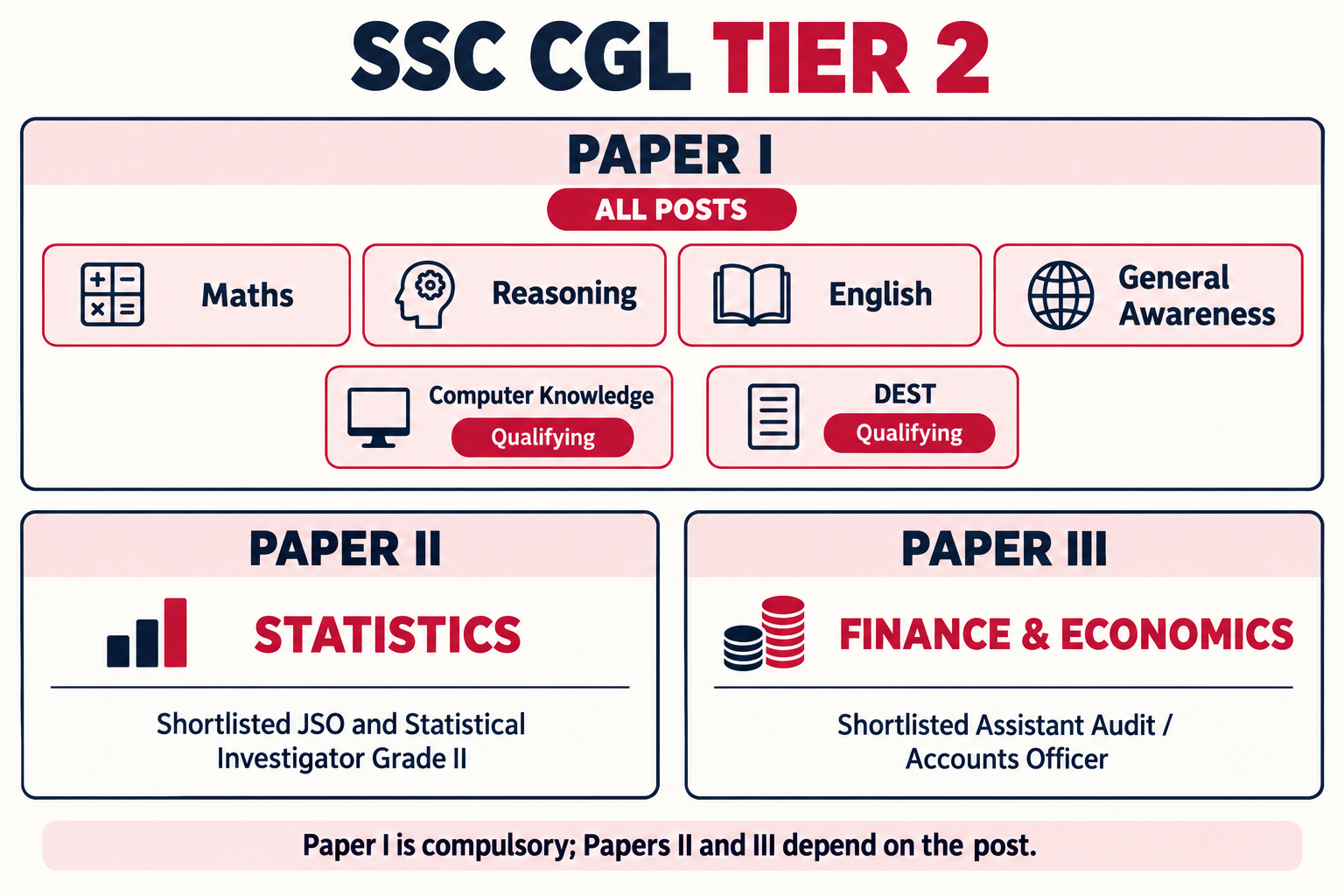
Preparation should also account for Tier 2. Its compulsory Paper I covers Maths, Reasoning, English, General Awareness, Computer Knowledge and a Data Entry Speed Test. Shortlisted candidates for specified posts also take Paper II: Statistics or Paper III: General Studies—Finance and Economics. This guide covers both tiers, including the specialist papers, so you can identify your complete study requirement in one place. SSC 2026 notice, sections 13.8–13.9.
Download the illustrated RojgarRank syllabus guide. It includes the syllabus, comparison tables, revision checklist and original practice questions. For the authoritative examination rules, use the separate official SSC CGL 2026 notification.
1. Start here: which syllabus do you need?
All candidates begin with the four Tier 1 subjects. For Tier 2, choose the row that matches the posts for which SSC has shortlisted you; a paper’s availability does not establish your eligibility for that post.
| Your Tier 2 route | Papers to prepare |
|---|---|
| Posts other than the specialist routes below | Paper I, including Computer Knowledge and DEST |
| Junior Statistical Officer or Statistical Investigator Grade-II | Paper I and Paper II: Statistics |
| Assistant Audit Officer or Assistant Accounts Officer | Paper I and Paper III: Finance and Economics |
Paper II applies to candidates who applied for the relevant statistical posts and are shortlisted for them. Paper III applies to candidates shortlisted for Assistant Audit Officer or Assistant Accounts Officer. Paper I is compulsory for all posts, subject to the narrowly defined DEST exemption explained below. Official applicability, sections 13.9.2–13.9.4.
Use the contents to move between the Tier 1 checklist, Tier 2 pattern, Paper I subjects, specialist papers and preparation tools. The topic lists below reorganise SSC’s indicative syllabus for easier revision; they do not promise a fixed number of questions from any chapter.
2. SSC CGL Tier 1 exam pattern 2026
Tier 1 is a computer-based, objective multiple-choice examination. Its four subjects carry equal marks, but each has its own timer.
| Subject | Questions | Marks | Standard timer |
|---|---|---|---|
| General Intelligence and Reasoning | 25 | 50 | 15 minutes |
| General Awareness | 25 | 50 | 15 minutes |
| Quantitative Aptitude | 25 | 50 | 15 minutes |
| English Comprehension | 25 | 50 | 15 minutes |
| Total | 100 | 200 | 60 minutes |
The correct-answer value is 2 marks, derived from 50 marks across 25 questions. The penalty is 0.50 marks per wrong answer. Questions are in English and Hindi, except English Comprehension. Candidates eligible for a scribe under paragraphs 7.1–7.3 receive 20 minutes per subject, making 80 minutes in total. Eligibility for this accommodation follows the notice’s conditions. Pattern and marking, section 13.8.
Practice implication: use four timed subject blocks when checking readiness. A single unrestricted one-hour mock does not reproduce the published subject timers. Do not build your strategy around transferring unused minutes between subjects. Follow SSC’s test instructions for the actual navigation controls.
3. Complete SSC CGL pre syllabus: Tier 1
Treat each checklist line as a group of related topics. For every group, complete the concept, solve representative questions, then revisit mistakes before marking it revised.
General Intelligence and Reasoning
The official syllabus includes verbal and non-verbal reasoning. Its full coverage can be grouped as follows:
- ☐ Analogy and comparison: semantic, symbolic/number and figural analogies; similarities and differences.
- ☐ Classification: semantic, symbolic/number and figural classification; arithmetical reasoning and figural classification exercises.
- ☐ Series and patterns: semantic, number, arithmetic number, figural and non-verbal series; trends.
- ☐ Coding and operations: coding-decoding, word building, numerical operations and symbolic operations.
- ☐ Space and figures: spatial orientation, space visualisation, embedded figures, punched-hole/pattern folding and unfolding, figural folding and completion.
- ☐ Logic and conclusions: problem solving, analysis, judgment, decision making, relationship concepts, statement–conclusion questions, syllogistic reasoning, Venn diagrams and drawing inferences.
- ☐ Observation and matching: visual memory, discrimination, observation, indexing, address matching, date and city matching, and classification of centre codes or roll numbers.
- ☐ Letter/number handling: coding, decoding and classification involving small letters, capital letters and numbers.
- ☐ Thinking and social understanding: critical thinking, emotional intelligence and social intelligence.
Matching codes and addresses may look less familiar than series or analogy, but they are explicitly named in the notice. Keep them in your checklist. For logic questions, separate what the statement establishes from what seems plausible in everyday life. Tier 1 Reasoning, section 13.10.1.
General Awareness
SSC describes awareness of the surrounding environment and its application to society, current events, and the scientific aspects of everyday observations and experience. It also names the following areas concerning India and neighbouring countries:
- ☐ History and culture.
- ☐ Geography.
- ☐ Economic scene.
- ☐ General policy.
- ☐ Scientific research.
- ☐ Current events and everyday science connected with the wider description above.
Use these headings to organise notes. For example, a report about a scientific mission can prompt revision of the science involved; a public-policy development can lead back to the relevant institution or constitutional provision. This is a study method, not an additional official topic list.
The syllabus does not specify a fixed current-affairs month range. Avoid treating “only the last six months” or another unsupported window as an SSC rule. Review current events alongside static concepts rather than allowing short news summaries to replace the broader syllabus. General Awareness, section 13.10.2.
Quantitative Aptitude
The official scope tests appropriate use of numbers and number sense. Cover each of these groups:
- ☐ Numbers: whole numbers, decimals, fractions, relationships between numbers and square roots.
- ☐ Arithmetic: percentages, ratio and proportion, averages, interest, profit and loss, discount, partnership business, mixture and alligation, time and distance, time and work.
- ☐ Algebra: basic identities of school algebra, elementary surds and graphs of linear equations.
- ☐ Geometry: triangles and their centres; congruence and similarity; circles, chords and tangents; angles subtended by chords; common tangents to two or more circles.
- ☐ Plane mensuration: triangles, quadrilaterals, regular polygons and circles.
- ☐ Solid mensuration: right prisms, right circular cones and cylinders, spheres, hemispheres, rectangular parallelepipeds, and regular right pyramids with a triangular or square base.
- ☐ Trigonometry: trigonometric ratios, degree and radian measures, standard identities, complementary angles, heights and distances.
- ☐ Charts: histograms, frequency polygons, bar diagrams and pie charts.
When practising mensuration, write down the quantity requested before selecting a formula: perimeter, area, surface area and volume are different tasks. For charts, read units and totals first. These habits help identify whether an error came from the concept, calculation or interpretation. Quantitative Aptitude, section 13.10.3.
English Comprehension
Official Tier 1 wording is broad: SSC tests understanding of correct English, basic comprehension and writing ability. It does not give the detailed Tier 1 chapter list that appears for Tier 2 English. Tier 1 remains an objective examination; “writing ability” does not establish a separate descriptive paper.
For practical preparation, use this breakdown:
- ☐ Grammar and sentence construction: agreement, tenses, articles, pronouns, prepositions and conjunctions.
- ☐ Vocabulary in context: meanings, synonyms, antonyms, spelling, idioms and one-word expressions.
- ☐ Sentence accuracy: error identification, blanks and sentence improvement.
- ☐ Meaning-preserving changes: voice, reported speech and sentence arrangement.
- ☐ Reading: short passages, main ideas, stated details, contextual vocabulary and reasonable inferences.
These are preparation categories, not a verbatim SSC Tier 1 subtopic list or a promise that every format will occur. Practise grammar within complete sentences and read enough context before selecting a word. Official English description, section 13.10.4.
Level: SSC specifies graduation-level questions for Tier 1 Reasoning, General Awareness and English, and Class 10 level for Quantitative Aptitude. That statement describes the notified standard, not a guarantee that every question will feel equally difficult. Section 13.10.5.
4. SSC CGL Tier 2 pattern: Paper I, II and III
Paper I: compulsory for all posts
Paper I has four sections across two sessions on the same day. Session I contains the three objective sections; Session II contains DEST after a break for re-registration.
| Section and subject | Questions | Marks | Standard time |
|---|---|---|---|
| I-A: Mathematical Abilities | 30 | 90 | 30 minutes |
| I-B: Reasoning and General Intelligence | 30 | 90 | 30 minutes |
| II-A: English Language and Comprehension | 45 | 135 | 40 minutes |
| II-B: General Awareness | 25 | 75 | 20 minutes |
| III: Computer Knowledge Test | 20 | 60 | 15 minutes |
| IV: Data Entry Speed Test | One task | Qualifying | 15 minutes |
Session I totals 150 questions, 450 marks and 135 minutes. Session II adds 15 minutes of DEST; the intervening break is separate. The objective correct-answer value is 3 marks and the penalty is 1 mark per wrong answer, including in the qualifying Computer Knowledge Test.
For candidates eligible under paragraphs 7.1–7.3, the respective timers are 40, 40, 55, 25, 20 and 20 minutes. Use the timer for your own subject and entitlement, not a generic extended-time total. The section structure and subject timers appear in the official tables and sections 13.9.4–13.9.8.
Specialist papers
| Paper | Subject | Questions and marks | Standard duration |
|---|---|---|---|
| II | Statistics | 100 questions; 200 marks | 2 hours |
| III | General Studies—Finance and Economics | 100 questions; 200 marks | 2 hours |
Both specialist papers award 2 marks per correct answer and deduct 0.50 marks per wrong answer. Eligible candidates receive 2 hours 40 minutes for each. They are held in separate shifts or days as scheduled by SSC. Tier 2 objective questions are bilingual, except the English Language and Comprehension part; DEST is the practical exception to the multiple-choice format. Sections 13.9.1–13.9.8.
5. Tier 2 Paper I: full subject syllabus
Mathematical Abilities
Much of this syllabus overlaps with Tier 1 Maths, but the official Tier 2 list explicitly adds elementary statistics and probability.
- ☐ Number systems: computations with whole numbers, decimals and fractions; relationships between numbers.
- ☐ Arithmetic operations: percentages, ratios and proportion, square roots, averages, simple and compound interest, profit and loss, discount, partnerships, mixture and alligation, time–distance and time–work.
- ☐ Algebra: school algebra identities, simple elementary-surds problems and linear-equation graphs.
- ☐ Geometry: elementary figures and facts; triangle centres; congruence and similarity; circles, chords, tangents, chord-subtended angles and common tangents.
- ☐ Mensuration: triangles, quadrilaterals, regular polygons, circles, right prisms, right circular cones and cylinders, spheres, hemispheres, rectangular parallelepipeds, and regular right pyramids with triangular or square bases.
- ☐ Trigonometry: ratios, complementary angles, simple height-and-distance problems and standard identities.
- ☐ Statistics and probability: tables, histograms, frequency polygons, bar diagrams, pie charts, mean, median, mode, standard deviation and simple probabilities.
The notified level is matriculation. Keep a separate revision line for basic statistics and probability: familiarity with pie charts alone does not complete this area. This Paper I material is much narrower than specialist Paper II Statistics. Sections 13.11.1 and 13.11.8.
Reasoning and General Intelligence
The syllabus again includes verbal and non-verbal questions:
- ☐ Semantic, symbolic/number and figural analogies.
- ☐ Semantic, symbolic/number and figural classification.
- ☐ Semantic, number and figural series; trends.
- ☐ Symbolic operations, numerical operations, word building and coding-decoding.
- ☐ Space orientation, Venn diagrams and drawing inferences.
- ☐ Punched-hole/pattern folding and unfolding; figural folding and completion; embedded figures.
- ☐ Critical thinking, problem solving, emotional intelligence and social intelligence.
SSC also retains “other sub-topics, if any” in this indicative list. Use topic practice to build recognition, then mixed practice to check whether you can select a method without a chapter label telling you what to do. Section 13.11.2.
English Language and Comprehension
Unlike the broad Tier 1 description, SSC gives a detailed Tier 2 English list. Complete all the following:
- ☐ Vocabulary, grammar, sentence structure and correct usage.
- ☐ Synonyms, homonyms and antonyms.
- ☐ Error spotting, fill-in-the-blanks and sentence improvement.
- ☐ Spellings and detection of misspelt words.
- ☐ Idioms and phrases; one-word substitution.
- ☐ Active and passive voice of verbs.
- ☐ Conversion between direct and indirect narration.
- ☐ Rearrangement of sentence parts and sentences in a passage.
- ☐ Cloze passages and reading comprehension.
For comprehension, the notice specifies three or more paragraphs: at least one simple passage based on a book or story and the other two based on current affairs, a report or an editorial. The notified English standard is Class 12. Practise both straightforward factual reading and denser explanatory prose. Sections 13.11.3 and 13.11.8.
General Awareness
The official scope is similar to Tier 1: environment and society, current events, scientific aspects of everyday experience, and India and neighbouring countries, particularly history, culture, geography, the economic scene, general policy and scientific research.
Keep one well-organised set of General Awareness notes for both tiers, then practise under the relevant timer. Similar syllabus wording does not establish identical questions, difficulty or chapter distribution. Section 13.11.4.
Computer Knowledge and Proficiency
This is Section III, with 20 questions for 60 marks. Its four official topic groups are:
- ☐ Computer basics: organisation of a computer, Central Processing Unit (CPU), input/output devices, memory and its organisation, backup devices, ports, Windows Explorer and keyboard shortcuts.
- ☐ Software: Windows operating system and Microsoft Office basics, including Word, Excel and PowerPoint.
- ☐ Internet and email: browsing, searching, downloading, uploading, managing an email account and electronic banking.
- ☐ Networking and cyber security: devices and protocols, network/information-security threats such as hacking, viruses, worms and Trojans, and preventive measures.
Practise recognising functions as well as terminology: what an input device does, what a spreadsheet command changes, or which preventive action addresses a particular threat. The official syllabus gives topic families rather than a software-version checklist. Section 13.11.5.
6. DEST and qualifying computer requirements
The Data Entry Speed Test (DEST) is Section IV of Paper I. SSC specifies a passage of about 2,000 key depressions in 15 minutes. Key depressions are not the same as words; do not substitute a words-per-minute target and assume the measures are interchangeable. Eligible candidates receive five additional minutes.
Both Computer Knowledge and DEST are compulsory qualifying requirements, subject to the specified DEST exemption. Higher standards apply to designated posts. Examples of posts requiring higher standards in both include specified Assistant Section Officer posts and CBIC inspector posts; higher DEST standards also apply to the listed Tax Assistant and Central Bureau of Narcotics UDC/SSA posts. Read the complete post lists in the notice before choosing a target standard. Sections 13.9.9–13.9.10.
Exemption is narrow. PwBD-OH candidates may claim DEST exemption with the prescribed Annexure XIV medical certificate establishing permanent unfitness for typing due to physical disability. The exemption does not apply to posts requiring computer proficiency or DEST, except the stated Tax Assistant in CBDT exception. Other PwBD candidates are not eligible for this exemption. The notice also limits a passage reader to visually impaired candidates who opted for a scribe in the written examination. Sections 13.9.10.6–13.9.10.7.
For practice, use complete timed passages, record errors, and retype troublesome sequences carefully. Check the Regional Office’s detailed skill-test instructions and SSC’s evaluation guidance when issued; this syllabus does not settle every keyboard or software behaviour.
7. Tier 2 Paper II: Statistics syllabus
Paper II is a graduation-level specialist paper for the applicable JSO and Statistical Investigator Grade-II route. Basic Paper I statistics does not cover it. Use these 12 official areas as a separate study checklist:
- ☐ Collection, classification and presentation: primary/secondary data, collection methods, tabulation, graphs and charts, frequency distributions and their diagrammatic presentation.
- ☐ Central tendency: mean, median and mode; partition values including quartiles, deciles and percentiles.
- ☐ Dispersion: range, quartile deviation, mean deviation, standard deviation and relative measures of dispersion.
- ☐ Moments, skewness and kurtosis: types of moments and their relationships; meaning and measures of skewness and kurtosis.
- ☐ Correlation and regression: scatter diagrams, simple correlation coefficients and regression lines, Spearman rank correlation, association of attributes, multiple regression, and multiple/partial correlation for three variables only.
- ☐ Probability theory: meaning and definitions, conditional and compound probability, independent events and Bayes’ theorem.
- ☐ Random variables and distributions: probability functions, expectation, variance, higher moments, binomial/Poisson/normal/exponential distributions, and the discrete joint distribution of two random variables.
- ☐ Sampling theory: population/sample, parameter/statistic, sampling and non-sampling errors; probability and non-probability sampling techniques, including simple random, stratified, multistage, multiphase, cluster, systematic, purposive, convenience and quota sampling; sampling distributions at statement level; sample-size decisions.
- ☐ Statistical inference: point and interval estimation; properties of a good estimator; moments, maximum-likelihood and least-squares estimation; hypotheses and basic testing concepts; small/large sample tests; Z, t, chi-square and F tests; confidence intervals.
- ☐ Analysis of variance: one-way and two-way classified data.
- ☐ Time series: components, methods of determining trend and methods of measuring seasonal variation.
- ☐ Index numbers: meaning, construction problems, types and formulae, base shifting, splicing, cost-of-living indices and uses.
Study related ideas together: describe data before working through distributions, and understand sampling before inference. Maintain a formula sheet that records assumptions and interpretation alongside the calculation. This is suggested study order, not SSC chapter weightage. Statistics syllabus, sections 13.11.6.1–13.11.6.12.
8. Tier 2 Paper III: Finance and Economics syllabus
Paper III is for candidates shortlisted for Assistant Audit Officer or Assistant Accounts Officer. The paper is at graduation level and divides its 200 marks into Finance and Accounts: 80 and Economics and Governance: 120.
Part A: Finance and Accounts — 80 marks
- ☐ Accounting foundations: fundamental principles, nature and scope of financial accounting, its limitations, basic concepts and conventions, and generally accepted accounting principles.
- ☐ Recording transactions: single and double entry; books of original entry; journals, ledgers and trial balance; bank reconciliation; rectification of errors.
- ☐ Accounts and statements: manufacturing, trading and profit-and-loss appropriation accounts; balance sheet; distinction between capital and revenue expenditure.
- ☐ Valuation and specialised topics: depreciation, inventory valuation, non-profit organisation accounts, receipts-and-payments and income-and-expenditure accounts, bills of exchange and self-balancing ledgers.
As a preparation exercise, trace a transaction from its original entry to the relevant statement. Then check how an error affects the trial balance or the final accounts. Keep conceptual definitions and numerical work connected.
Part B: Economics and Governance — 120 marks
- ☐ Constitutional institutions: constitutional provisions, role and responsibilities of the Comptroller and Auditor-General of India; role and functions of the Finance Commission.
- ☐ Economic foundations: definition, scope and nature of economics; methods of economic study; central problems of an economy; production-possibility curve.
- ☐ Demand, supply and consumers: meaning, determinants and laws of demand/supply; price, income and cross elasticity of demand; supply elasticity; Marshallian and indifference-curve approaches to consumer behaviour.
- ☐ Production and cost: meaning and factors of production; law of variable proportions; returns to scale.
- ☐ Markets and prices: perfect competition, monopoly, monopolistic competition and oligopoly; price determination in these markets.
- ☐ Indian economy: its nature; agriculture, industry and services, including their roles, problems and growth; national-income concepts and measurement methods.
- ☐ Population and development: population size, growth and implications; absolute/relative poverty; types, causes and incidence of unemployment; energy, transport and communication infrastructure.
- ☐ Reforms: economic reforms since 1991, liberalisation, privatisation, globalisation and disinvestment.
- ☐ Money and banking: monetary/fiscal policy; RBI’s role and functions; functions of commercial banks, regional rural banks and payment banks; budget, fiscal deficits, balance of payments, and the Fiscal Responsibility and Budget Management Act, 2003.
- ☐ Governance and technology: role of information technology in governance.
The 80/120 split is official. More detailed topic-by-topic marks are not provided in this syllabus. Plan for the whole paper instead of presenting a coaching estimate as a guaranteed distribution. Paper III and standards, sections 13.11.7–13.11.8.
9. Tier 1 versus Tier 2: what changes?
| Feature | Tier 1 | Tier 2 |
|---|---|---|
| Core subjects | Maths, Reasoning, English, General Awareness | The same broad areas in Paper I |
| Additional requirements | No separate computer or typing component | Computer Knowledge, DEST and applicable specialist paper |
| Objective scoring | +2 correct; −0.50 wrong | Paper I: +3/−1; Papers II and III: +2/−0.50 |
| Timing | Four 15-minute subject blocks | Subject timers, separate DEST session and specialist papers |
| Role | Shortlisting for Tier 2 | Final merit, with qualifying requirements |
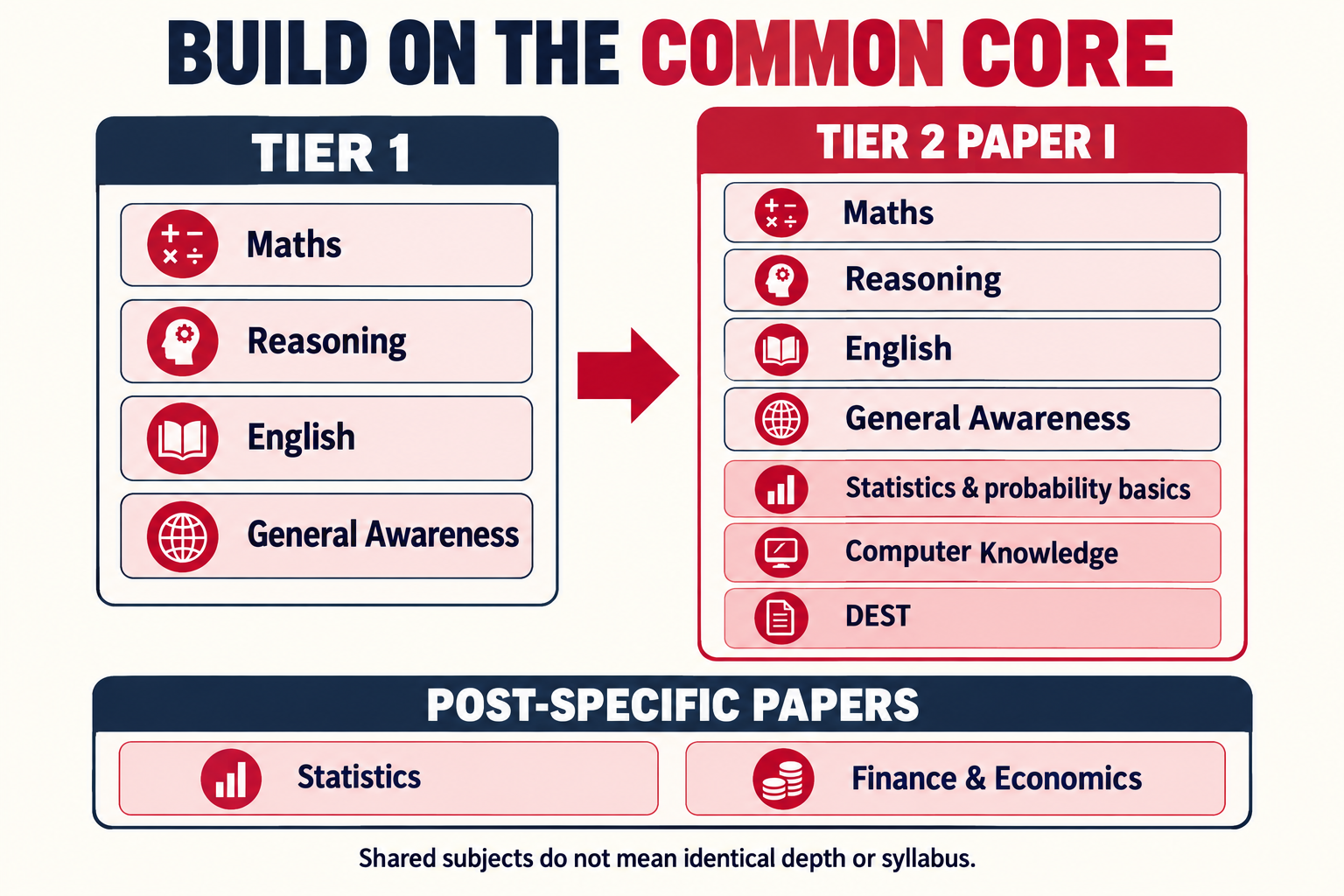
The efficient connection is to revise common concepts once and test them in both formats. However, retain the separate official lists: degree/radian measures are expressly named in Tier 1 Maths, while simple probability and standard deviation are expressly named in Tier 2 Paper I. The English descriptions also differ in detail and stated standard.
10. Marking, qualifying standards and final merit
For a Tier 1 raw-score example, suppose you answer 76 correctly, 12 incorrectly and leave 12 unanswered. The calculation is (76 × 2) − (12 × 0.50) = 146 out of 200. This is a practice/raw score; the notice provides for normalisation where the computer-based examination uses multiple shifts. Section 13.2.
Minimum qualifying marks are 30% for UR, 25% for OBC/EWS and 20% for other categories. They apply to Tier 1, Sections I–III of Tier 2 Paper I and the specialist papers. These minimums are not competitive cutoffs. DEST’s stated maximum error percentages are 20%, 25% and 30%, respectively; designated posts require higher standards. Sections 16.1–16.6.
Tier 1 marks shortlist; final merit uses Tier 2. Paper I Sections I and II total 390 marks. Computer Knowledge’s 60 marks are qualifying, explaining why the objective paper totals 450 without all 450 entering merit. The applicable specialist route adds its 200-mark paper. All required sections must be qualified; qualifying components are not optional. Sections 16.10–16.14.
11. A practical four-week revision plan
This is an adaptable revision cycle for someone who has already studied the basics, not a promise to complete the whole examination syllabus from zero in four weeks. Extend a week when your diagnostic work shows missing concepts. If a specialist paper applies, allocate it a regular separate block from the beginning.
| Week | Main work | Evidence to record |
|---|---|---|
| 1: Audit and repair | Check every syllabus group; repair arithmetic, grammar and reasoning foundations; organise General Awareness notes | Topics you cannot yet explain or solve independently |
| 2: Connect and practise | Mix related topics; add geometry, trigonometry, Paper I statistics/probability and computer topics | Accuracy by topic and repeated error types |
| 3: Use the timers | Practise 15-minute Tier 1 subjects and the relevant Tier 2 subject timers; continue typing and specialist study | Attempted, correct, wrong and unfinished questions |
| 4: Review and retest | Alternate representative mocks with error correction; revise weak groups and retest old mistakes | Whether the same mistake recurs without hints |
For a suggested daily session, begin with an old error, complete one concept/practice block, attempt a short timed set, then record the result. Add reading and General Awareness revision according to your available time. Use a complete typing passage regularly, rather than delaying DEST until all objective subjects feel finished.
Choose study order from evidence. If fractions and percentages cause errors, repair them before repeatedly timing profit-and-loss sets. If you know a grammar rule but miss it in passages, work on contextual reading. A correct answer obtained with a hint belongs in the revision queue, not the completed column.
Printable syllabus progress tracker
Use the detailed checklists above for topics and this table for overall progress. In the blank cells, add a tick and date only after doing the work. “Practised” means attempted independently; “retested” means checked again after a gap.
| Subject or requirement | Learned | Practised | Revised | Retested |
|---|---|---|---|---|
| Maths: numbers and arithmetic | ☐ | ☐ | ☐ | ☐ |
| Maths: algebra, geometry and mensuration | ☐ | ☐ | ☐ | ☐ |
| Maths: trigonometry, charts, basic statistics/probability | ☐ | ☐ | ☐ | ☐ |
| Reasoning | ☐ | ☐ | ☐ | ☐ |
| English | ☐ | ☐ | ☐ | ☐ |
| General Awareness | ☐ | ☐ | ☐ | ☐ |
| Computer Knowledge | ☐ | ☐ | ☐ | ☐ |
| DEST | ☐ | ☐ | ☐ | ☐ |
| Paper II or III, if applicable | ☐ | ☐ | ☐ | ☐ |
Printable error log
Record the reason for an error in words you can act on: “used selling price as the profit base” is more useful than “silly mistake”. Include skipped questions caused by weak concepts as well as wrong answers.
| Date / topic | Error or difficulty | Correction / next action | Retest date / result |
|---|---|---|---|
| Example: profit percentage | Used the wrong denominator | Recalculate using cost price; solve a fresh example | ______ |
| ______ | ______ | ______ | ______ |
| ______ | ______ | ______ | ______ |
| ______ | ______ | ______ | ______ |
Review the log before choosing the next practice set. If the same mistake continues, slow down and revisit the explanation. If you can solve accurately without a timer but not with one, practise selecting a method and completing the calculation efficiently.
12. Eight original diagnostic questions
These are original practice questions, not previous-year SSC questions. There are two from each Tier 1 subject. This small set checks selected foundations; it cannot estimate your complete readiness, rank or likely cutoff.
Reasoning
1. What is the next number in 4, 9, 19, 39, 79, …?
A. 119 B. 149 C. 159 D. 169
2. Statements: All notebooks are books. No book is a stone. Which conclusion must follow?
A. All books are notebooks. B. No notebook is a stone. C. Some stones are notebooks. D. All stones are books.
General Awareness
3. Which Article of the Constitution provides for the Comptroller and Auditor-General of India?
A. Article 110 B. Article 148 C. Article 280 D. Article 324
4. What is the SI base unit of electric current?
A. Kelvin B. Mole C. Ampere D. Candela
Quantitative Aptitude
5. An item costs ₹800. Its marked price is 25% above cost, and a 10% discount is offered on that marked price. What is the profit percentage?
A. 10% B. 12.5% C. 15% D. 22.5%
6. A can complete a job in 12 days and B in 18 days. Working together at these constant rates, how long do they take?
A. 6 days B. 7.2 days C. 8 days D. 15 days
English
7. Choose the correct verb: “Each of the candidates ___ a valid admit card.”
A. carry B. carries C. have carried D. were carrying
8. Read: “The library extended its opening hours during the examination month. Students could then use the reading room until 9 p.m.” Which statement is supported?
A. The library opens until 9 p.m. throughout the year. B. All students studied until 9 p.m. C. The reading room was available until 9 p.m. during the examination month. D. The library introduced an admission fee.
Answer key and explanations
1 — C, 159. Each term equals twice the previous term plus one: 4 × 2 + 1 = 9, continuing to 79 × 2 + 1 = 159. Checking the rule against every given transition avoids choosing it from only the first pair.
2 — B. Notebooks lie within the group “books”, and that entire group excludes stones. Therefore no notebook can be a stone. The first statement does not say that every book is a notebook.
3 — B, Article 148. This Article establishes the office of the Comptroller and Auditor-General of India. Constitution of India, Article 148. For broader revision, read RojgarRank’s Indian Constitution: key facts and features.
4 — C, ampere. Ampere is the SI base unit for electric current. The other options measure thermodynamic temperature, amount of substance and luminous intensity, respectively. BIPM’s SI base-unit table.
5 — B, 12.5%. Marked price = ₹800 × 1.25 = ₹1,000. Selling price after discount = ₹1,000 × 0.90 = ₹900. Profit = ₹100; profit percentage = 100 ÷ 800 × 100 = 12.5%. Markup and discount use different bases.
6 — B, 7.2 days. Combined daily work = 1/12 + 1/18 = 5/36 of the job. Time = 36/5 = 7.2 days. Adding the individual completion times does not produce the joint completion time.
7 — B, carries. The subject is the singular “Each”. The plural noun in “of the candidates” does not change that subject–verb agreement.
8 — C. The passage explicitly supports reading-room access until 9 p.m. in the examination month. It does not establish year-round hours, individual attendance or a fee. Base the answer on the text rather than a plausible extra assumption.
13. Frequently asked questions and official references
Is SSC CGL pre the same as Tier 1?
Yes, “pre” or “prelims” commonly refers to Tier 1. The 2026 notice names the stages Tier I and Tier II. Preparing only the pre syllabus leaves Computer Knowledge, DEST and any applicable specialist paper uncovered.
Does SSC CGL 2026 have sectional timing?
Yes. The published Tier 1 table assigns 15 minutes per subject; eligible compensatory time makes it 20. Tier 2 Paper I assigns separate subject timers, including 40 minutes for English and 20 for General Awareness under standard timing.
Does everyone take Statistics, Finance and Economics?
Everyone taking Paper I needs its basic statistics and probability topics. The separate Statistics Paper II applies to the shortlisted statistical-post route. Finance and Economics Paper III applies to shortlisted Assistant Audit Officer/Assistant Accounts Officer candidates. Do not confuse the Paper I statistics topic with Paper II.
Is Computer Knowledge optional because it is qualifying?
No. Qualifying means it is a required condition rather than part of the merit total. DEST is also qualifying, with only the specified exemption. Prepare both alongside the four core subjects.
Are there guaranteed high-weightage chapters?
The notice sets subject/paper marks and the syllabus, but does not guarantee chapter-wise counts. Prioritise missing foundations and errors shown by your practice. Any analysis of earlier papers should be identified by year and paper, not presented as a promise for a future examination.
Which PDF should I download?
Use the RojgarRank illustrated guide for revision and printable tools. Keep the official SSC notice for rules. The guide is an independent explanation, not an SSC-issued document.
Where can I verify a rule?
- Pattern, timers, penalties and paper applicability: official notification, sections 13.8–13.9, printed pages 25–30.
- Tier 1 syllabus: sections 13.10.1–13.10.5, printed pages 30–31.
- Tier 2 syllabus and levels: sections 13.11.1–13.11.8, printed pages 31–36.
- Qualifying standards and merit: section 16, printed pages 41–43.
These references use the 2026 SSC CGL notification. Recheck SSC’s notices and your admission instructions for subsequent directions affecting your examination. Keep the official source, your applicable paper route and your progress checklist together when planning the next revision session.
Related SSC CGL application references
For the original application dates, fees and document checklist, read the archived SSC CGL 2026 application guide. For live photo capture and signature file requirements, use the SSC CGL photo and signature guide. These references explain the 2026 application requirements; they do not announce an open application window.
Sources & Further Reading
| Document / Website | Link |
|---|---|
| Staff Selection Commission: Combined Graduate Level Examination 2026 notification | Open Staff Selection Commission: Combined Graduate Level Examination 2026 notification ↗ssc.gov.in |
| Legislative Department: Constitution of India, Article 148 | Open Legislative Department: Constitution of India, Article 148 ↗www.legislative.gov.in |
| BIPM: International System of Units, base units | Open BIPM: International System of Units, base units ↗www.bipm.org |