
China Completes Testing of World's Largest Fusion Superconducting Magnet
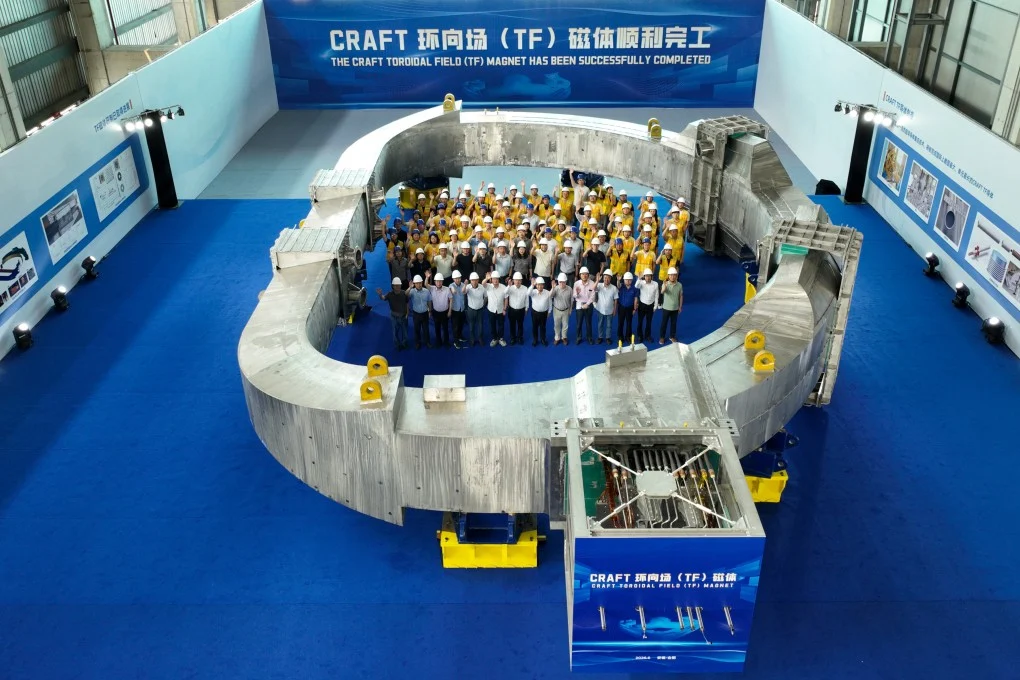
On 27 June 2026, China successfully completed expert acceptance and full-parameter testing of two domestically developed superconducting magnets at the Institute of Plasma Physics, Chinese Academy of Sciences, Hefei. These included a 21-metre-long D-shaped toroidal field superconducting magnet—the largest fusion reactor magnet built to date—and a high-temperature superconducting central solenoid coil. Both magnets reached internationally leading performance levels and were produced with 100% domestic supply chain integration. These advancements support China’s Comprehensive Research Facility for Fusion Technology (CRAFT) and its 'artificial sun' programme, aiming for fusion power generation around 2030. The toroidal magnet surpasses ITER magnets in volume by 1.3 times and in stored energy by three times, marking a major milestone in fusion research technology.
On this page
Key Facts
- Date of achievement: 27 June 2026
- Location: Institute of Plasma Physics, Chinese Academy of Sciences, Hefei, Anhui Province
- Magnets tested: Toroidal field superconducting magnet and high-temperature superconducting central solenoid coil
- Toroidal magnet dimensions: 21 metres length, 12 metres width, 582 tonnes weight
- Structure: Toroidal magnet has a D-shaped configuration
- Significance: Largest fusion reactor superconducting magnet built worldwide to date
- Both magnets achieved 100% domestic production, including core raw materials and fabrication
- Part of China's Comprehensive Research Facility for Fusion Technology (CRAFT) under the “artificial sun” programme
- Target for fusion power generation by China: Around 2030
- Compared to ITER magnets: China’s toroidal magnet has 1.3 times the volume and three times the stored energy
Background & Context
Fusion is the process of combining light atomic nuclei to release significant energy, powering the Sun and stars. In magnetic confinement fusion devices such as tokamaks, powerful magnetic fields generated by superconducting magnets confine the plasma, which is heated up to approximately 100 million degrees Celsius. The toroidal field superconducting magnet generates a magnetic bottle that confines plasma inside a vacuum chamber, stabilizing it for controlled fusion reaction. The central solenoid coil induces and drives plasma current, a core function for plasma ignition and stability during fusion operation.
ITER, the International Thermonuclear Experimental Reactor based in France, represents a flagship global fusion project utilizing superconducting magnet technology. China’s achievement in building a larger and more powerful toroidal field magnet with greater stored energy than ITER demonstrates significant advancement and leadership in fusion research technology and domestic production capability.
Why This Matters for Exams / Exam Relevance
This development is vital for exams covering science and technology, especially topics on energy, international scientific progress, and current affairs. Fusion energy is next-generation, clean, and sustainable power. China's breakthroughs under its 'artificial sun' programme highlight cutting-edge research and global competition in fusion energy. Key dates, locations, technical specifications of magnets, and China-ITER comparisons are likely exam topics in competitive exams.
Points to Remember
- Testing completed on 27 June 2026 at Hefei, China
- Two magnets tested: a 21m long D-shaped toroidal field superconducting magnet and a high-temperature superconducting central solenoid coil
- The toroidal magnet weighs 582 tonnes, largest built for fusion research worldwide
- Toroidal magnet confines plasma with strong magnetic fields in a vacuum chamber
- Central solenoid coil drives plasma current, essential for ignition and stability
- Both magnets reached leading international performance levels and were 100% domestically produced
- Project linked to CRAFT under China’s 'artificial sun' fusion programme
- China aims to achieve fusion power generation by around 2030
- The toroidal magnet has 1.3 times the volume and three times the stored energy compared to ITER magnets
- Fusion, tokamak, superconducting magnets, and ITER are key technical terms
Sources & Further Reading
| Document / Website | Link |
|---|---|
| China Completes Testing of World’s Largest Fusion Magnet - GKToday | Open China Completes Testing of World’s Largest Fusion Magnet - GKToday ↗www.gktoday.in |
| International Thermonuclear Experimental Reactor (ITER) Official Website | Open International Thermonuclear Experimental Reactor (ITER) Official Website ↗www.iter.org |
| Plasma Physics and Fusion Energy - U.S. Department of Energy | Open Plasma Physics and Fusion Energy - U.S. Department of Energy ↗www.energy.gov |