
China Rejects Indian Dried Red Chilli Shipments Over Methamidophos Residue
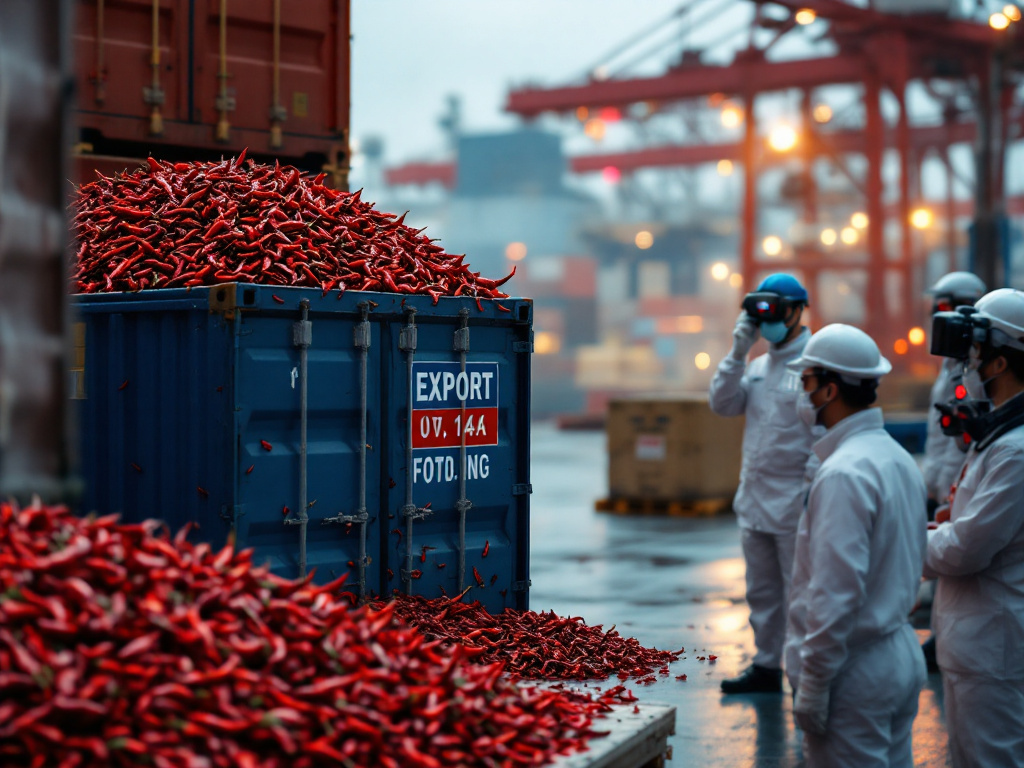
On 11 June 2026, China rejected multiple consignments of Indian dried red chillies after detection of excessive levels of methamidophos, an organophosphate insecticide. Subsequently, China temporarily suspended three Indian exporting firms. India is a significant global producer and exporter of dried red chillies, with China being its largest import market, importing about 2.36 lakh tonnes during the 2024-25 financial year. This incident highlights China's increasing scrutiny on imported food products via residue testing and compliance checks, which had also affected Indian non-Basmati rice consignments earlier in 2026. Ensuring pesticide residue compliance and rigorous quality control along the supply chain is essential for Indian chilli exports to maintain access to premium international markets.
On this page
Key Facts
- Date of incident: 11 June 2026
- Product involved: Indian dried red chillies
- Reason for rejection: Excessive residue of methamidophos, a toxic organophosphate insecticide
- Number of Indian exporters suspended: Three
- India's export volume of red chillies to China in FY 2024-25: Approximately 2.36 lakh tonnes
- Estimated export value to China in 2024-25: About ₹3,857 crore
Background & Context
Methamidophos is a highly toxic organophosphate insecticide affecting the nervous system and is not approved for use in chilli cultivation in India. China enforces strict food safety regulations, and its increased residue testing has led to recent rejections of Indian agricultural products, including about 70 consignments of Indian non-Basmati rice in May 2026 due to genetically modified organism (GMO) concerns. India is one of the world's largest producers and exporters of dried red chillies, primarily grown in states like Andhra Pradesh, Telangana, and Karnataka. China is the largest buyer of Indian red chillies, with imports catering mainly to its oleoresin extraction, food processing, and culinary industries.
Why This Matters for Exams / Exam Relevance
This incident exemplifies international trade challenges linked to food safety and pesticide residues, which are critical topics in Indian agro-economy, export policy, and India-China bilateral trade dynamics. Understanding pesticide regulations, maximum residue limits (MRLs), and the role of compliance in maintaining market access is vital for exam preparations in economics, geography, and international relations syllabi.
Points to Remember
- Methamidophos is banned in Indian chilli cultivation due to its toxicity.
- China is the largest market for Indian dried red chillies, importing over one-third of India's chilli exports.
- On 11 June 2026, multiple consignments were rejected by China over methamidophos residues.
- Three Indian exporting firms were temporarily suspended by Chinese authorities following the detection.
- China’s enhanced residue testing and food safety checks also led to rice import rejections earlier in 2026.
- No blanket ban on Indian chilli exports to China has been declared as of the incident date.
- Strict farm-level pesticide control, traceability, and pre-export testing are essential for sustaining and growing Indian chilli exports.
Sources & Further Reading
| Document / Website | Link |
|---|---|
| China rejects Indian chilli consignments over pesticide residue | Open China rejects Indian chilli consignments over pesticide residue ↗www.gktoday.in |
| Pesticide Residues in Chilli Pepper and Tomato - PMC | Open Pesticide Residues in Chilli Pepper and Tomato - PMC ↗pmc.ncbi.nlm.nih.gov |
| Why China is rejecting Indian chilli shipments — CNBC TV18 | Open Why China is rejecting Indian chilli shipments — CNBC TV18 ↗www.cnbctv18.com |