
Earth’s Second-Oldest Orbicular Rock Found in Madhya Pradesh
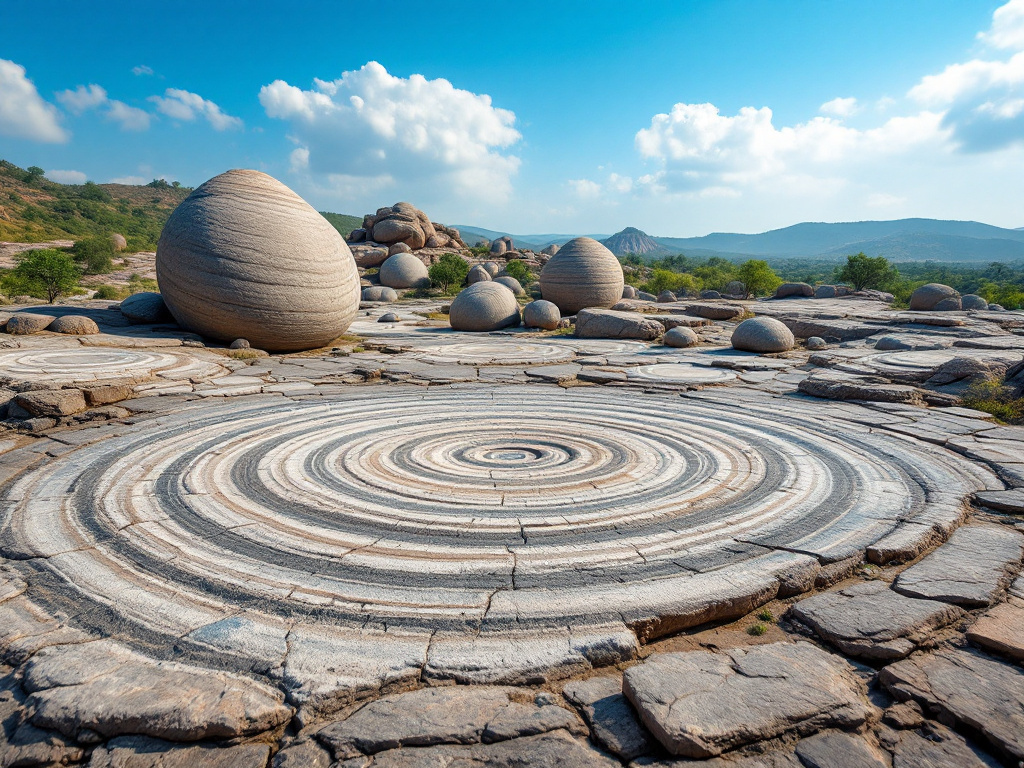
The Pichhore orbicular granite near Kutawali village in Shivpuri district, Madhya Pradesh, has been dated to about 2.56 billion years old, making it the second-oldest known orbicular rock globally, after a similar formation in Western Australia. This rare igneous rock contains orbicules—spherical structures primarily made of quartz and feldspar with concentric layering. Uranium-Lead (U-Pb) zircon dating was used to establish its age, revealing inherited zircon crystals up to 3.5 billion years old. Found within the Bundelkhand Craton, one of India’s oldest stable continental blocks, the discovery sheds light on Precambrian geology and the early evolution of the Indian shield.
On this page
Key Facts
- Location: Near Kutawali village, Shivpuri district, Madhya Pradesh
- Rock type: Orbicular granite containing orbicules that can be up to 30 centimetres in diameter
- Age: Approximately 2.56 billion years, dating to the Neoarchean Era
- Dating method: Uranium-Lead (U-Pb) zircon dating, a precise geochronological technique used for very old rocks
- Oldest mineral age: Inherited zircon crystals as old as 3.5 billion years embedded within the rock
- Geological setting: Part of the Bundelkhand Craton, a stable, ancient geological block of the Indian shield
- Research institutions involved: Banaras Hindu University, IIT Kanpur, IISER Berhampur, University of Campinas (Brazil), Japan Advanced Institute of Science and Technology (JAIST)
Background & Context
Orbicular granite is an uncommon igneous rock characterized by the presence of orbicules—rounded, concentrically layered mineral structures commonly composed of quartz and feldspar. The Pichhore orbicular granite represents a significant discovery because orbicular rocks are globally rare and even more so when ancient. This granite crystallized during the Neoarchean Era (~2.56 billion years ago), a critical period in Earth's early crust formation.
Inherited zircon crystals found within the granite provide evidence for crustal recycling of even older continental material (up to 3.5 billion years), highlighting complex geological processes active in the early Precambrian. The Bundelkhand Craton, where the rock was found, is a key geological unit that has remained largely stable for billions of years, making it an important area for understanding the evolution of the Indian shield and continental crust formation in the Precambrian.
Why This Matters for Exams / Exam Relevance
This discovery is important for students studying Indian geography and geology because it exemplifies ancient rock formations on Indian soil and provides insight into dating techniques and geological history. Questions for competitive and academic exams may focus on:
- Types and characteristics of orbicular rocks
- Geochronological methods like Uranium-Lead zircon dating
- Significance of the Bundelkhand Craton in Indian geology
- Understanding of geological eras, especially the Neoarchean Era
- Role of inherited minerals like zircon in interpreting Earth’s ancient history
Points to Remember
- The Pichhore orbicular granite is the second-oldest orbicular rock known worldwide after one in Western Australia.
- Orbicules in this granite can be up to 30 cm in diameter and display concentric layering indicative of their formation process.
- U-Pb zircon dating is a standard and highly reliable method for determining the age of ancient rocks.
- The Bundelkhand Craton is one of India’s oldest geological blocks and is crucial for studies on the Precambrian period.
- Inherited zircon crystals dated to about 3.5 billion years provide evidence of ancient crustal recycling during early Earth history.
- The research was a collaborative effort among multiple international and Indian institutions and published in the journal Geosystems and Geoenvironment.
Sources & Further Reading
| Document / Website | Link |
|---|---|
| Earth’s Second Oldest Orbicular Rock Found in Madhya Pradesh - GKToday | Open Earth’s Second Oldest Orbicular Rock Found in Madhya Pradesh - GKToday ↗www.gktoday.in |
| Geosystems and Geoenvironment Journal | Open Geosystems and Geoenvironment Journal ↗link.springer.com |
| Geochronology and U-Pb Zircon Dating Methods - Britannica | Open Geochronology and U-Pb Zircon Dating Methods - Britannica ↗www.britannica.com |