
India Objects to Pakistan's Remarks on Jammu and Kashmir at the United Nations
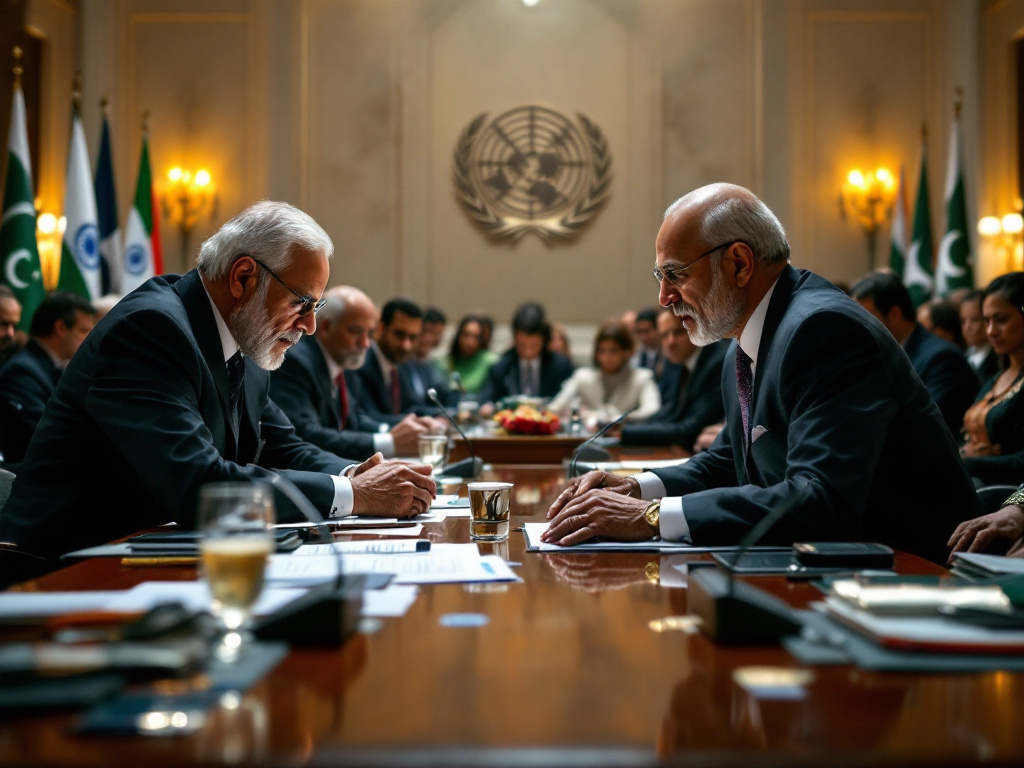
On 24 June 2026, India strongly objected to Pakistan raising the Jammu and Kashmir issue at an informal United Nations Security Council meeting in New York. India reaffirmed that Jammu and Kashmir is an integral and inalienable part of India, emphasizing it as a strictly internal matter. The Union Territory of Jammu and Kashmir was formed in 2019 after the reorganisation of the former state under the Jammu and Kashmir Reorganisation Act, 2019. India rejected Pakistan's assertions and third-party involvement, criticizing the politicization of the forum.
On this page
Key Facts
- On 24 June 2026, India objected to Pakistan raising the Kashmir issue at an informal United Nations Security Council (UNSC) meeting in New York.
- India’s Permanent Representative to the UN, Ambassador Parvathaneni Harish, stressed that the Union Territory of Jammu and Kashmir is strictly an internal matter of India.
- The Union Territory of Jammu and Kashmir was formed on 31 October 2019, following the Jammu and Kashmir Reorganisation Act, 2019, which bifurcated the former State of Jammu and Kashmir into two Union Territories: Jammu and Kashmir (with legislature) and Ladakh (without legislature).
- India maintains that Jammu and Kashmir and Ladakh are integral and inseparable parts of India and rejects any third-party involvement in the matter.
- The UNSC meeting was an Arria-formula meeting, which is an informal consultation platform, jointly organised by China and Pakistan on "Bridging the Implementation Gap: Security Council Resolutions and the Maintenance of International Peace and Security."
Background & Context
The Jammu and Kashmir Reorganisation Act, 2019, passed by the Indian Parliament, revoked the special status granted under Article 370 of the Indian Constitution and reconstituted Jammu and Kashmir into two Union Territories from 31 October 2019. This act abolished the Jammu and Kashmir Legislative Council and enabled direct central government administration with limited legislative powers for the Union Territory of Jammu and Kashmir.
Pakistan traditionally raises the Kashmir issue in international forums, characterizing it as a political dispute; India consistently rejects these claims and any external interference, asserting sovereignty over the entire territory within its borders. This diplomatic contention often plays out at the United Nations, where India preserves the stance that Kashmir is an internal matter and emphasizes adherence to the UN Charter's peaceful dispute resolution mechanisms, particularly under Chapter VI.
The UNSC consists of 15 members: five permanent members (China, France, Russia, the United Kingdom, and the United States) and ten non-permanent members elected for two-year terms. Arria-formula meetings are informal UNSC meetings allowing for open and frank exchanges among members and invited participants, but they do not have decision-making power.
Why This Matters for Exams / Exam Relevance
- Understanding current diplomatic events involving India, Pakistan, and the Kashmir issue is crucial for contemporary affairs sections in competitive exams.
- Knowledge of the Jammu and Kashmir Reorganisation Act, 2019, its provisions, and implications is important for questions on India's constitutional and political landscape.
- Familiarity with the functioning of United Nations organs, especially the Security Council and its informal Arria-formula meetings, is relevant for international relations and governance topics.
- Statements by India's Permanent Representative, Ambassador Parvathaneni Harish, are significant factual details illustrating India's official stance in multilateral diplomacy.
Points to Remember
- Date of India's objection: 24 June 2026.
- Indian spokesperson: Ambassador Parvathaneni Harish, Permanent Representative to the UN.
- Jammu and Kashmir was reorganized in 2019 under the Jammu and Kashmir Reorganisation Act, splitting into two Union Territories.
- India emphasizes Jammu and Kashmir as an internal matter and rejects Pakistan's characterization of the dispute and third-party involvement.
- UNSC has 15 members including 5 permanent and 10 non-permanent members.
- An Arria-formula meeting is an informal forum for UNSC members and invited guests to discuss issues candidly.
- UN Charter Chapter VI promotes the pacific settlement of disputes through negotiation, mediation, conciliation, arbitration, and judicial settlement.
- India calls for reviewing outdated mediation frameworks to reflect current realities.
Sources & Further Reading
| Document / Website | Link |
|---|---|
| India objects to Pakistan remarks on Jammu and Kashmir at UN | Open India objects to Pakistan remarks on Jammu and Kashmir at UN ↗www.gktoday.in |
| India tears into Pakistan at UN meeting over Kashmir remarks | Open India tears into Pakistan at UN meeting over Kashmir remarks ↗www.indiatvnews.com |
| Jammu and Kashmir Reorganisation Act, 2019 - Wikipedia | Open Jammu and Kashmir Reorganisation Act, 2019 - Wikipedia ↗en.wikipedia.org |
| UN mediation of the Kashmir dispute - Wikipedia | Open UN mediation of the Kashmir dispute - Wikipedia ↗en.wikipedia.org |