
India's Nuclear Energy Mission Targets 100 GW Capacity by 2047
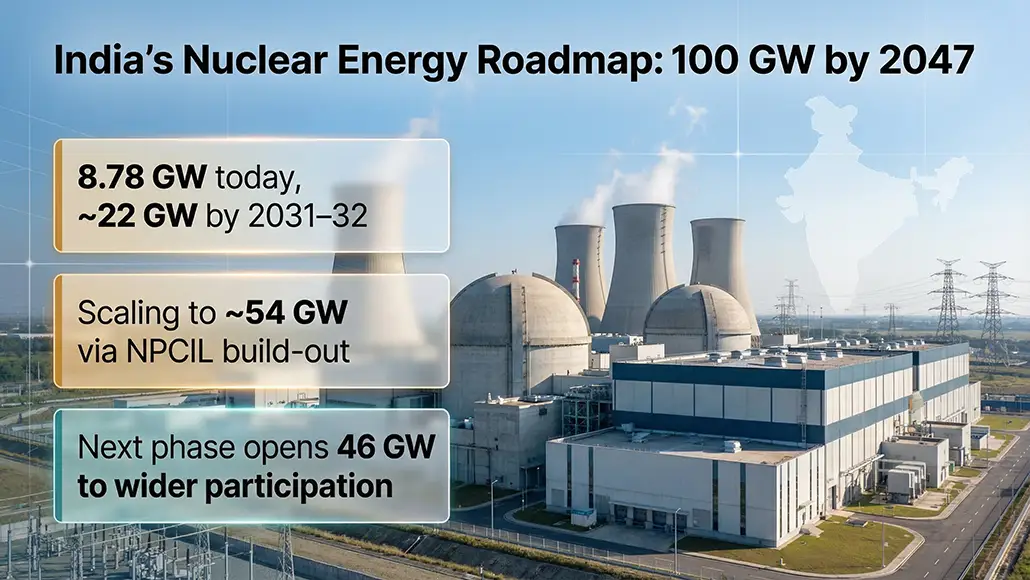
India aims to achieve 100 GWe nuclear energy capacity by 2047 through a strategic mission focusing on indigenous Pressurised Heavy Water Reactors (PHWRs) and Small Modular Reactors (SMRs). The initiative supports India's energy security and climate goals, including net zero emissions by 2070, with a dedicated budget allocation for SMR development and enabling private and foreign investment under the new SHANTI Act, 2025.
On this page
Key Facts
- India targets 100 GWe nuclear power capacity by 2047 under the Nuclear Energy Mission.
- The roadmap integrates large indigenous PHWRs at greenfield sites and Small Modular Reactors (SMRs) at brownfield sites, including repurposing retiring fossil-fuel plants.
- At least five indigenously designed SMRs are planned to be operational by 2033, supported by a ₹20,000 crore allocation (Union Budget 2025-26).
- Bhabha Atomic Research Centre (BARC) is developing several domestic reactor designs: 220 MWe Bharat SMR, 55 MWe SMR-55, and High Temperature Gas Cooled Reactors (HTGR) for hydrogen production.
- The SHANTI Act, 2025 provides the legal framework, ending the state monopoly, allowing private sector participation and up to 49% foreign direct investment, and caps liability at approximately ₹3,900 crore.
- Technology transfer and collaboration between BARC and Indian industries are enhancing local manufacturing capabilities for SMR components.
- Stakeholder consultations by NITI Aayog in 2026 addressed regulatory frameworks and supply chain requirements.
Background & Context
India presently has around 8.78 GWe of nuclear power capacity and follows a unique three-stage nuclear programme aimed at using thorium reserves in the long term. The expansion through the Nuclear Energy Mission focuses on reducing fossil-fuel dependency, decarbonizing energy production, and meeting growing electricity demands sustainably.
Pressurised Heavy Water Reactors (PHWRs) use heavy water both as coolant and moderator and form the backbone of India's current nuclear fleet. Small Modular Reactors (SMRs) offer modular, scalable, and flexible nuclear power solutions and can be deployed more rapidly, including at locations of retiring fossil-fuel power plants.
The High Temperature Gas Cooled Reactors (HTGR) under development use inert gas coolants (like helium) and can offer high-temperature heat for hydrogen production, expanding the application of nuclear technology beyond electricity generation.
The SHANTI Act replaces earlier nuclear laws, enabling broader participation and investment while instituting liability limits and safety accountability, though some provisions (like the liability cap) have faced legal challenges.
Why This Matters for Exams / Exam Relevance
- The 100 GWe nuclear capacity target by 2047 aligns with India's energy security, industrial growth, and climate commitments and is a significant government policy document for Current Affairs and GS papers.
- The Nuclear Energy Mission introduces new technologies (SMRs, HTGRs) and legislative reforms (SHANTI Act) relevant for understanding India's energy transition and governance reforms.
- Knowledge of reactor types (PHWR, SMR, HTGR) and their roles is essential for Science & Technology topics.
- The mission supports Make in India and Atmanirbhar Bharat goals, enhancing indigenous technology development and manufacturing.
- The regulatory and financial reforms encouraging private sector and foreign investment reflect governance and economic policy modernization themes.
Points to Remember
- The Nuclear Energy Mission's 2047 timeline marks the centenary of Indian independence, symbolizing a vision for a developed and self-reliant India (Viksit Bharat).
- SMRs offer flexibility with smaller reactor capacity (220 MWe and 55 MWe designs) and are suited for modular factory fabrication and deployment.
- BARC plays a key role in R&D, indigenous design, and knowledge transfer to industry for SMR and advanced reactor development.
- The SHANTI Act, 2025 repeals previous outdated laws, enables private participation, allows up to 49% FDI, and sets a liability cap (~₹3,900 crore) to balance investor confidence with safety responsibility.
- NITI Aayog’s consultations indicate a multi-stakeholder approach to regulatory and supply chain frameworks essential for practical mission implementation.
Sources & Further Reading
| Document / Website | Link |
|---|---|
| Government Outlines Roadmap for Self-Reliant Nuclear Energy Ecosystem | Open Government Outlines Roadmap for Self-Reliant Nuclear Energy Ecosystem ↗www.gktoday.in |
| India’s Nuclear Energy Mission Targets 100 GWe by 2047 for Viksit Bharat | Open India’s Nuclear Energy Mission Targets 100 GWe by 2047 for Viksit Bharat ↗smestreet.in |
| India’s Nuclear Energy Push: Roadmap to 100 GW Capacity by 2047 - NEXT IAS | Open India’s Nuclear Energy Push: Roadmap to 100 GW Capacity by 2047 - NEXT IAS ↗www.nextias.com |
| Small Modular Reactors in India | Open Small Modular Reactors in India ↗vajiramandravi.com |
| SHANTI Bill Spurs Private Sector to Nuclear Plants - The Hindu | Open SHANTI Bill Spurs Private Sector to Nuclear Plants - The Hindu ↗www.thehindu.com |