
Jainendra K. Jain Wins 2025 Wolf Prize in Physics for Discovery of Composite Fermions
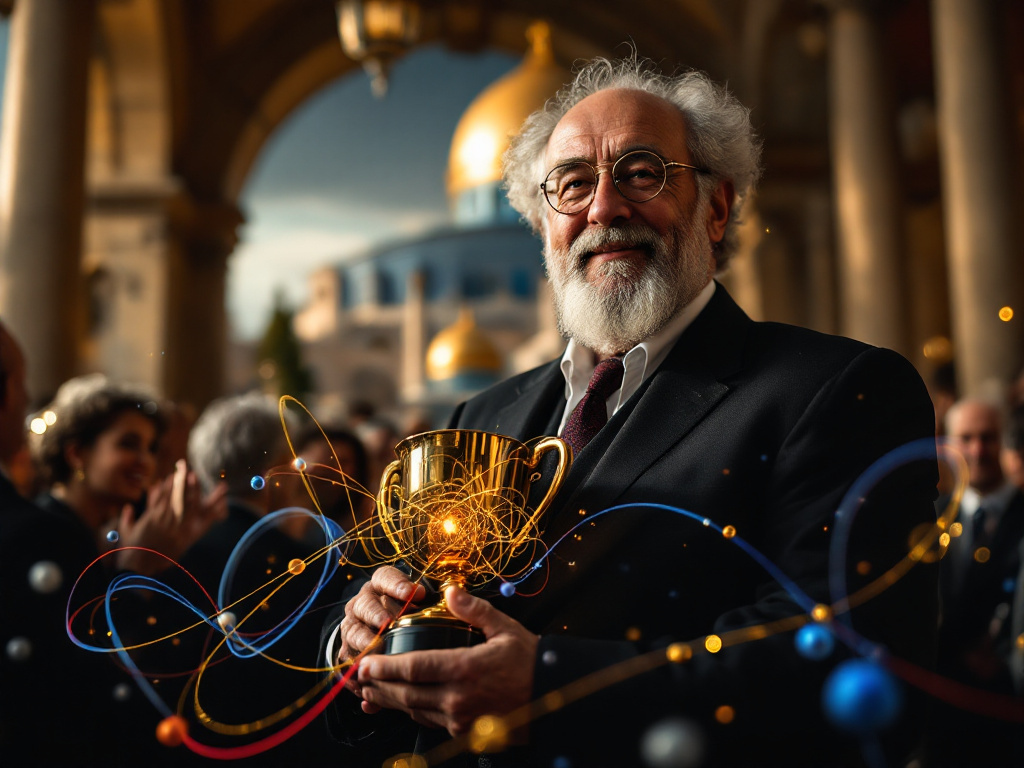
Rajasthan-born physicist Jainendra K. Jain was awarded the 2025 Wolf Prize in Physics for his pioneering work on composite fermions, crucial to explaining the fractional quantum Hall effect (FQHE). Presented by Israeli President Isaac Herzog on June 18, 2026, in Jerusalem, this honor recognizes Jain's transformative concept introduced in 1989 that has significantly advanced the understanding of two-dimensional electron systems under strong magnetic fields. Jain shared the prize with James P. Eisenstein and Mordehai Heiblum. The Wolf Prize, established in 1978, is a top international physics award considered second only to the Nobel Prize.
On this page
Key Facts
- Jainendra K. Jain is the first person of Indian origin to be awarded the Wolf Prize in Physics (2025).
- The award ceremony took place on 18 June 2026 at the Knesset in Jerusalem; the prize was presented by Israeli President Isaac Herzog.
- The prize recognized Jain's discovery of composite fermions, a fundamental concept for explaining the fractional quantum Hall effect.
- The Wolf Prize in Physics was established in 1978 by the Wolf Foundation in Israel.
- Jain shared the 2025 prize with James P. Eisenstein and Mordehai Heiblum for advances in understanding two-dimensional electron systems under strong magnetic fields.
- Composite fermions are quasiparticles consisting of electrons bound to an even number of magnetic flux quanta, which simplify the complex behavior of the fractional quantum Hall effect.
- Jain is an Evan Pugh University Professor and Eberly Family Chair in Physics at Pennsylvania State University, and founding director of the Lodha Theoretical Physics Institute in India.
Background & Context
The fractional quantum Hall effect (FQHE) is a quantum phenomenon observed in two-dimensional electron systems at very low temperatures and strong magnetic fields, characterized by fractional quantization of Hall conductance. This effect reveals unconventional quasiparticles carrying fractional electric charge.
In 1989, while a postdoctoral researcher at Yale University, Jain introduced the concept of composite fermions—electrons bound to two magnetic flux quanta—that effectively transform the complicated interactions in the FQHE into an integer quantum Hall effect of these new particles. This insight provided a unifying theoretical framework to understand numerous experimental features of the FQHE, confirmed by experiments and further theoretical work in the 1990s.
Why This Matters for Exams / Exam Relevance
- Jainendra K. Jain’s work on composite fermions is a cornerstone in modern condensed matter physics, often included in academic and competitive examinations focusing on quantum phenomena and physics achievements.
- Understanding the fractional quantum Hall effect and its explanation via composite fermions is important for higher education in physics and related fields.
- The Wolf Prize's history, prestige, and notable laureates like Jain are common knowledge points in general studies and current affairs sections of competitive exams.
- Key dates such as establishment of the Wolf Prize in 1978, Jain's composite fermion theory in 1989, and award ceremony in 2026, and related persons (Isaac Herzog, James P. Eisenstein, Mordehai Heiblum) are relevant for factual recall questions.
Points to Remember
- Composite fermions are electrons attached to an even number of magnetic flux quanta, forming new quasiparticles that explain fractional quantum Hall states.
- The fractional quantum Hall effect involves quantized Hall conductance at fractional values of e²/h, explained by Jain's composite fermion theory.
- The Wolf Prize in Physics is presented annually in Jerusalem by the Wolf Foundation and is regarded as one of the most prestigious physics awards globally.
- Jain shares the 2025 prize with experimentally eminent physicists Eisenstein and Heiblum, highlighting contributions connecting theory and experiment.
- Jainendra K. Jain holds significant academic positions in the US and India, contributing to physics research and education.
Sources & Further Reading
| Document / Website | Link |
|---|---|
| Jainendra Jain Wins Wolf Prize in Physics | Open Jainendra Jain Wins Wolf Prize in Physics ↗www.gktoday.in |
| Fractional quantum Hall effect - Wikipedia | Open Fractional quantum Hall effect - Wikipedia ↗en.wikipedia.org |
| Wolf Prize in Physics - Wikipedia | Open Wolf Prize in Physics - Wikipedia ↗en.wikipedia.org |