
NASA Discovers 2.5 Billion-Year-Old Hidden Geological Structure in Zimbabwe's Great Dyke
NASA scientists have discovered a concealed, approximately 2.5 billion-year-old internal geological structure within the Great Dyke of Zimbabwe, an extensive layered mafic lopolithic intrusion that stretches over 550 km. This hidden structure, revealed through satellite imaging and geophysical methods, is associated with ancient magma storage zones and contributes to our understanding of early Earth's crust formation and magmatic processes. The Great Dyke is a significant geological and economic feature, rich in valuable minerals like platinum and chromium, preserved by regional tectonic stability.
On this page
Key Facts
- The Great Dyke of Zimbabwe is approximately 2.5 billion years old and is a layered mafic intrusion of igneous, metal-bearing rock.
- It extends more than 550 kilometers (about 342 miles) northeast to southwest across central Zimbabwe, with a width varying between 3 and 12 kilometers.
- Geologically, it is classified as a lopolith (a saucer-shaped igneous intrusion) rather than a simple linear dyke, lying parallel to existing rock layers.
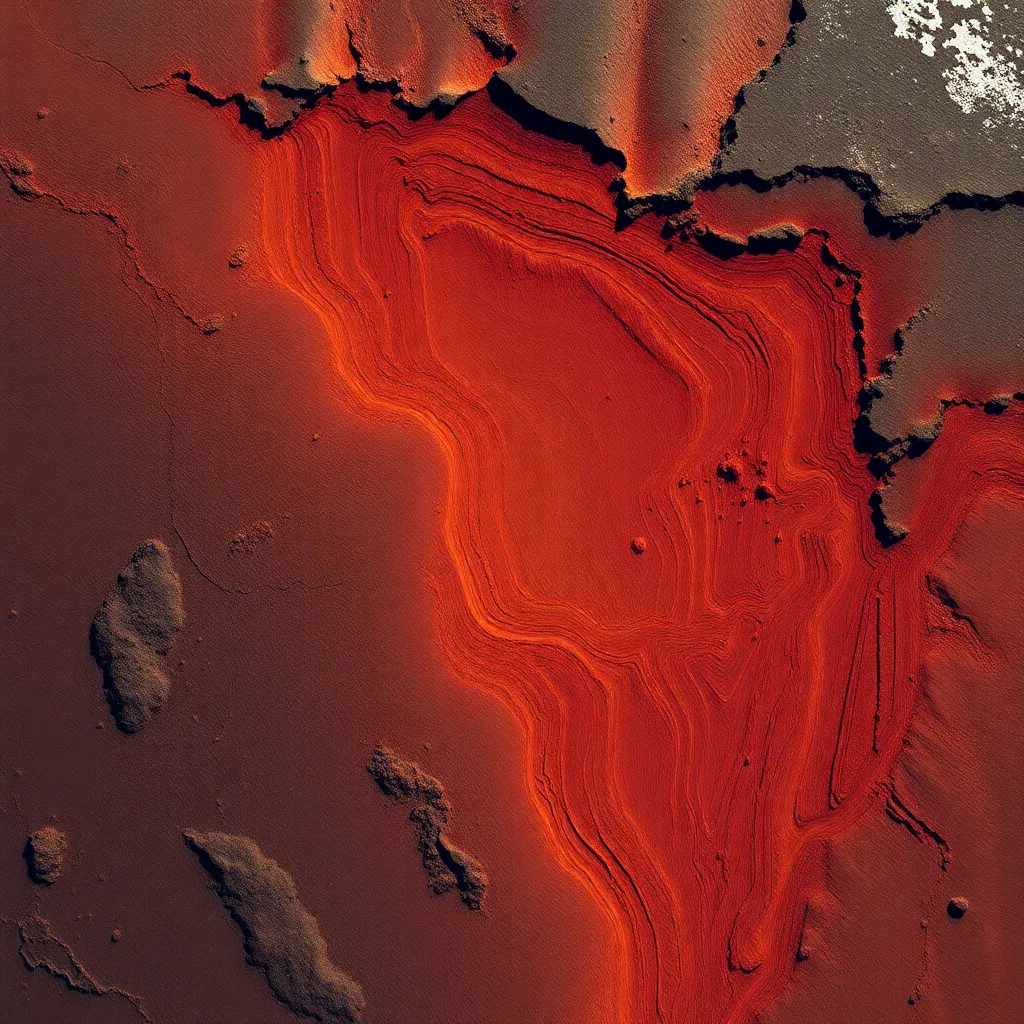
- NASA scientists have identified a hidden internal geological structure within the Great Dyke using satellite imaging and geophysical techniques; this structure is not visible on the surface.
- The internal structure is thought to be related to ancient magmatic pipes or magma storage zones where magma cooled and chemically differentiated, forming distinct mineral layers during the Archean Eon.
- The Great Dyke contains economically important metals such as platinum, chromium (in the form of chromite), nickel, copper, titanium, iron, vanadium, and tin; chromium and platinum are particularly abundant and actively mined.
- The region's tectonic stability has helped preserve the Great Dyke formation and its internal features over billions of years.
Background & Context
The Great Dyke cuts across the Zimbabwe Craton, one of Africa's oldest continental cores composed of ancient crystalline rocks. It probably formed over centuries as molten rock forced its way up through the Earth's interior. This geological intrusion is of great interest for understanding the processes of early continental crust formation during the Archean Eon, approximately 2.5 billion years ago. The identification of a concealed internal structure within the dyke offers new insights into magmatic evolution and mineral formation processes in ancient Earth history. It is also a significant source of various strategic minerals that support the Zimbabwean economy.
Why This Matters for Exams / Exam Relevance
This topic is relevant for competitive exams covering geography, geology, earth sciences, and mineral resources. It demonstrates key concepts such as the formation of ancient continental crust, the nature of layered mafic intrusions, and the economic geology of mineral-rich rock bodies. It also exemplifies how modern scientific methods like satellite remote sensing and geophysical mapping contribute to geological discoveries. Remembering the Great Dyke's location, age, classification as a lopolith, key mineral contents, and the significance of the newly discovered internal structure will be valuable for exams.
Points to Remember
- The Great Dyke is located in Zimbabwe, in central Africa.
- It formed about 2.5 billion years ago in the Archean Eon.
- It is a lopolithic layered mafic intrusion approximately 550 km long and 3–12 km wide.
- NASA discovered a hidden internal geological structure within it using satellite and geophysical data.
- The structure is associated with ancient magmatic chambers or magma storage zones.
- The Dyke is rich in valuable minerals: platinum, chromium (chromite), nickel, copper, titanium, iron, vanadium, and tin.
- Tectonic stability has preserved its features over billions of years.
Sources & Further Reading
| Document / Website | Link |
|---|---|
| NASA Finds 2.5 Billion-Year-Old Structure in Great Dyke | Open NASA Finds 2.5 Billion-Year-Old Structure in Great Dyke ↗www.gktoday.in |
| Great Dyke of Zimbabwe - NASA Earth Observatory | Open Great Dyke of Zimbabwe - NASA Earth Observatory ↗earthobservatory.nasa.gov |
| Great Dyke, Zimbabwe - NASA Science | Open Great Dyke, Zimbabwe - NASA Science ↗science.nasa.gov |
| Great Dyke - Wikipedia | Open Great Dyke - Wikipedia ↗en.wikipedia.org |