
NITI Aayog Releases Report on Empowering Caregivers in Viksit Bharat@2047
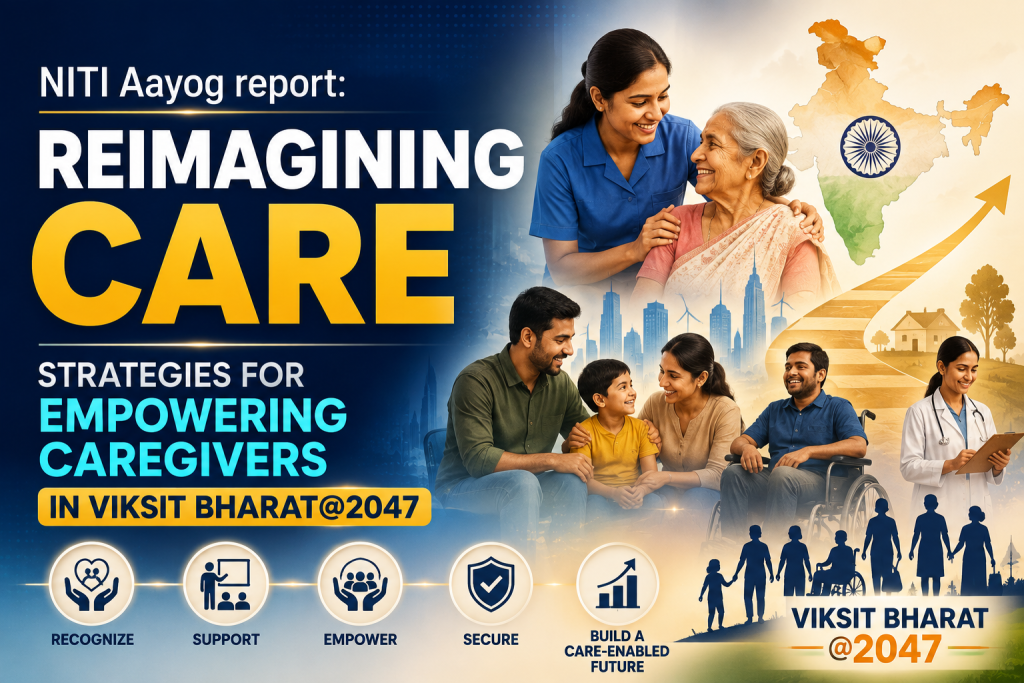
On August 5, 2026, NITI Aayog released "Reimagining Care: Strategies for Empowering Caregivers in Viksit Bharat@2047", outlining a comprehensive framework to establish a professional, accessible, and organised caregiving ecosystem in India. The report emphasizes caregiving as a skilled and dignified profession, proposing the creation of a National Caregiving Council (NCC) to regulate and standardize care services. It also suggests a National Caregiving Qualification Framework and a National Caregiver Registry to support workforce planning and certification. With India's elderly population projected to rise from 149 million in 2022 to 347 million by 2050, the report addresses the urgent need for structured caregiving to meet future demographic demands and positions India as a potential global leader in caregiving services.
On this page
Key Facts
- On August 5, 2026, NITI Aayog released the report titled "Reimagining Care: Strategies for Empowering Caregivers in Viksit Bharat@2047."
- The report proposes establishing a National Caregiving Council (NCC) to regulate, set standards, and professionalize caregiving services across India.
- A National Caregiving Qualification Framework is recommended to standardize education, training, accreditation, and certification in caregiving.
- The report also calls for creating a National Caregiver Registry and a digital platform to aid workforce planning and service delivery.
- India's elderly population is projected to increase from 149 million in 2022 to 347 million by 2050, with their share rising from 10.5% to 20.8%.
- The report addresses social security and welfare expansion along with entrepreneurship support for caregivers.
Background & Context
India faces a rapidly aging population, putting pressure on traditional family-based caregiving models due to urbanization and shifting family structures. Recognizing caregiving as a skilled and dignified profession aligns with India's civilizational ethos of Seva and Samvedana. The report draws on extensive consultations and international benchmarks to propose an institutional framework that empowers family caregivers and professionals and positions India as a global hub for caregiving services. This initiative is part of the long-term national vision, Viksit Bharat@2047, aiming for inclusive and sustainable social development.
Why This Matters for Exams / Exam Relevance
The report is a significant policy milestone addressing demographic challenges, healthcare, and social welfare in India. Questions may focus on the NITI Aayog's role, the importance of the National Caregiving Council, components of the National Caregiving Qualification Framework, and demographic projections. Moreover, understanding India's approach to formalizing caregiving as a profession and its integration with social security schemes is crucial for various competitive exams in public administration, social welfare, and healthcare sectors.
Points to Remember
- NITI Aayog is the government's policy think tank, replacing the Planning Commission in 2015.
- 'Reimagining Care: Strategies for Empowering Caregivers in Viksit Bharat@2047' was released on August 5, 2026.
- The National Caregiving Council (NCC) aims to regulate and accredit caregiving training and services nationwide.
- The National Caregiving Qualification Framework standardizes caregiving education, training, certification, and accreditation.
- The National Caregiver Registry and digital platform help manage the caregiver workforce and improve service delivery.
- India's elderly population is projected to almost double by 2050, necessitating a professional caregiving ecosystem.
- The report emphasizes expanding social security, welfare measures, and entrepreneurship support for caregivers, including family and community caregivers.
- India is positioned within the global care economy, highlighting international demand and opportunities for caregiver mobility.
Sources & Further Reading
| Document / Website | Link |
|---|---|
| NITI Aayog report on caregiving for Viksit Bharat@2047 | Open NITI Aayog report on caregiving for Viksit Bharat@2047 ↗www.gktoday.in |
| NITI Aayog calls for national caregiving framework | Open NITI Aayog calls for national caregiving framework ↗economictimes.indiatimes.com |
| NITI Aayog proposes National Caregiver Council to regulate caregiving services | Open NITI Aayog proposes National Caregiver Council to regulate caregiving services ↗www.newindianexpress.com |