
QS World University Rankings 2027: India's Significant Rise with 52 Institutions Featured
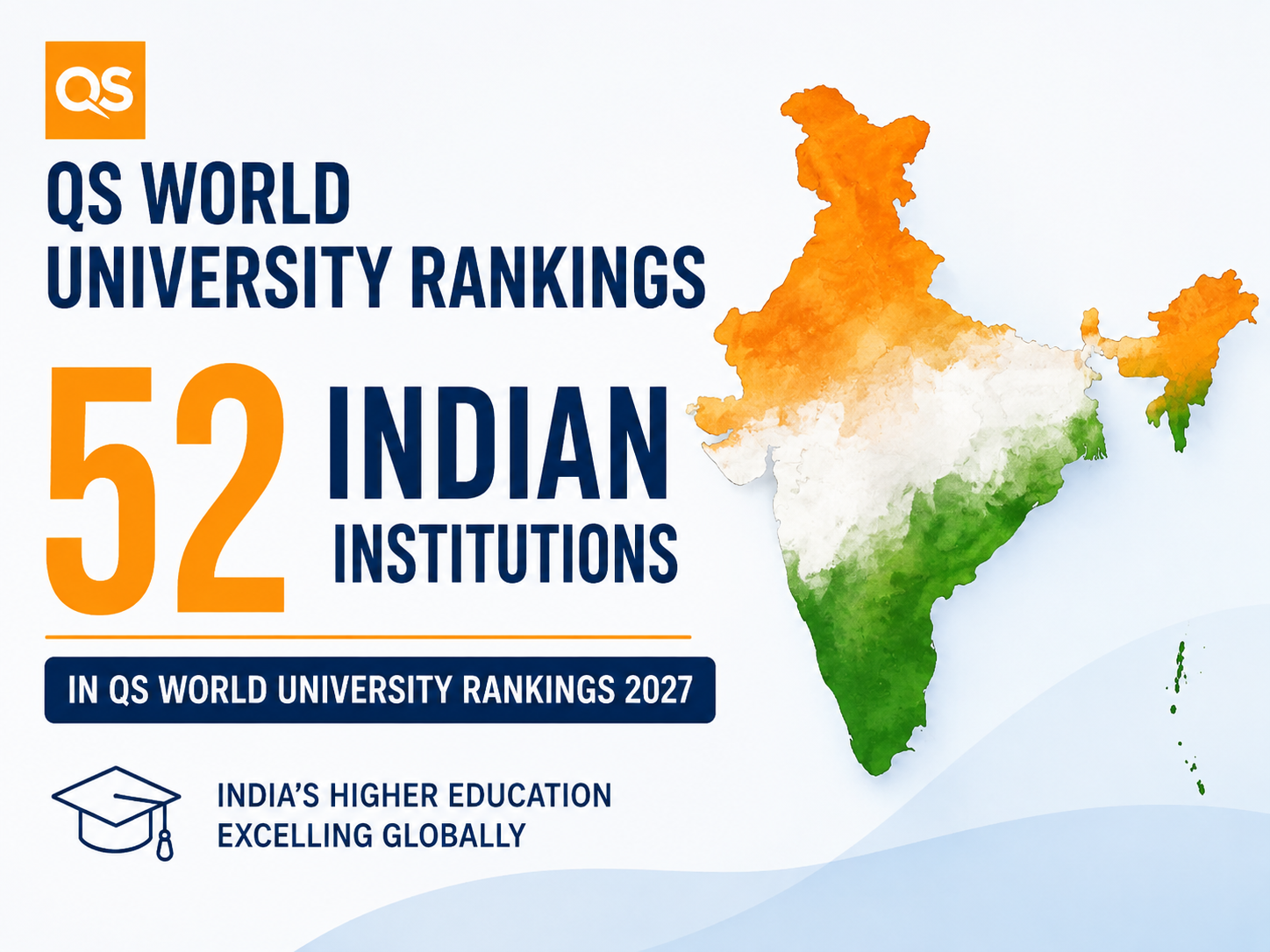
The QS World University Rankings 2027 showcased a remarkable increase in India's global academic presence, with 52 Indian higher education institutions featured compared to just 11 in 2015. IIT Delhi emerged as the highest-ranked Indian institution globally at 118th position. This rise in rankings is attributed by the Indian government to the National Institutional Ranking Framework (NIRF) launched in 2015. Indian institutions improved their research output, academic reputation, and employability scores, reflecting enhanced quality and internationalisation efforts. India is now the fourth most represented country in the QS rankings, behind the US, UK, and China.
On this page
Key Facts
- The QS World University Rankings 2027 included 52 Indian institutions, a significant rise from 11 in 2015.
- Indian Institute of Technology (IIT) Delhi ranked 118th globally, becoming India's highest-ranked institution and matching the highest-ever global position achieved by an Indian university in QS rankings.
- Out of 52 Indian institutions featured, 26 improved their rank, nine remained stable, 15 declined, and two appeared for the first time.
- Eighteen Indian institutions recorded their best-ever QS rankings in 2027.
- The National Institutional Ranking Framework (NIRF), launched in 2015 by the Ministry of Education, has been linked by the government to this rise in global rankings.
- Other notable Indian universities in the rankings include IIT Bombay (134th), IIT Madras (170th), IIT Kharagpur (205th), Indian Institute of Science Bengaluru and IIT Kanpur (joint 221st), and University of Delhi (322nd), which is India’s top non-STEM institution.
- QS World University Rankings assesses universities based on academic reputation, employer reputation, faculty-student ratio, citations per faculty, international faculty, international student ratios, employment outcomes, and sustainability.
- NIRF parameters include Teaching, Learning & Resources; Research & Professional Practice; Graduation Outcomes; Outreach & Inclusivity; and Perception.
Background & Context
The QS World University Rankings are an annual global university ranking system published by Quacquarelli Symonds, evaluating over 1,500 universities worldwide on multiple indicators including academic reputation and research impact. India’s participation and performance in these rankings have risen significantly over the past decade. This improvement coincides with governmental initiatives, particularly the launch of the National Institutional Ranking Framework (NIRF) in 2015, designed to evaluate and rank higher education institutions in India transparently and systematically.
The NIRF framework assesses multiple dimensions such as teaching quality, research and professional practice, student outcomes, inclusiveness, and institutional perception, thereby promoting systemic improvements in education quality. Additionally, increased focus on research output, citations, international collaborations, and employer reputation has enhanced the global visibility of Indian institutions.
Why This Matters for Exams / Exam Relevance
Understanding India’s advancements in global university rankings and the role of domestic policies like the NIRF is important for General Studies and education-related questions in competitive examinations. It reflects India’s growing emphasis on quality higher education, research competitiveness, and international academic standing. Key institutions like IIT Delhi, IIT Bombay, IIT Madras, IISc Bengaluru, and University of Delhi serve as examples of India’s academic progress. Knowledge of ranking frameworks, government initiatives, and their implications is relevant for topics on education reforms, international cooperation, and new education policies.
Points to Remember
- The QS World University Rankings 2027 were released on 18 June 2026.
- India featured 52 universities in QS 2027, up from 11 in 2015.
- IIT Delhi improved from 123rd in QS 2026 to 118th in 2027, matching the highest rank ever for India.
- The National Institutional Ranking Framework (NIRF) was launched in 2015 by the Ministry of Education to improve quality and rank Indian institutions across parameters such as teaching, research, graduation outcomes, inclusivity, and perception.
- QS rankings use an array of indicators including academic and employer reputation, citations per faculty, faculty-student ratio, internationalisation, employment outcomes, and sustainability metrics.
- India is currently the fourth most represented country in the QS rankings after the USA, UK, and China.
- Institutions outside the IIT system, including University of Delhi, Jamia Millia Islamia, and private universities, are also improving rankings, indicating a broad-based enhancement in India’s higher education ecosystem.
Sources & Further Reading
| Document / Website | Link |
|---|---|
| QS World University Rankings 2027 listed more Indian institutions than ever | Open QS World University Rankings 2027 listed more Indian institutions than ever ↗www.gktoday.in |
| QS World University Rankings 2027 and India's Performance | Open QS World University Rankings 2027 and India's Performance ↗vajiramandravi.com |
| India’s performance in the QS World University Rankings 2027 | QS | Open India’s performance in the QS World University Rankings 2027 | QS ↗www.qs.com |