
Telangana Seeks Higher Height Approval for Tummidihatti Barrage in Dispute with Maharashtra
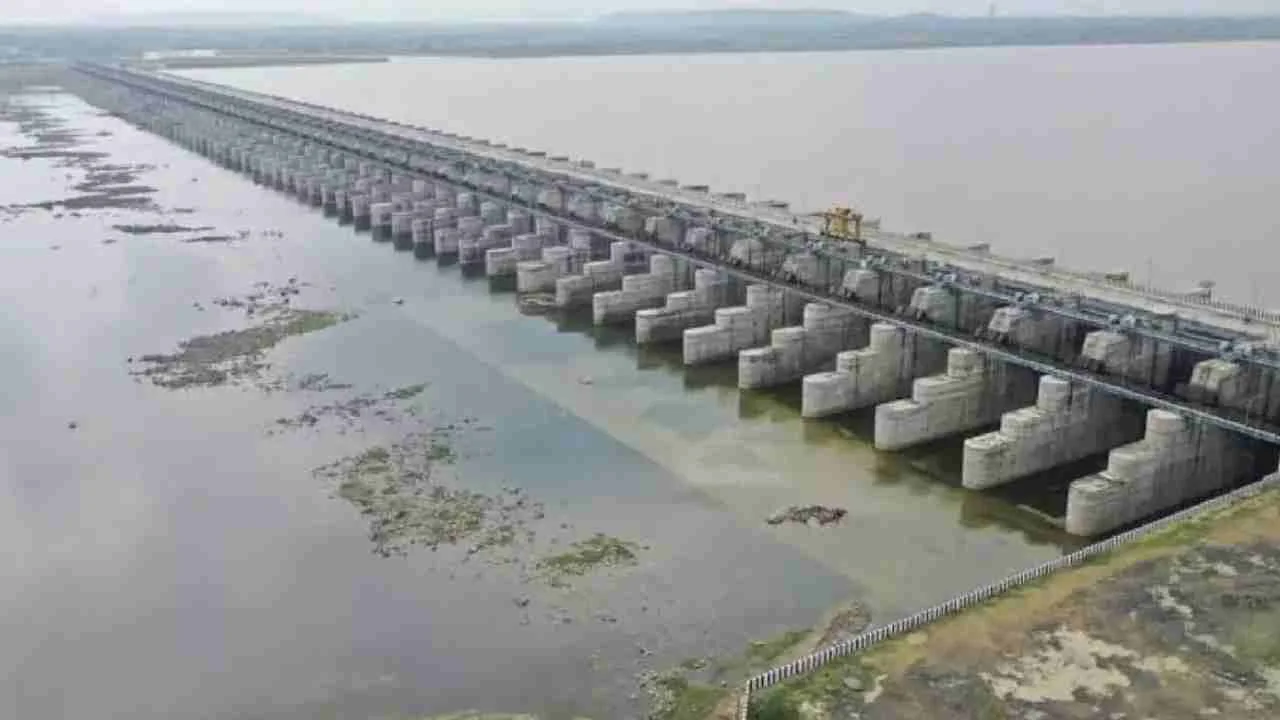
On 5 August 2026, Telangana Chief Minister A. Revanth Reddy met Union Jal Shakti Minister C.R. Patil in New Delhi to seek central government intervention in the ongoing dispute with Maharashtra regarding the proposed Full Reservoir Level (FRL) height of the Tummidihatti barrage. The Telangana government has requested raising the barrage height to 150 metres, instead of the previously agreed 148 metres, to enable effective utilization of its allocated Godavari waters via gravity flow, thereby reducing reliance on costlier lift irrigation methods. The dispute involves concerns over potential submergence in Maharashtra and water sharing under the Pranahita-Chevella irrigation project, for which Tummidihatti barrage is a critical component.
On this page
Key Facts
- Date of Meeting: 5 August 2026
- Participants: Telangana Chief Minister A. Revanth Reddy, Union Jal Shakti Minister C.R. Patil, Telangana Irrigation Minister N. Uttam Kumar Reddy, several Members of Parliament
- Location: New Delhi
- Barrage Site: Tummidihatti village, Kouthala mandal, erstwhile Adilabad district, Telangana
- Project: Pranahita-Chevella irrigation project
- Requested FRL height: 150 metres (Telangana request) vs. 148 metres (earlier Maharashtra agreement)
- Water volume utilization: Engineering experts indicated at least 100 tmcft of water could be utilized with 150 m FRL
- Submergence Area: Expected to be below 1,000 hectares in Maharashtra even at 150 m height
Background & Context
The Tummidihatti barrage is constructed on the Pranahita River, a tributary of the Godavari basin, significant for providing irrigation water to northern Telangana. The proposed barrage is part of the larger Pranahita-Chevella irrigation project aimed at harnessing Godavari waters. Telangana advocates for a higher Full Reservoir Level (FRL) of 150 metres to enable gravity-based irrigation, which is more economical compared to lift irrigation systems that require pumping. The 2-metre difference in barrage height is critical because it affects total water storage capacity and efficient utilization. Maharashtra's agreement is vital as the barrage’s backwaters may submerge land on its side. Telangana argues that even at 150 m FRL, submergence on Maharashtra’s land will remain within acceptable limits (under 1,000 hectares). The state government seeks approval from Maharashtra and the central government to finalize the barrage height and construction modalities. The dispute reflects the complexities of inter-state river water management and highlights the need for coordinated planning and agreements between involved states.
Why This Matters for Exams / Exam Relevance
This incident exemplifies key themes commonly examined in Indian polity and geography such as inter-state water disputes, river basin management, and the role of central government in federal water resource governance. Important technical concepts like Full Reservoir Level (FRL), tmcft (thousand million cubic feet), gravity versus lift irrigation, and submergence issues are integral to understanding water resource engineering and management. The involvement of political leaders, dates, and locations serves as factual details relevant for exam answers on contemporary water conflicts, irrigation projects, and regional development programs.
Points to Remember
- Full Reservoir Level (FRL) indicates the maximum design water storage level in a reservoir or barrage.
- The Tummidihatti barrage is part of the Pranahita-Chevella irrigation project, located on the Pranahita River, a tributary of the Godavari basin.
- Telangana requested increasing the barrage height to 150 metres to enable effective gravity flow irrigation, reducing reliance on lift irrigation.
- Engineering assessments suggest a 150-metre FRL would enable utilization of at least 100 tmcft of water.
- Projected submergence in Maharashtra due to the barrage at 150 metres FRL would remain below 1,000 hectares.
- Inter-state river water disputes require negotiation between states and often involve central government mediation.
- Important dates: Meeting on 5 August 2026 between Telangana CM and Union Minister; technical discussion on 2 May 2026; Telangana CM’s letter to Maharashtra CM on 27 May 2026.
- Geographical context: Kouthala mandal in erstwhile Adilabad district, Telangana; adjoining territories of Maharashtra impacted by submergence.
Sources & Further Reading
| Document / Website | Link |
|---|---|
| Telangana Seeks Higher Tummidihatti Barrage | Open Telangana Seeks Higher Tummidihatti Barrage ↗www.gktoday.in |
| Interstate River Water Disputes in India | Open Interstate River Water Disputes in India ↗igpb.in |
| Godavari River Basin Management | Open Godavari River Basin Management ↗nmcg.nic.in |