
Centre Redefines Ganga Floodplain Norms Under National Mission for Clean Ganga
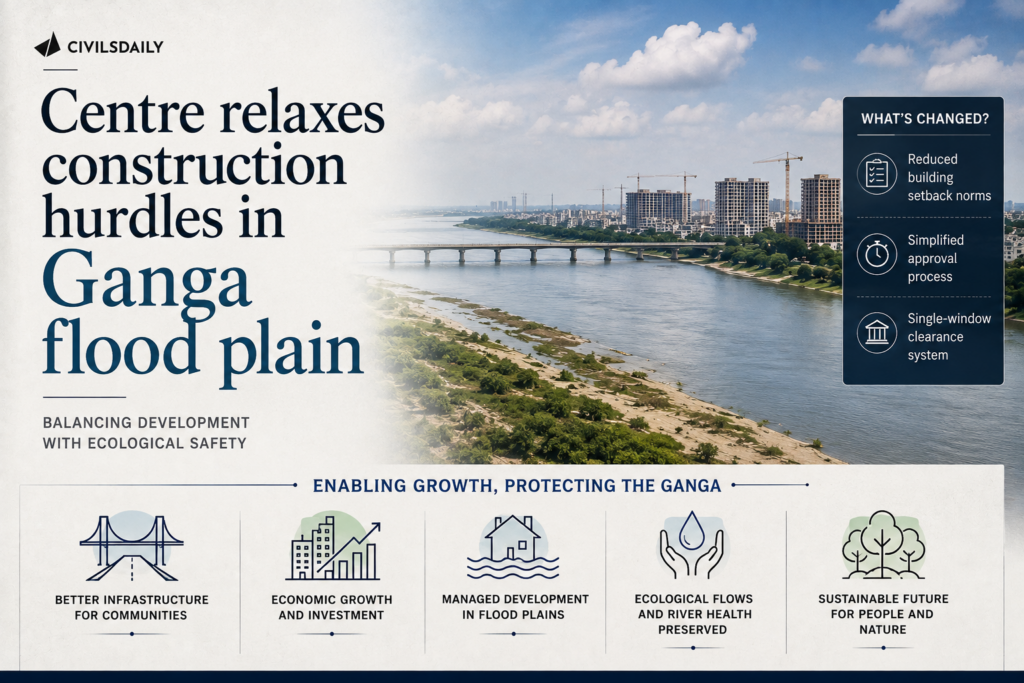
In August 2026, the Ministry of Jal Shakti issued the River Ganga (Rejuvenation, Protection and Management) Authorities (Second Amendment) Order, revising floodplain regulations for the Ganga and its tributaries. The amendment introduced three floodplain zones based on flood return frequencies—the Active Floodplain (inundation in 1-in-5-year flood events), the Regulatory Zone (flooding in 5 to 25-year events), and the Warning Zone (flooding in 25 to 100-year events). Strict prohibitions on construction remain in the Active Floodplain. Construction is allowed in Regulatory and Warning Zones but only subject to official clearances. This replaces the 2016 blanket no-construction clause with a stratified, approval-based regulatory regime, aiming to balance ecological protection with developmental needs under the Namami Gange programme.
On this page
Key Facts
- The Union Jal Shakti Ministry issued the River Ganga (Rejuvenation, Protection and Management) Authorities (Second Amendment) Order, 2026 on 7 August 2026; it was published in the official Gazette on 10 August 2026.
- This amendment revised the floodplain framework for the Ganga River and its tributaries under the National Mission for Clean Ganga.
- For the first time, the amendment defined the “Active Floodplain” as areas inundated during floods with a one-in-five-year return period.
- The amendment established a “Regulatory Zone,” affected by floods occurring once every 5 to 25 years, where construction requires official clearance.
- A “Warning Zone” was introduced for outer areas subject to rare flooding once every 25 to 100 years; construction here is also clearance-dependent.
- The original 2016 order imposed a blanket prohibition on construction in the floodplain, which the 2026 amendment replaced with tiered regulations.
- The River Ganga (Rejuvenation, Protection and Management) Authorities framework and floodplain norms are linked with the National Mission for Clean Ganga and the broader Namami Gange programme, which has an outlay of ₹30,000 crore.
Background & Context
The 2016 River Ganga (Rejuvenation, Protection and Management) Authorities Order implemented strict no-construction rules to protect the floodplain and river ecosystem. However, such blanket prohibitions created legal and developmental challenges. The 2026 amendment aims to correct legal inconsistencies by introducing a nuanced framework distinguishing flood-prone zones through hydrological return periods to allow limited and regulated construction in less vulnerable zones. This is in line with the broader objectives of river rejuvenation, ecological conservation, and sustainable development under the Namami Gange programme.
Why This Matters for Exams
This amendment is significant in current affairs and environmental governance contexts especially for competitive examination syllabi focused on government policy, environment laws, and water resource management. Candidates should be familiar with the amendment’s key features, including the categorization of floodplains, construction norms, regulatory authorities involved such as the Ministry of Jal Shakti and NMCG, and the relation to the Namami Gange program along with its budget. Understanding floodplain management concepts like return periods and regulatory zoning is critical.
Points to Remember
- Active Floodplain: Areas submerged during floods occurring once every 5 years; construction is strictly prohibited except for minor temporary structures like religious events.
- Regulatory Zone: Areas flooded with a frequency of every 5 to 25 years; construction requires prior official approval.
- Warning Zone: Areas flooded rarely, with return periods of 25 to 100 years; construction allowed only with clearances.
- The amendment replaced a blanket no-construction policy (2016) with a stratified, approval-based regime.
- The Namami Gange programme overseeing this framework has a ₹30,000 crore budget.
- The order was promulgated by the Ministry of Jal Shakti and is an integral part of the National Mission for Clean Ganga framework.
Sources & Further Reading
| Document / Website | Link |
|---|---|
| Centre Redefines Ganga Floodplain Norms | Open Centre Redefines Ganga Floodplain Norms ↗www.gktoday.in |
| Centre redefines Ganga floodplain, drops ‘construction-free zone’ provision - The Hindu | Open Centre redefines Ganga floodplain, drops ‘construction-free zone’ provision - The Hindu ↗www.thehindu.com |
| Namami Gange – National Mission for Clean Ganga (NMCG) | Open Namami Gange – National Mission for Clean Ganga (NMCG) ↗www.indiascienceandtechnology.gov.in |
| National Mission for Clean Ganga (NMCG) official site | Open National Mission for Clean Ganga (NMCG) official site ↗nmcg.nic.in |