
China Launched 24th Batch of Low-Earth Orbit Internet Satellites
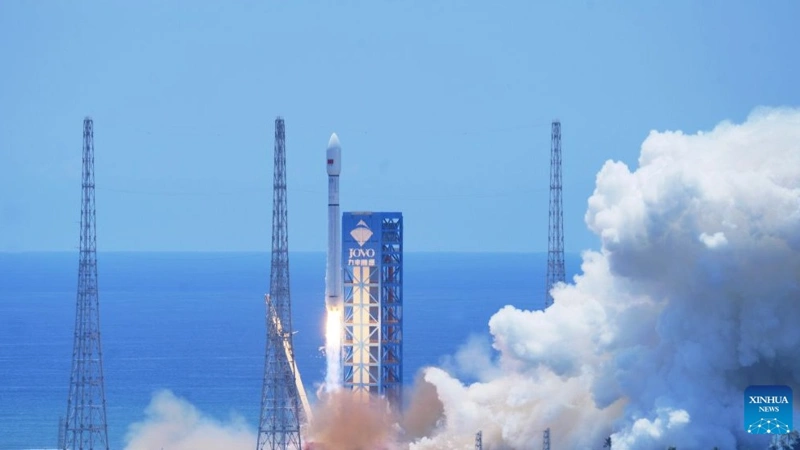
On 16 August 2026, China successfully launched the 24th batch of SatNet LEO internet satellites from Wenchang Space Launch Site, Hainan Province. The satellites were deployed by a Long March-12 carrier rocket and placed into low-Earth orbit (160-2000 km altitude) to expand China's satellite internet constellation, providing global broadband connectivity with reduced latency.
On this page
Key Facts
- Date of Launch: 16 August 2026
- Satellite Batch: 24th batch of SatNet LEO Group
- Launch Vehicle: Long March-12 carrier rocket, Y8 mission
- Launch Site: Wenchang Space Launch Site, Hainan Province, China
- Orbit: Low-Earth orbit (approx. 160 to 2000 km altitude)
- Purpose: Global broadband internet connectivity with lower latency compared to geostationary satellites
- Previous Incident: Long March 7A rocket explosion on 10 August 2026
Background & Context
China has been developing a national constellation of low-Earth orbit satellites designed to provide global internet connectivity by deploying multiple spacecraft into low-Earth orbit. Low-Earth orbit satellites are favored for communication tasks due to their shorter distance from Earth, resulting in lower signal latency compared to geostationary satellites which orbit at around 35,786 km above Earth's equator.
The Long March series of rocketry, including the Long March-12 launch vehicle used in this mission, serves as China's primary launch infrastructure for satellite deployment. The Wenchang Space Launch Site is located in Hainan Province, a southern island region of China near the equator, offering advantageous launch conditions including easy access to a wide range of orbital inclinations. Wenchang is a major coastal launch complex equipped to handle large payloads and commercial space missions.
The 24th batch launch followed a recent mishap where a Long March 7A rocket exploded during ascent on 10 August 2026, demonstrating China's resilience and continued commitment to expanding its space capabilities.
Why This Matters for Exams / Exam Relevance
This launch event is significant for students preparing for competitive exams, particularly those sections covering current affairs, space technology, and international relations. Understanding China's expanding role in satellite technology, the specifics of its launch vehicles and facilities, and the function and characteristics of low-Earth orbit satellites can support broader knowledge in science and technology topics.
Points to Remember
- Low-Earth orbit (LEO) ranges roughly between 160 km and 2000 km above Earth’s surface and is preferred for low-latency communication satellites.
- Geostationary orbit is much higher at approximately 35,786 km above Earth's equator, used mainly for stationary communication satellites but with higher latency.
- The Long March rocket family (including Long March-12 and Long March 7A) is China’s main suite of launch vehicles.
- The Wenchang Space Launch Site in Hainan Province is a coastal launch complex suitable for heavy payloads and commercial missions, benefiting from proximity to the equator.
- China’s 24th batch of SatNet LEO satellites were launched on 16 August 2026, expanding its satellite internet constellation despite a recent launch failure with the Long March 7A rocket.
Sources & Further Reading
| Document / Website | Link |
|---|---|
| GKToday - China launches 24th batch of low orbit internet satellites | Open GKToday - China launches 24th batch of low orbit internet satellites ↗www.gktoday.in |
| NASA – Satellite Orbits | Open NASA – Satellite Orbits ↗www.nasa.gov |
| ISRO - Indian Space Research Organisation | Open ISRO - Indian Space Research Organisation ↗www.isro.gov.in |