
China's Gravity-1 Solid-Fuel Rocket Launches Nine Satellites Successfully
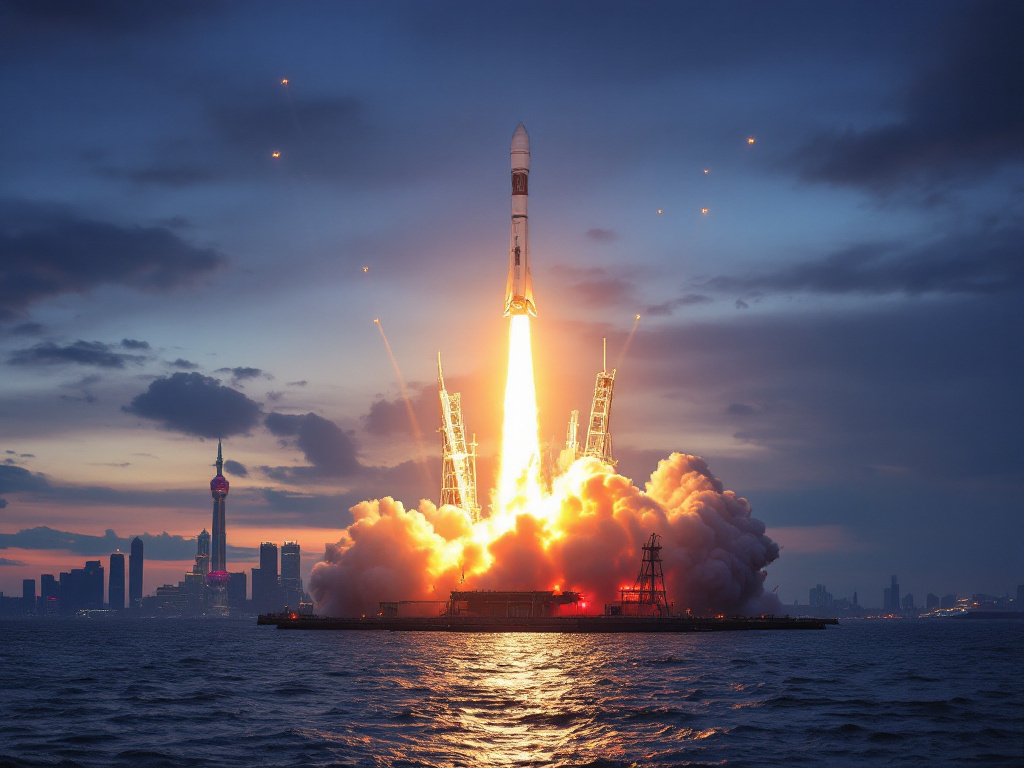
On 22 July 2026, China’s private space company Orienspace successfully launched the Gravity-1 solid-fuel carrier rocket from a maritime platform in the East China Sea, near Shanghai. The rocket placed nine satellites into designated orbits, marking the third successful flight of Gravity-1 and China's first far-sea launch of a private commercial rocket.
On this page
Key Facts
- Date of launch: 22 July 2026, 10:54 a.m. Beijing time
- Launch location: Maritime platform in the East China Sea, east of Shanghai, within the Yangtze River Delta region
- Rocket: Gravity-1, described as the world's most powerful solid-fuel carrier rocket
- Developer: Orienspace, a private Chinese commercial launch company
- Number of satellites launched: Nine
- Satellite names: Dongpo-13, Dongpo-14, Dongpo-17, Dongpo-18, Dongpo-19, Dongpo-20, Xiguang-201, Tianyi-49, and Lilac-3 (also called Zidingxiang-3)
- Satellite purposes: Earth observation (all-weather, all-time), mineral exploration, agriculture, forestry, environmental monitoring, urban planning
- Previous Gravity-1 launches: First successful flight in January 2024; second successful flight in October 2025
- Significance: First far-sea launch by a private Chinese commercial rocket, utilizing maritime launch platform for safety over open water
Background & Context
Gravity-1 is a solid-fuel rocket that has been developed by Orienspace, reflecting China's growing private space sector capabilities. Solid-fuel rockets carry propellant in a solid state, offering advantages in simplicity, reliability, and cost compared to liquid-fuel rockets. This launch focuses on Earth observation and remote sensing applications, supporting key sectors such as mining, agriculture, forestry, environmental monitoring, and urban planning. Conducting the launch from a maritime platform east of Shanghai offers wider safety corridors over the sea, enabling larger and safer launch operations. Orienspace also plans to develop larger liquid-fuel rockets, named Gravity-2 and Gravity-3, to expand their launch capacity.
Why This Matters for Exams
This event is important for exam topics on China's space industry advancements, private sector involvement in space activities, types of rocket propulsion, and applications of Earth observation satellites. Detailed knowledge of the launch date, location, company, rocket characteristics, satellite payloads, and the strategic significance of maritime launches supports a comprehensive understanding. The progression from solid-fuel to liquid-fuel rocket development illustrates China's technological roadmap in launch vehicle diversification.
Points to Remember
- Launch Date: 22 July 2026
- Launch Time: 10:54 a.m. Beijing Time
- Launch Site: Maritime platform in the East China Sea, Yangtze River Delta
- Company: Orienspace, private commercial launch provider in China
- Rocket: Gravity-1, world's most powerful solid-fuel rocket
- Satellites: Nine, including Dongpo series, Xiguang-201, Tianyi-49, Lilac-3 (Zidingxiang-3)
- Satellites' Main Applications: All-weather Earth observation, mineral exploration, agriculture, forestry, environmental monitoring, urban planning
- Previous Flights: January 2024 (1st), October 2025 (2nd)
- Future Plans: Additional launches of internet satellites using Gravity-1; development of Gravity-2 and Gravity-3 (liquid-fuel rockets)
- Significance: First private Chinese rocket launch from far-sea maritime platform
Sources & Further Reading
| Document / Website | Link |
|---|---|
| China launches Gravity-1 rocket with nine satellites | Open China launches Gravity-1 rocket with nine satellites ↗www.gktoday.in |
| Orienspace and China’s private space launch sector | Open Orienspace and China’s private space launch sector ↗www.spacechina.com |
| Solid-Fuel vs Liquid-Fuel Rockets Explained | Open Solid-Fuel vs Liquid-Fuel Rockets Explained ↗www.nasa.gov |