
Discovery of 10 Billion-Year-Old Fast Radio Burst FRB 20240304B by MeerKAT and James Webb Telescope
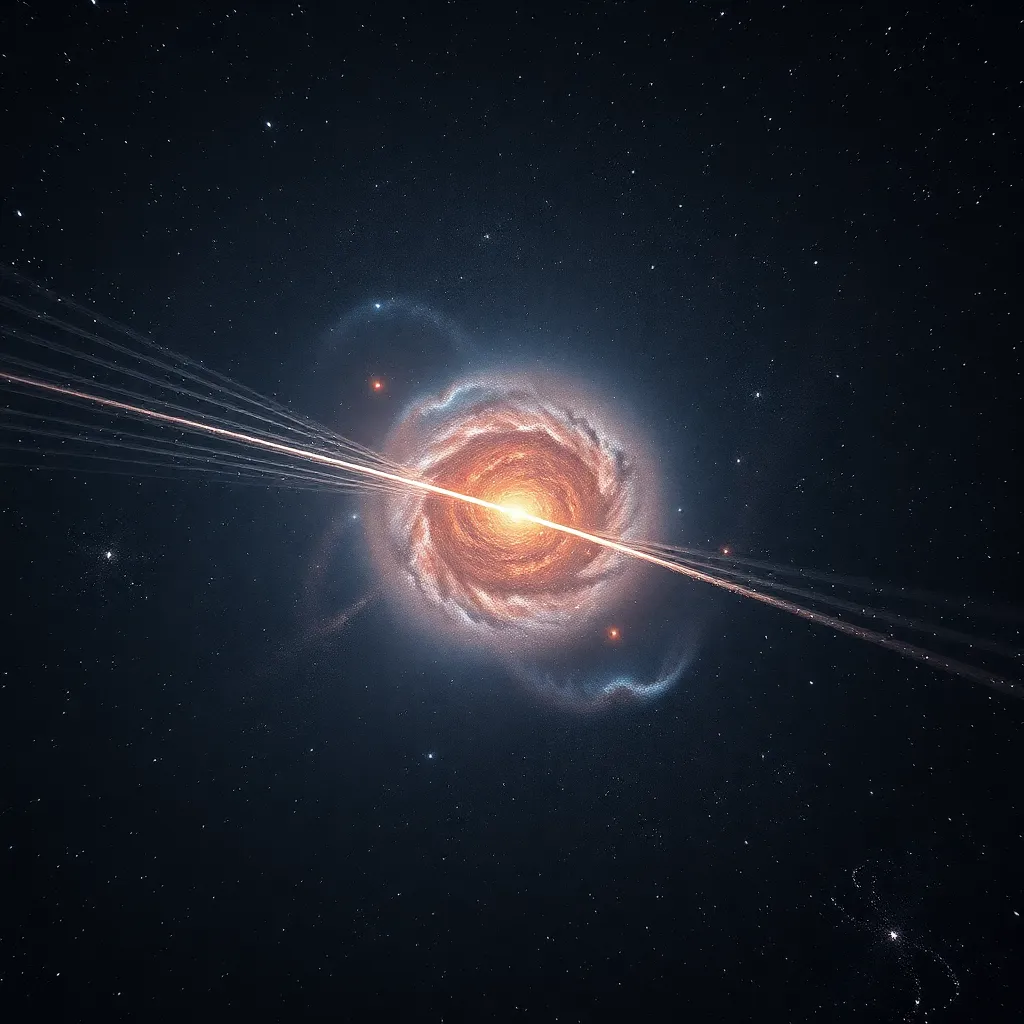
On 4 March 2024, scientists detected a fast radio burst (FRB) named FRB 20240304B with the MeerKAT radio telescope in South Africa. The radio signal traveled approximately 10 billion years before reaching Earth, originating from a small, clumpy, low-mass, star-forming dwarf galaxy identified using the James Webb Space Telescope. This event occurred about 3 billion years after the Big Bang, during the epoch known as cosmic noon—the peak period of star formation in the universe. The discovery effectively doubled the known redshift range of localized FRBs, providing valuable insights into galaxy evolution, the intergalactic medium, and compact astrophysical objects such as magnetars.
On this page
Key Facts
- The fast radio burst (FRB) named FRB 20240304B was detected on 4 March 2024 by the MeerKAT radio telescope array in South Africa.
- The burst traveled about 10 billion years before its radio waves reached Earth.
- Follow-up observations using NASA's James Webb Space Telescope identified the host galaxy as a small, clumpy, low-mass, star-forming dwarf galaxy.
- The signal originated during cosmic noon, roughly 3 billion years after the Big Bang, a key epoch marked by the universe's peak star formation activity.
- This detection doubled the known redshift range over which fast radio bursts have been localized, enhancing their utility for studying cosmology and galaxy evolution.
Background & Context
Fast Radio Bursts (FRBs) are intense, millisecond-duration flashes of radio waves from extragalactic sources, whose astrophysical origins remain a topic of active research. FRBs are characterized by their dispersion measure, redshift, and association with host galaxies. Localizing FRBs enables astronomers to probe the intergalactic medium, trace the evolution of galaxies, and investigate compact objects such as magnetars, believed to be a source of some FRBs. The MeerKAT telescope, located in South Africa, operates at radio wavelengths and enables sensitive detection of such transient signals. The James Webb Space Telescope (JWST) provides high-resolution infrared imaging and spectroscopy, which aids in studying the properties of distant galaxies and confirming FRB host galaxies.
Why This Matters for Exams / Exam Relevance
- Understanding FRBs is important in the context of contemporary space science and astrophysics, commonly covered in competitive exams and general studies syllabi.
- The combined use of ground-based (MeerKAT) and space-based (JWST) observatories highlights international collaboration and technological advances in astronomy.
- The concept of cosmic noon helps explain the evolutionary history of galaxies and star formation, a typical topic in cosmology sections of science exams.
- This discovery exemplifies the use of multi-wavelength astronomy to study transient cosmic phenomena, a key learning point in modern astrophysics.
Points to Remember
- FRB 20240304B was detected on 4 March 2024 by MeerKAT in South Africa.
- The radio burst traveled approximately 10 billion light-years.
- The host galaxy is a small, low-mass, star-forming dwarf galaxy identified by JWST.
- The burst occurred during cosmic noon, approximately 3 billion years after the Big Bang.
- This detection doubled the redshift reach for localized FRBs, aiding cosmological studies.
Sources & Further Reading
| Document / Website | Link |
|---|---|
| Scientists detect 10 billion-year-old radio signal | Open Scientists detect 10 billion-year-old radio signal ↗www.gktoday.in |
| MIT scientists pin down the origins of a fast radio burst | Open MIT scientists pin down the origins of a fast radio burst ↗news.mit.edu |
| Galaxies at Cosmic Noon - Cosmic Dark to Cosmic Dawn | Open Galaxies at Cosmic Noon - Cosmic Dark to Cosmic Dawn ↗cosmicdawn.astro.ucla.edu |
| NASA Webb Explores Effect of Strong Magnetic Fields on Star Formation | Open NASA Webb Explores Effect of Strong Magnetic Fields on Star Formation ↗science.nasa.gov |