
Supermassive Black Hole Activates After 100 Million Years of Dormancy
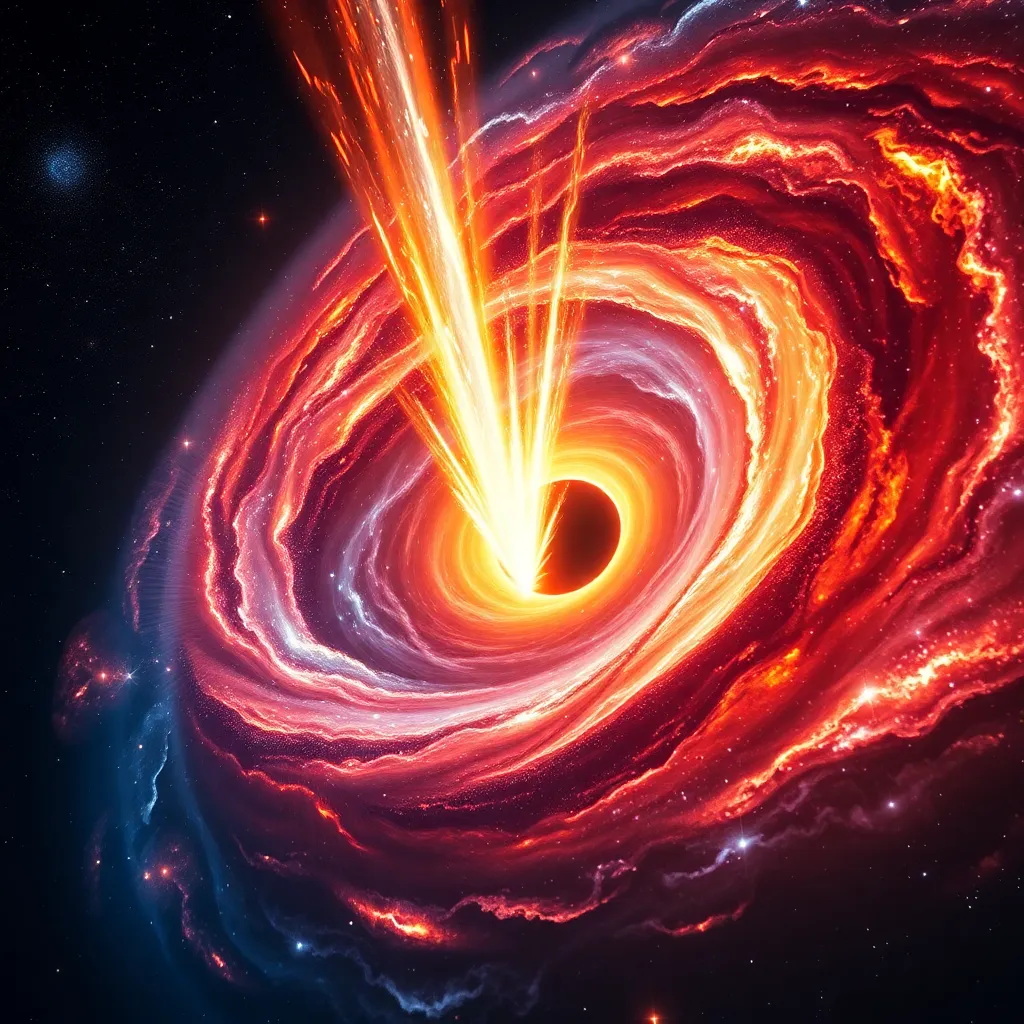
Astronomers have observed a supermassive black hole in a distant galaxy reactivating after nearly 100 million years of inactivity. This sudden awakening emitted a powerful burst of energy, similar to a volcanic eruption in space, providing key insights into black hole cycles and their influence on galaxy evolution. Such black holes switch between dormant and active states depending on available matter, with active phases producing intense radiation and jets that can regulate star formation within galaxies.
On this page
Key Facts
- A supermassive black hole in a distant galaxy resumed activity after nearly 100 million years of dormancy.
- The reactivation generated a powerful burst of energy, often likened to a volcanic eruption, due to sudden release of accumulated energy in the form of radiation and particle jets.
- Black holes alternate between inactive (dormant) and active phases based on the availability of nearby matter (gas, dust, stars) to consume.
- Active phases correspond to Active Galactic Nuclei (AGN), which emit enormous energy and powerful jets that can influence their host galaxies significantly.
- Energy emissions from black holes during active phases affect star formation and redistribute gas and energy within galaxies, playing a crucial role in galaxy evolution.
Background & Context
Supermassive black holes, typically found at the centers of most galaxies, do not constantly accrete matter. When their surroundings lack sufficient gas, dust, or stellar material, they remain dormant for extended periods, sometimes lasting millions of years. However, when fresh matter falls into their gravitational grip, these black holes ignite energetic processes, releasing intense radiation and relativistic jets of particles into space. The scale of energy released during such bursts can exceed that of all the stars in their host galaxy combined.
This intermittent activity is critical to understanding the dynamic relationship between black holes and their galaxies. These outbursts can heat or expel surrounding gas, thereby regulating star formation rates and influencing the morphological and chemical evolution of galaxies across cosmic time.
Why This Matters for Exams / Exam Relevance
In competitive exams, understanding the behavior of supermassive black holes is important in topics related to astronomy, astrophysics, and cosmology. The concepts of active and dormant phases, the nature of Active Galactic Nuclei, and the impact of black hole energy emissions on star formation and galactic evolution are commonly tested. Knowledge of how black holes influence their host galaxies deepens comprehension of cosmic structures and processes.
Points to Remember
- Supermassive black holes can remain inactive for tens to hundreds of millions of years.
- Black hole activity is reignited when new matter enters their gravitational sphere of influence.
- Active Galactic Nuclei are the luminous centers powered by accreting supermassive black holes.
- Jets and radiation emitted during active phases can regulate star formation by affecting galactic gas distribution.
- The observed awakening event is a rare and valuable case enhancing our understanding of black hole-galaxy co-evolution.
Sources & Further Reading
| Document / Website | Link |
|---|---|
| Black Hole Awakens After 100 Million Years, Scientists Observe | Open Black Hole Awakens After 100 Million Years, Scientists Observe ↗www.gktoday.in |
| Why It’s Hard for Black Holes to Get Together | Open Why It’s Hard for Black Holes to Get Together ↗nautil.us |
| Galaxy starves its supermassive black hole, loses 95% of its brightness | Open Galaxy starves its supermassive black hole, loses 95% of its brightness ↗www.space.com |