
Gaganyaan Mission Achieves Key Human-Rating Milestones
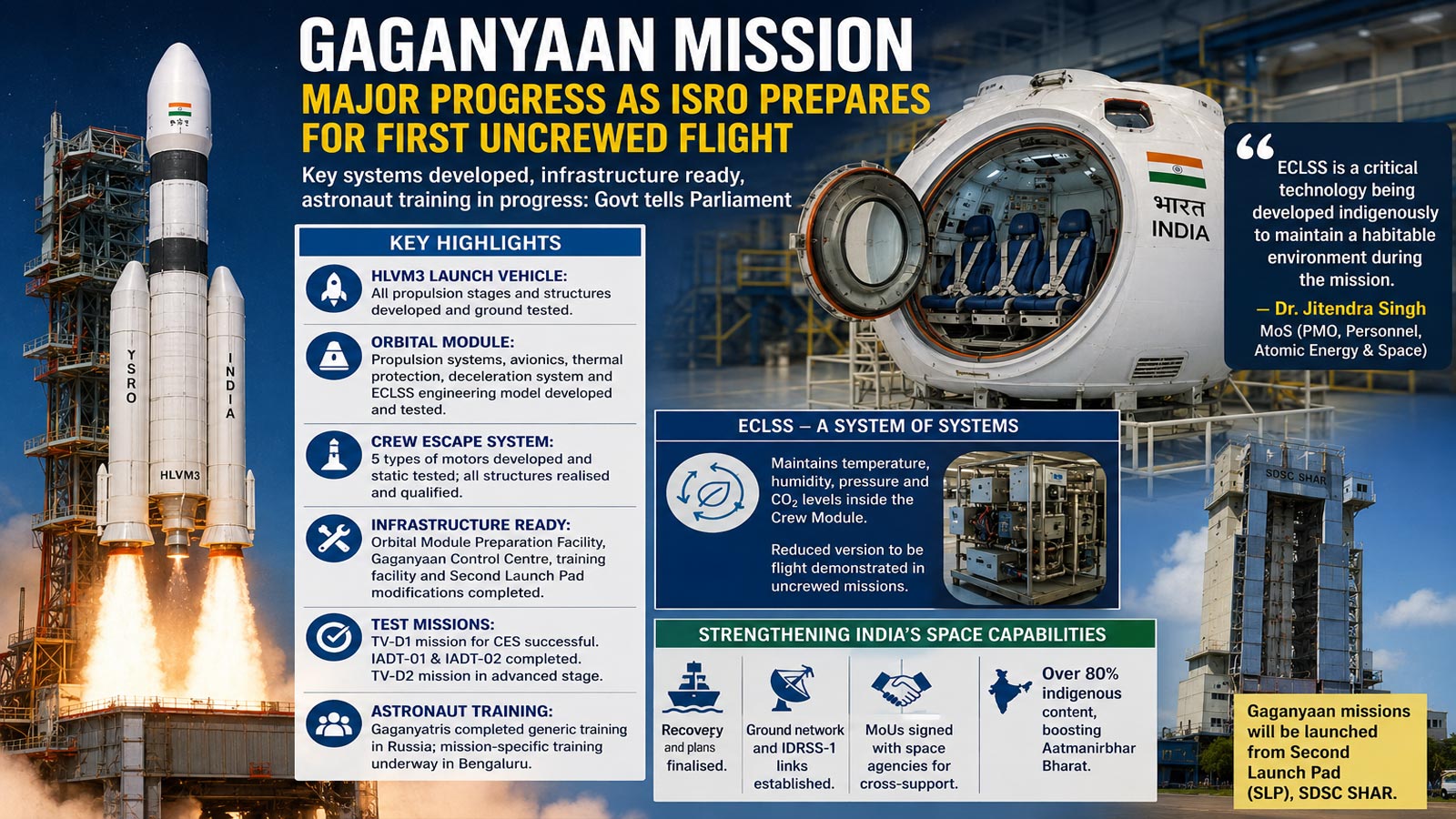
India’s first human spaceflight mission, Gaganyaan, has successfully completed crucial development and validation milestones for its human-rating systems as informed by the Union Minister of State for Science and Technology on 6 August 2026. The mission’s human-rated launch vehicle, HLVM3, has undergone extensive propulsion, structural, life-support, and safety testing, facilitating readiness for upcoming uncrewed and crewed flights. The maiden uncrewed flight carrying the humanoid robot Vyommitra is scheduled for the fourth quarter of 2026, marking significant progress toward India's human spaceflight goals and the planned establishment of Bharatiya Antariksh Station by 2035.
On this page
Key Facts
- Gaganyaan is India's first indigenous human spaceflight programme by ISRO.
- The Human Rated Launch Vehicle Mark-3 (HLVM3), a human-rated variant of the GSLV Mk III, has completed development and ground testing of all propulsion stages and structures.
- Critical systems developed and tested include the Environmental Control and Life Support System (ECLSS), Thermal Protection System, Crew Escape System (CES) with five types of motors, the Crew Module Up-righting System, and end-to-end avionics.
- Precursor validation missions like the TV-D1 Test Vehicle Mission (abort mission) and Integrated Air Drop Tests (IADT-01 and IADT-02) have successfully validated the spacecraft deceleration and crew escape systems.
- The first uncrewed experimental flight carrying Vyommitra, a half-humanoid robot designed to simulate astronaut responses, is targeted for the fourth quarter (Q4) of 2026.
- The Bharatiya Antariksh Station (Indian Space Station) is planned to be operational by 2035, showcasing India's long-term human spaceflight ambitions.
- The Indian Navy is involved in recovery operations during crew module splashdowns in testing phases, including those in the Bay of Bengal.
Background & Context
The Gaganyaan mission represents India’s ambitious first human spaceflight programme under the Indian Space Research Organisation (ISRO). This programme involves developing the Human Rated Launch Vehicle Mark-3 (HLVM3), a three-stage launch vehicle enhanced from the GSLV Mk III with human-rating features such as higher redundancy, increased safety margins, and crew abort capabilities.
Human-rating ensures that the launch vehicle and spacecraft systems reliably transport humans by integrating crew safety systems, including abort/escape mechanisms, life-support systems, thermal protection, and avionics, with rigorous ground and flight testing.
Key validation missions such as the TV-D1 Test Vehicle Abort mission demonstrated the Crew Escape System's ability to pull the crew module safely away from the launch vehicle during an emergency. The Integrated Air Drop Tests validated descent and landing systems, critical for crew recovery.
Vyommitra, the humanoid robot onboard the first uncrewed flight, will help evaluate the environmental and operational conditions inside the crew module that astronauts will face, verifying life-support and safety systems.
Why This Matters for Exams / Exam Relevance
- Gaganyaan is a highly significant topic in Indian current affairs and science and technology sectors, relevant for UPSC prelims and mains examination syllabus under topics like space technology, science advancements, and India's strategic capabilities.
- Terminologies such as HLVM3, Crew Escape System, Vyommitra, and key dates like 6 August 2026 (milestones announcement) and Q4 2026 (expected uncrewed flight) are commonly asked factual points.
- Understanding the human-rating concept and components of crew safety systems aligns with questions on space mission technology and India's space ambitions.
- Long-term plans like the Bharatiya Antariksh Station (2035) are relevant for India's future space exploration and policy questions.
Points to Remember
- The Human Rated Launch Vehicle Mark-3 (HLVM3) is the human-rated variant of the GSLV Mk III, designed with enhanced safety and redundancy.
- The Crew Escape System consists of five different types of motors, all statically tested to ensure astronaut safety during emergency abort scenarios.
- TV-D1 was the first full abort test validating the Crew Escape System's real-time flight performance.
- Vyommitra, a half-humanoid robot, will be aboard the first uncrewed Gaganyaan mission to simulate and monitor human physiological and mission parameters.
- The Environmental Control and Life Support System (ECLSS), Thermal Protection System, Avionics, and Crew Module Up-righting System have been developed and tested successfully.
- The Indian Navy supports recovery operations for crew module splashdowns, crucial for mission safety and validation.
- India plans a sequence of uncrewed test flights leading to the first crewed orbital flight targeted in 2027.
- The Bharatiya Antariksh Station is envisaged as a crewed Indian space station planned operational by 2035, demonstrating extended human presence in space.
Sources & Further Reading
| Document / Website | Link |
|---|---|
| Gaganyaan Achieves Human-Rating Milestones - GKToday | Open Gaganyaan Achieves Human-Rating Milestones - GKToday ↗www.gktoday.in |
| Gaganyaan Clears Key Human-Rating Milestones - Global Governance News | Open Gaganyaan Clears Key Human-Rating Milestones - Global Governance News ↗globalgovernancenews.com |
| Test on Crew Escape System - Drishti IAS | Open Test on Crew Escape System - Drishti IAS ↗www.drishtiias.com |