
Haryana and Rajasthan Sign MoU to Implement 1994 Upper Yamuna Water Sharing Agreement
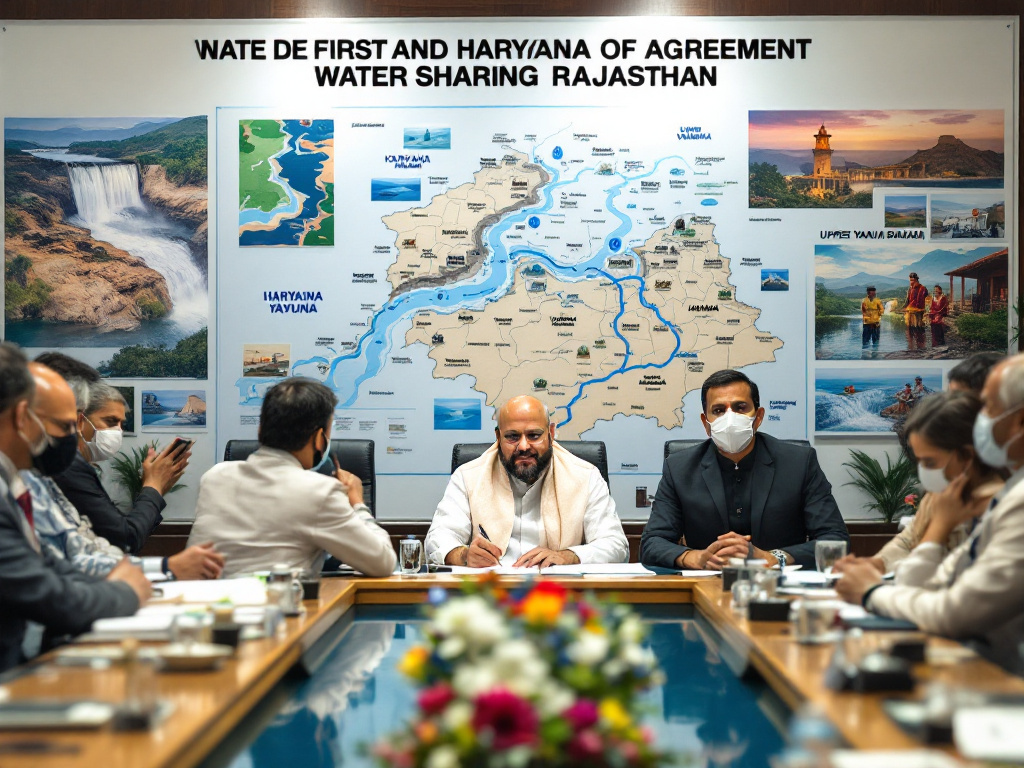
On 29 June 2026, Haryana and Rajasthan signed a Memorandum of Understanding (MoU) in New Delhi to put into effect the 1994 Upper Yamuna River Board Agreement that regulates the allocation and transfer of Yamuna river water among basin states. The agreement enables Rajasthan to receive its allocated share of Yamuna water through a dedicated 295.5-km underground pipeline system from the Hathini Kund barrage during the monsoon season, at an estimated project cost of Rs 34,102 crore. The MoU was signed in the presence of Union Home Minister Amit Shah, Union Jal Shakti Minister C.R. Patil, and the chief ministers of Haryana and Rajasthan. This arrangement resolves a decades-long delay in implementing the pact due to infrastructural constraints and aims to provide drinking water security to water-stressed regions of Rajasthan such as Churu, Sikar, and Jhunjhunu.
On this page
Key Facts
- On 29 June 2026, Haryana and Rajasthan states signed the MoU in New Delhi to implement the 1994 Upper Yamuna River Board (UYRB) Agreement.
- The original 1994 agreement involved five basin states: Haryana, Rajasthan, Uttar Pradesh, Himachal Pradesh, and Delhi; Uttarakhand was included later in 2000.
- Rajasthan’s allocation of water from the Yamuna River will be delivered via a dedicated 295.5-km underground pipeline termed the Yamuna Water Project.
- The pipeline project is estimated to cost Rs 34,102 crore and will transport water from the Hathini Kund barrage in Haryana during monsoon months.
- The regions in Rajasthan benefiting from this project include water-scarce districts such as Churu, Sikar, and Jhunjhunu.
- The signing ceremony was attended by Union Home Minister Amit Shah, Union Jal Shakti Minister C.R. Patil, Haryana Chief Minister Nayab Singh Saini, and Rajasthan Chief Minister Bhajan Lal Sharma.
Background & Context
The Upper Yamuna River Board Agreement, signed on 12 May 1994, established a framework for equitable sharing of Yamuna river waters among the basin states. The Upper Yamuna River Board (UYRB) was constituted by the central government to oversee the regulation and allocation of water, with the Upper Yamuna Review Committee (UYRC) monitoring its functioning. However, implementation of the agreement was delayed for 32 years, primarily due to the lack of infrastructural facilities to transfer Rajasthan’s share of water effectively.
The current MoU operationalizes the original agreement by creating an underground pipeline system to efficiently transfer Rajasthan’s allocated water from Hathini Kund barrage during the monsoon season. This modern approach reduces losses common to open-channel conveyance systems.
Why This Matters for Exams / Exam Relevance
- Inter-state river water sharing is a significant topic under Indian polity, water resources governance, and environmental management.
- The 1994 Upper Yamuna River Board Agreement serves as a key case study for conflict resolution and cooperative federalism in managing shared natural resources.
- The seven-decade gap between agreement signing and implementation highlights challenges in administrative execution and infrastructural development in India.
- The use of underground pipelines showcases technological advancements adopted for efficient water transfer and loss minimization in shared river waters.
- The involvement of prominent leaders and departments, such as the Ministry of Jal Shakti and the Office of the Union Home Minister, exemplifies the role of the central government in facilitating inter-state agreements.
Points to Remember
- The 1994 Upper Yamuna River Board Agreement involved five initial basin states — Haryana, Rajasthan, Uttar Pradesh, Himachal Pradesh, and Delhi; Uttarakhand was later added in 2000.
- The MoU to implement this agreement between Haryana and Rajasthan was signed on 29 June 2026 in New Delhi.
- Rajasthan’s water share is to be transferred via a 295.5-km-long underground canal at an approximate cost of Rs 34,102 crore.
- Water will be sourced from Hathini Kund barrage in Haryana during monsoon season and transmitted primarily to water-stressed areas in Rajasthan.
- The event was marked by the presence of key officials including Union Home Minister Amit Shah and Union Jal Shakti Minister C.R. Patil, demonstrating high-level political support.
- The water sharing pact exemplifies central government intervention to resolve long-standing inter-state water disputes and promote cooperative water management solutions in India.
Sources & Further Reading
| Document / Website | Link |
|---|---|
| Haryana Rajasthan sign Upper Yamuna water sharing pact - GKToday | Open Haryana Rajasthan sign Upper Yamuna water sharing pact - GKToday ↗www.gktoday.in |
| Haryana, Rajasthan sign MoU to implement 1994 Yamuna water agreement - The Economic Times | Open Haryana, Rajasthan sign MoU to implement 1994 Yamuna water agreement - The Economic Times ↗economictimes.indiatimes.com |
| Haryana, Rajasthan sign deal to implement 32-year-old Yamuna water accord - The Federal | Open Haryana, Rajasthan sign deal to implement 32-year-old Yamuna water accord - The Federal ↗thefederal.com |
| Upper Yamuna River Board - Ministry of Jal Shakti | Open Upper Yamuna River Board - Ministry of Jal Shakti ↗jalshakti-dowr.gov.in |
| Inter-state Water Sharing Disputes in India - PWOnlyIAS | Open Inter-state Water Sharing Disputes in India - PWOnlyIAS ↗pwonlyias.com |
| Inter-state river water disputes in India - BYJU'S | Open Inter-state river water disputes in India - BYJU'S ↗byjus.com |