
India Bans New Renewable Energy Projects Near International Borders for Security Reasons
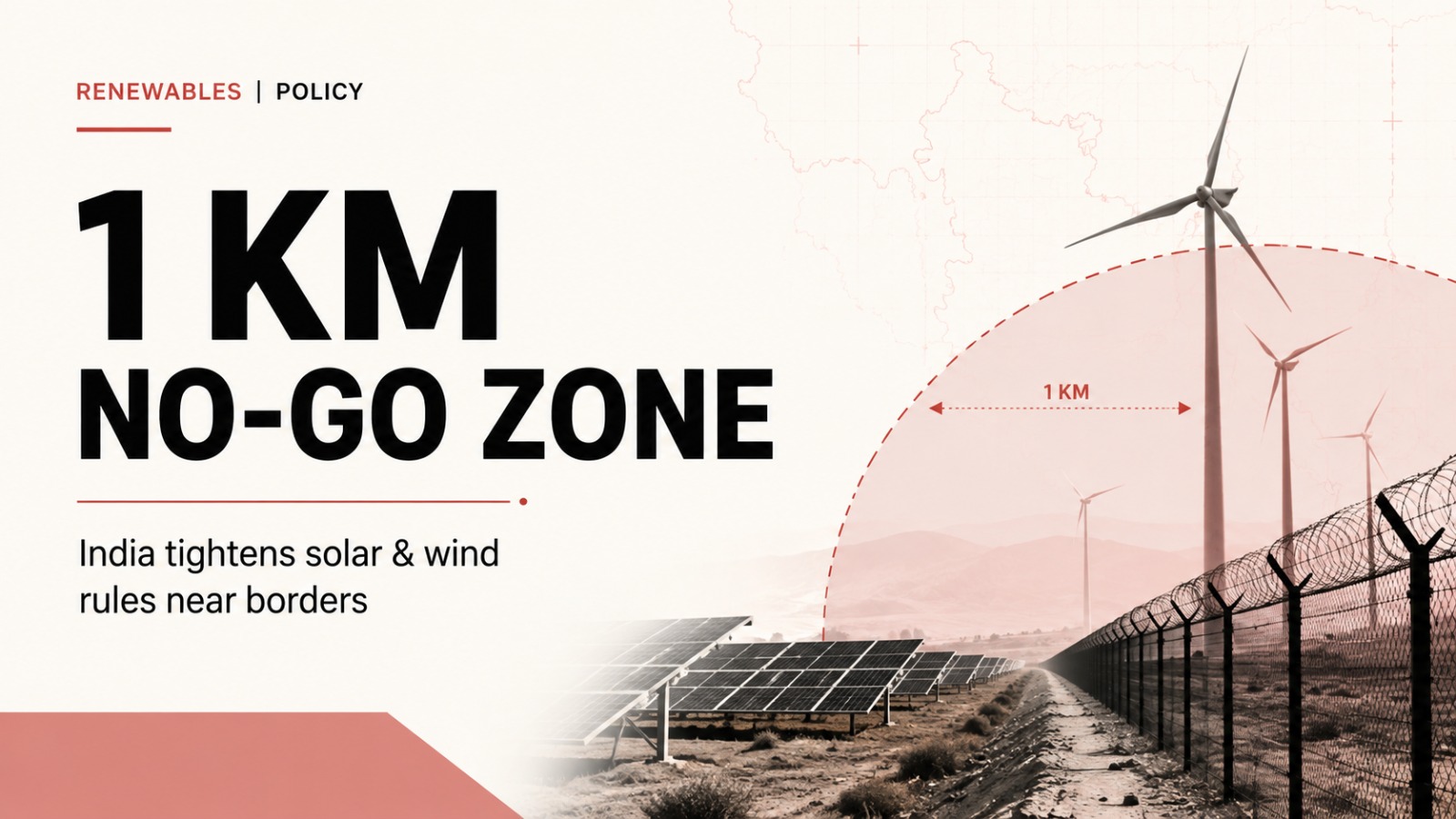
On August 8, 2026, India's Ministry of Home Affairs issued stringent national security guidelines banning new solar, wind, and hybrid renewable energy projects within 1 km of the International Border (IB), Line of Control (LoC), and Line of Actual Control (LAC). Projects up to 50 km from these borders require security clearance from the Ministry of Home Affairs (MHA), and those within 20 km also need a No Objection Certificate (NOC) from the Ministry of Defence. The rules also restrict employment of staff from Pakistan, China, and Bangladesh without prior government permission, prohibit land transfer to foreign companies without clearance, and mandate installation of anti-drone systems. Existing projects with prior clearance are exempted. This policy aims to balance India's renewable energy goals with national security imperatives in sensitive border areas spanning Jammu & Kashmir, Ladakh, Punjab, Rajasthan, Gujarat, Arunachal Pradesh, Himachal Pradesh, and Uttarakhand.
On this page
Key Facts
- The Ministry of Home Affairs (MHA) issued national security guidelines on August 8, 2026, for solar, wind, and hybrid renewable energy projects near the International Border, the Line of Control, and the Line of Actual Control.
- New renewable energy projects are banned within 1 km of these borders.
- Areas within 50 km are classified as sensitive, requiring security clearance from the MHA for every proposed project.
- Projects within 20 km require an additional No Objection Certificate (NOC) from the Ministry of Defence.
- Clearance for projects between 1 km and 50 km is assessed on a case-by-case basis.
- Applications must be submitted to the Ministry of New and Renewable Energy (MNRE).
- Employment of engineers, staff, or laborers from Pakistan, China, and Bangladesh is barred without prior permission from the Central Government.
- Transfer of project land to foreign companies is prohibited without clearance from the MHA and Central Government.
- Developers must bear the cost of mandatory security measures, including anti-drone systems, in these border zones.
- Existing projects approved before the issuance of these guidelines need not reapply.
- The states covered include Jammu & Kashmir, Ladakh, Punjab, Rajasthan, Gujarat, Arunachal Pradesh, Himachal Pradesh, and Uttarakhand.
Background & Context
India has been expanding its renewable energy capacity, including solar and wind projects, as part of its commitment to non-fossil fuel energy sources. These border areas have strategic and security sensitivities due to proximity to international boundaries and potential vulnerabilities. Previous lack of clear guidelines led to ambiguities regarding project approvals, prompting the MHA to institute a structured framework to safeguard national security while supporting renewable energy development.
The International Border refers to the recognized boundary between India and Pakistan in most sectors. The Line of Control separates Indian and Pakistan-administered territories in Jammu and Kashmir, while the Line of Actual Control demarcates the de facto boundary between India and China.
Why This Matters for Exams / Exam Relevance
This policy announcement is relevant for competitive exams focusing on current affairs regarding India’s national security, energy policy, and border management. The specifics of clearance zones, involved ministries, territorial areas, and procedural requirements are typical focuses in prelims and mains examination questions. The topic combines governance, strategic affairs, and environmental policy, making it important for comprehensive exam preparation.
Points to Remember
- Guidelines issued by Ministry of Home Affairs on 8 August 2026.
- Blanket ban on new renewable energy projects within 1 km of IB, LoC, and LAC.
- Security clearance from MHA needed for projects up to 50 km from border.
- No Objection Certificate from Ministry of Defence required for projects within 20 km.
- Employment of Pakistani, Chinese, and Bangladeshi nationals in projects without prior permission is prohibited.
- Land transfers to foreign entities require clearance from MHA and Central Government.
- Mandatory anti-drone and other security systems must be installed at the developers' cost.
- Projects with earlier clearances remain exempt from fresh applications.
- States affected include Jammu & Kashmir, Ladakh, Punjab, Rajasthan, Gujarat, Arunachal Pradesh, Himachal Pradesh, and Uttarakhand.
Sources & Further Reading
| Document / Website | Link |
|---|---|
| India Bans New Renewable Projects Near Borders | Open India Bans New Renewable Projects Near Borders ↗www.gktoday.in |
| No solar, wind renewable energy project within 1 km of international border, says Home Ministry - The Hindu | Open No solar, wind renewable energy project within 1 km of international border, says Home Ministry - The Hindu ↗www.thehindu.com |
| MHA bans new solar, wind projects within 1 km of India’s borders - The Economic Times | Open MHA bans new solar, wind projects within 1 km of India’s borders - The Economic Times ↗economictimes.indiatimes.com |