
India Notifies 11 Additional International Ports for E-Visa Entry in 2026
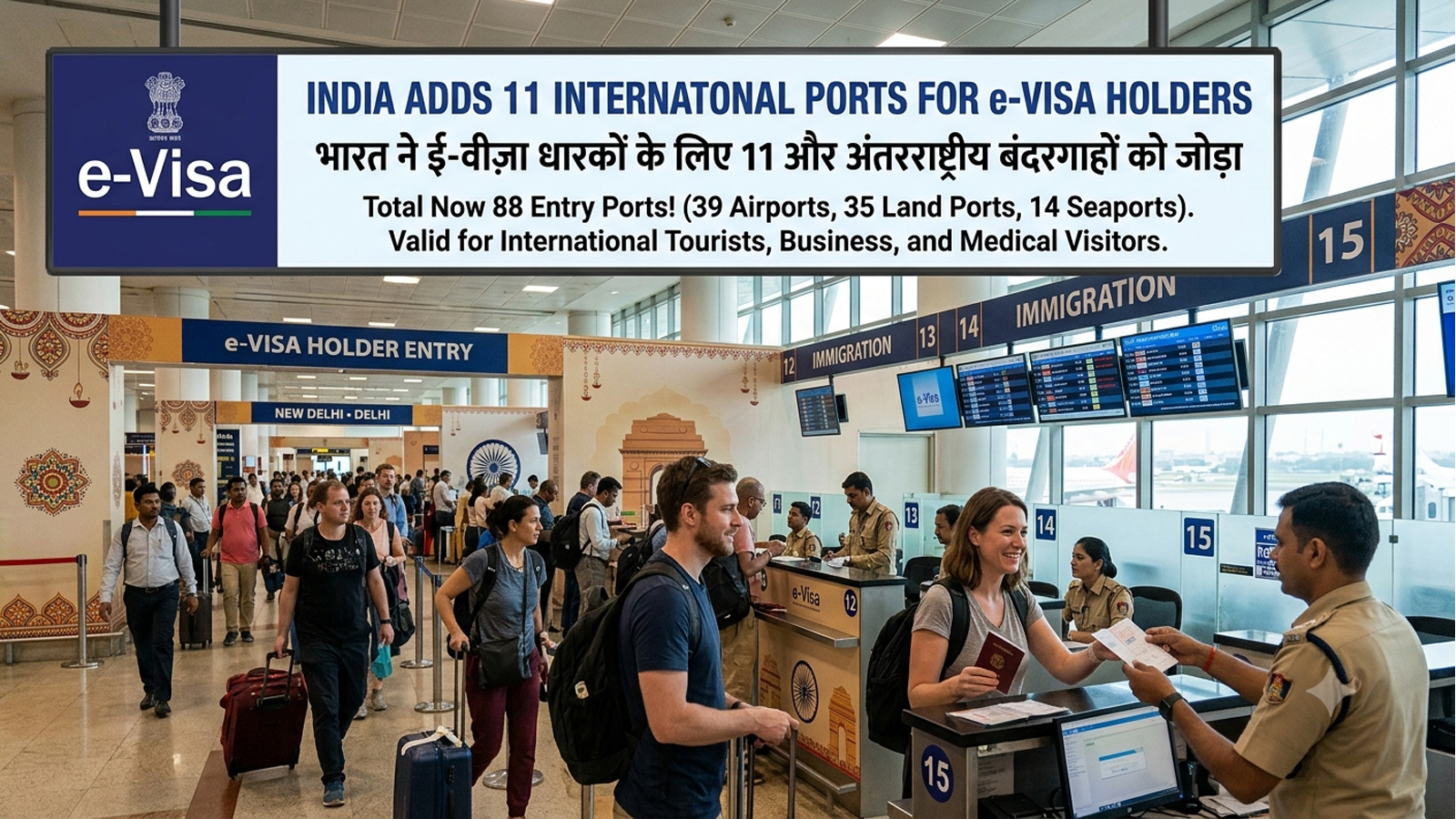
On August 10, 2026, India expanded its e-visa entry network by adding 11 new international ports, increasing the total to 88 ports comprising 37 airports, 38 seaports, and 13 land ports. The new additions include two airports—Bhopal in Madhya Pradesh and Tirupati in Andhra Pradesh—and nine land ports: Attari (Road, Punjab), Agartala (Tripura), Darranga (Assam), Gede, Ghojadanga, Haridaspur, Jaigaon (West Bengal), Dawki (Meghalaya), and Moreh (Manipur). This expansion aims to facilitate more convenient and accessible travel for foreign nationals holding e-visas. India’s e-visa system covers nationals of 172 countries, processes about 95% of applications within 72 hours, and electronic visas account for roughly 78% of all visas issued. However, Pakistani nationals are excluded from e-visa eligibility and must apply through traditional visa channels.
On this page
Key Facts
- Notification Date: 10 August 2026
- Total e-visa entry ports after expansion: 88 (37 airports, 38 seaports, 13 land ports)
- New Airports added: Bhopal (Madhya Pradesh), Tirupati (Andhra Pradesh)
- New Land Ports added: Attari (Road, Punjab), Agartala (Tripura), Darranga (Assam), Gede, Ghojadanga, Haridaspur, Jaigaon (West Bengal), Dawki (Meghalaya), Moreh (Manipur)
- E-Visa eligibility: Nationals of 172 countries across 17 visa categories
- Processing time: Approximately 95% applications processed within 72 hours
- E-visa share of total visas issued: Approximately 78%
- Exclusion: Pakistani nationals not eligible for e-visa and must apply through regular visas
Background & Context
India launched its e-visa facility in 2014 for 43 countries to simplify visa access and foster tourism and business travel. Over time, it expanded eligibility to 172 countries and diversified visa categories, including tourism, business, medical, student, and transit. The entry points have gradually increased, and this 2026 expansion adds key airports and land ports mainly to improve regional access, particularly in central and northeastern India. The expansion aligns with the 2025 Immigration and Foreigners Act framework, aiming to enhance security, streamline immigration processing, and promote ease of travel.
Why This Matters for Exams / Exam Relevance
This expansion is significant for competitive exams focusing on current affairs, government policy, internal security, tourism, and digital governance reforms. Candidates should remember the number and types of new ports added, the excluded categories (specifically Pakistani nationals), and the growing importance of e-visas in India’s immigration system. Understanding these changes provides insight into India’s immigration modernization and its international relations dynamics.
Points to Remember
- India's e-visa system was initiated in 2014 and has expanded considerably to 172 countries and 17 visa sub-categories.
- The number of designated e-visa entry points increased to 88 in 2026, including airports, seaports, and land ports.
- Two new airports added are Bhopal and Tirupati; nine new land ports include Attari and Moreh.
- Approximately 95% of e-visa applications are processed within 72 hours.
- E-visas constitute about 78% of all visas issued by India, indicating their growing importance.
- Pakistani nationals are not eligible for e-visa and must apply through regular diplomatic channels.
- Expansion is implemented under the legal framework of the Immigration and Foreigners Act, 2025.
Sources & Further Reading
| Document / Website | Link |
|---|---|
| India notifies 11 more ports for e-visa entry | Open India notifies 11 more ports for e-visa entry ↗www.gktoday.in |
| India e-Visa 2026 expansion details | Open India e-Visa 2026 expansion details ↗www.indiatoday.in |
| India adds 14 seaports to e-Visa scheme | Open India adds 14 seaports to e-Visa scheme ↗www.visaverge.com |