
India's Asiatic Lion Population Surges to 891 in 2025
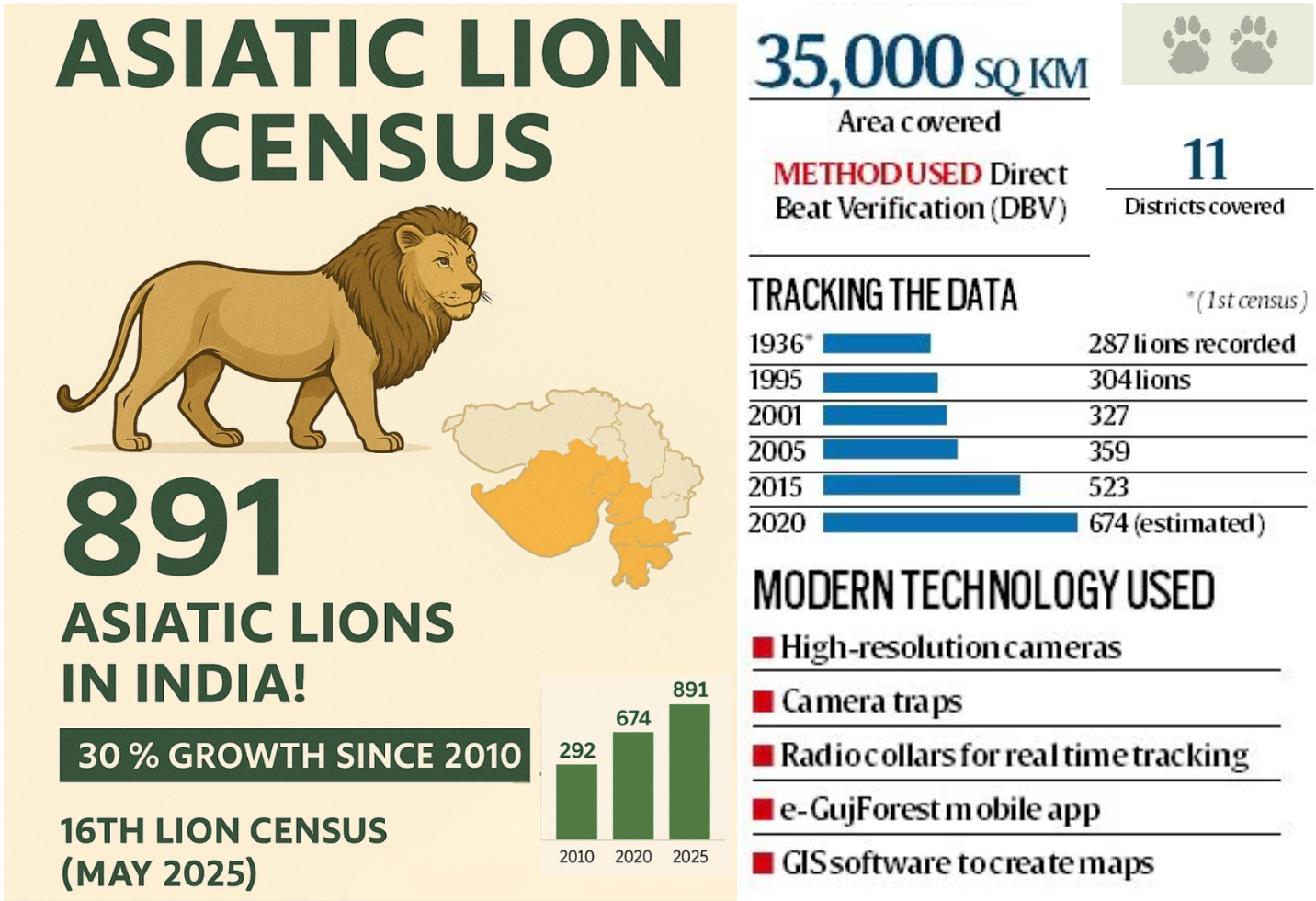
The Asiatic lion population in India has grown significantly, reaching 891 individuals in 2025 compared to 523 in 2015, according to the 16th Asiatic Lion Population Estimation conducted in Gujarat. This marks a 70.36% increase over a decade. The lions primarily inhabit Gujarat's Gir and Greater Gir landscapes, with their geographical range expanding from 30,000 sq km in 2020 to nearly 35,000 sq km in 2025. Project Lion, launched on 15 August 2020, has played a key role in this successful conservation effort through habitat improvement, disease surveillance, and medical support. The Asiatic lion, Panthera leo persica, is listed as Endangered on the IUCN Red List and is found only in India’s Saurashtra region, primarily Gujarat.
On this page
Key Facts
- Asiatic lion population increased from 523 in 2015 to 891 in 2025 as per the 16th Asiatic Lion Population Estimation.
- The geographical range of Asiatic lions expanded from about 30,000 sq km in 2020 to nearly 35,000 sq km in 2025.
- The census was conducted from 10 to 13 May 2025 across 11 districts of Gujarat, covering 58 talukas.
- The Direct Beat Verification method combined with the Block Count method was used for counting lions, involving 3,854 participants including forest officials, local volunteers, sarpanches, and village residents.
- Technologies like digital cameras, camera traps, GPS-enabled devices, and AI-based software were used to identify individual lions.
- Project Lion was launched by Prime Minister Narendra Modi on 15 August 2020 for the long-term conservation of the Asiatic lion.
- Population growth recorded was 32.2% from 674 in 2020 to 891 in 2025, and a 70.36% increase from 523 in 2015 to 891 in 2025.
- Population composition includes 196 males, 330 adult females, and a sizable number of cubs and sub-adults, with 497 lions living outside core protected areas.
- The Asiatic lion (Panthera leo persica) is classified as Endangered on the IUCN Red List.
Background & Context
The Asiatic lion once ranged broadly across West and South Asia but now survives only in the wild in India, primarily in the Gir and Greater Gir landscapes of Gujarat's Saurashtra region. Population recovery efforts began decades ago, with strict protection and habitat management. The species faces challenges of overcrowding in Gir due to limited habitat, leading to increasing dispersal into new areas within Gujarat. Project Lion, inspired by Project Tiger, was launched to enhance conservation via habitat restoration, scientific monitoring, disease control, and community involvement to sustain and expand the lion population.
Why This Matters for Exams / Exam Relevance
The Asiatic lion is an iconic species relevant to biodiversity and wildlife conservation syllabi, especially for UPSC and state civil services exams. It relates to topics on endangered species, habitat conservation, government schemes, ecological balance, and human-wildlife conflict. Understanding population trends, conservation methodologies like direct beat verification, and flagship projects like Project Lion helps answer questions on environment and ecology. The project exemplifies India's conservation success story and policy initiatives to safeguard species under threat.
Points to Remember
- India is the only country with wild Asiatic lions, concentrated mainly in Gujarat.
- 16th Asiatic Lion Population Estimation in 2025 recorded total count at 891 lions.
- Population growth since 2015 is over 70%, showcasing effective conservation efforts.
- Project Lion, launched in 2020, integrates habitat improvement, veterinary care, disease surveillance, and technology-driven monitoring.
- Population dispersal includes significant numbers outside core protected areas, expanding lion range.
- Census employs advanced tools like GPS, camera traps, GIS, AI in data analysis and mapping.
- Asiatic lions are classified as Endangered by the IUCN, highlighting conservation urgency.
- Population estimation involved thousands of stakeholders, emphasizing community participation.
Sources & Further Reading
| Document / Website | Link |
|---|---|
| India’s Asiatic Lion Population Reaches 891 in 2025 | Open India’s Asiatic Lion Population Reaches 891 in 2025 ↗www.gktoday.in |
| Asiatic lion population has grown 172% in 25 years | Open Asiatic lion population has grown 172% in 25 years ↗india.mongabay.com |
| Project Lion: Advancing Asiatic Lion Conservation and Community Engagement in Gujarat | Open Project Lion: Advancing Asiatic Lion Conservation and Community Engagement in Gujarat ↗timesofindia.indiatimes.com |
| India’s Asiatic Lion Fight for Survival: Conservation Initiatives and Challenges | Open India’s Asiatic Lion Fight for Survival: Conservation Initiatives and Challenges ↗timesofindia.indiatimes.com |
| State of India's Environment 2023: Forest & Wildlife Conservation | Open State of India's Environment 2023: Forest & Wildlife Conservation ↗indiaenvironmentportal.org.in |
| Asiatic Lion Reintroduction Project and Conservation Reports | Open Asiatic Lion Reintroduction Project and Conservation Reports ↗en.wikipedia.org |