
Mount Erebus: The Southernmost Active Volcano Spewing Microscopic Gold Crystals
Mount Erebus, located on Ross Island in Antarctica approximately 1,350 km from the South Pole, is the southernmost active volcano on Earth. It features a persistent lava lake and has been continuously erupting since at least 1972. Uniquely, Mount Erebus emits microscopic elemental gold crystals daily, approximately 80 grams, which disperse up to 1,000 kilometers away. These gold particles are faceted, crystalline, and can be up to 60 micrometers in diameter. Although valued economically (around $6,000 per day), recovery is impractical due to the crystals' microscopic size and widespread distribution. Scientific studies since 1991 have documented this phenomenon, though the precise mechanism of gold crystallization and emission remains under investigation, with theories involving volcanic gases containing chlorine or sulfur bearing compounds.
On this page
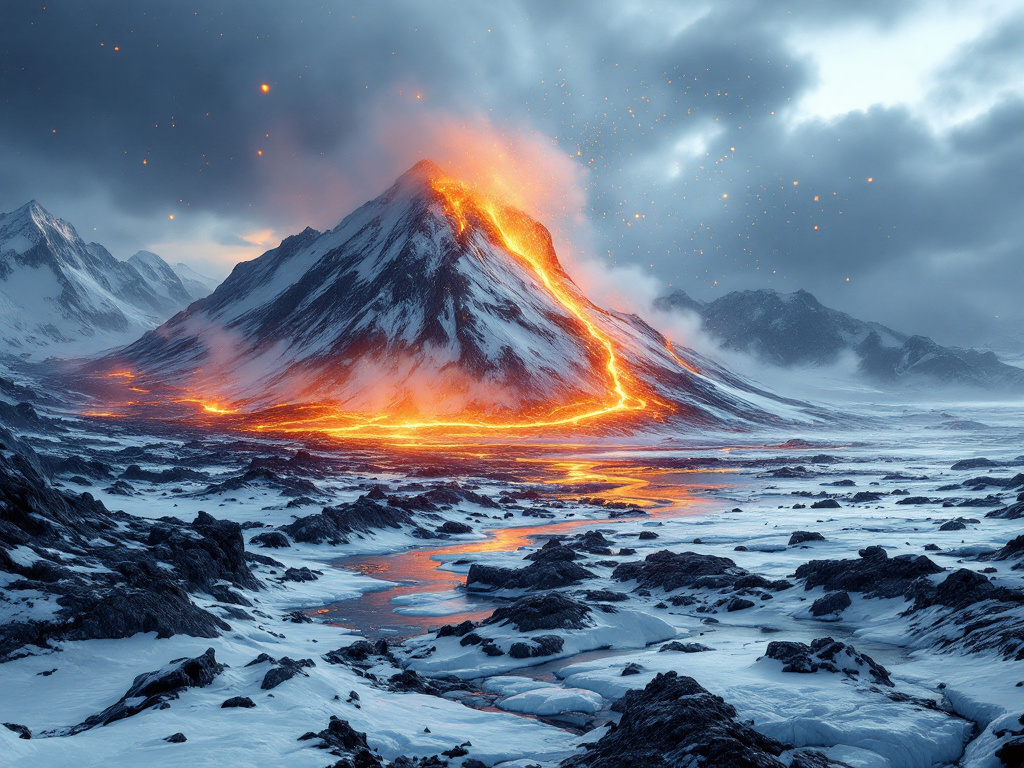
Key Facts
- Location: Ross Island, East Antarctica, about 1,350 km from the South Pole.
- Elevation: Approximately 3,792 meters (12,441 feet).
- Volcano Type: Stratovolcano with a permanent phonolitic lava lake; one of five such lava lakes on Earth.
- Volcanic Activity: Continuous eruptive activity recorded since at least 1972.
- Gold Emission: Emits around 80 grams of microscopic crystalline elemental gold daily.
- Gold Particle Size and Dispersion: Gold crystals up to about 60 micrometers across are dispersed up to 1,000 km from the volcano.
- Scientific Discovery: Emission of elemental gold particles first documented by a 1991 Geophysical Research Letters paper led by geochemist Kimberly Meeker.
Background & Context
Mount Erebus lies on Ross Island and is part of a group of volcanoes in Antarctica. It is renowned for its persistent lava lake—one of only a few worldwide—and Strombolian eruptive activity. The volcano’s geochemistry is unusual, producing anorthoclase-phonolite lava flows. Its gold emissions are exceptional because Mount Erebus is the only known volcano that consistently emits crystalline elemental gold particles, not merely trace amounts of gold in gaseous or particulate form.
Scientific hypotheses suggest that the gold escapes from magma dissolved in volcanic gases, possibly bound with chlorine- or sulfur-bearing compounds, then condenses as elemental gold crystals either on the lava lake surface or within the volcanic plume before atmospheric transport.
This natural process results in microscopic gold crystals dispersed over the Antarctic ice cap, though their recovery is impractical due to their small size and widespread distribution.
Why This Matters for Exams / Exam Relevance
Mount Erebus is significant in Earth Science and Geography syllabus for competitive exams due to its unique volcanic features, geographical location, and rare mineral emissions. It serves as a case study for:
- Active volcanism in extreme polar environments
- Geological and geochemical processes related to persistent lava lakes
- Volcanic emission and mineral deposition phenomena, specifically elemental gold crystal formation and transport
- Antarctic physical geography and volcanic hazards
Questions may cover its physical characteristics, eruption history, scientific discoveries, and environmental impact.
Points to Remember
- Mount Erebus is the southernmost active volcano on Earth.
- It has a permanent lava lake and ongoing eruptive activity documented since at least 1972.
- The volcano emits about 80 grams daily of microscopic elemental gold crystals.
- Gold particles are faceted crystals measuring up to 60 micrometers in size.
- These gold crystals are dispersed by wind over distances up to 1,000 kilometers across Antarctica.
- Gold emission from Mount Erebus was first reported in scientific literature in 1991.
- Scientific explanations for gold particle formation involve volatile chlorine- or sulfur-bearing compounds in volcanic gases.
- Economic recovery of this gold is unfeasible due to the microscopic size and dispersion of the crystals.
Sources & Further Reading
| Document / Website | Link |
|---|---|
| Mount Erebus - Wikipedia | Open Mount Erebus - Wikipedia ↗en.wikipedia.org |
| Mount Erebus, Antarctica - NASA Science | Open Mount Erebus, Antarctica - NASA Science ↗science.nasa.gov |
| Emission of elemental gold particles from Mount Erebus, Ross Island, Antarctica - Geophysical Research Letters | Open Emission of elemental gold particles from Mount Erebus, Ross Island, Antarctica - Geophysical Research Letters ↗doi.org |
| There's a Volcano in Antarctica Spewing Crystals of Gold Into The Atmosphere - ScienceAlert | Open There's a Volcano in Antarctica Spewing Crystals of Gold Into The Atmosphere - ScienceAlert ↗www.sciencealert.com |