
NASA completes assembly of Nancy Grace Roman Space Telescope, a powerful successor to Hubble
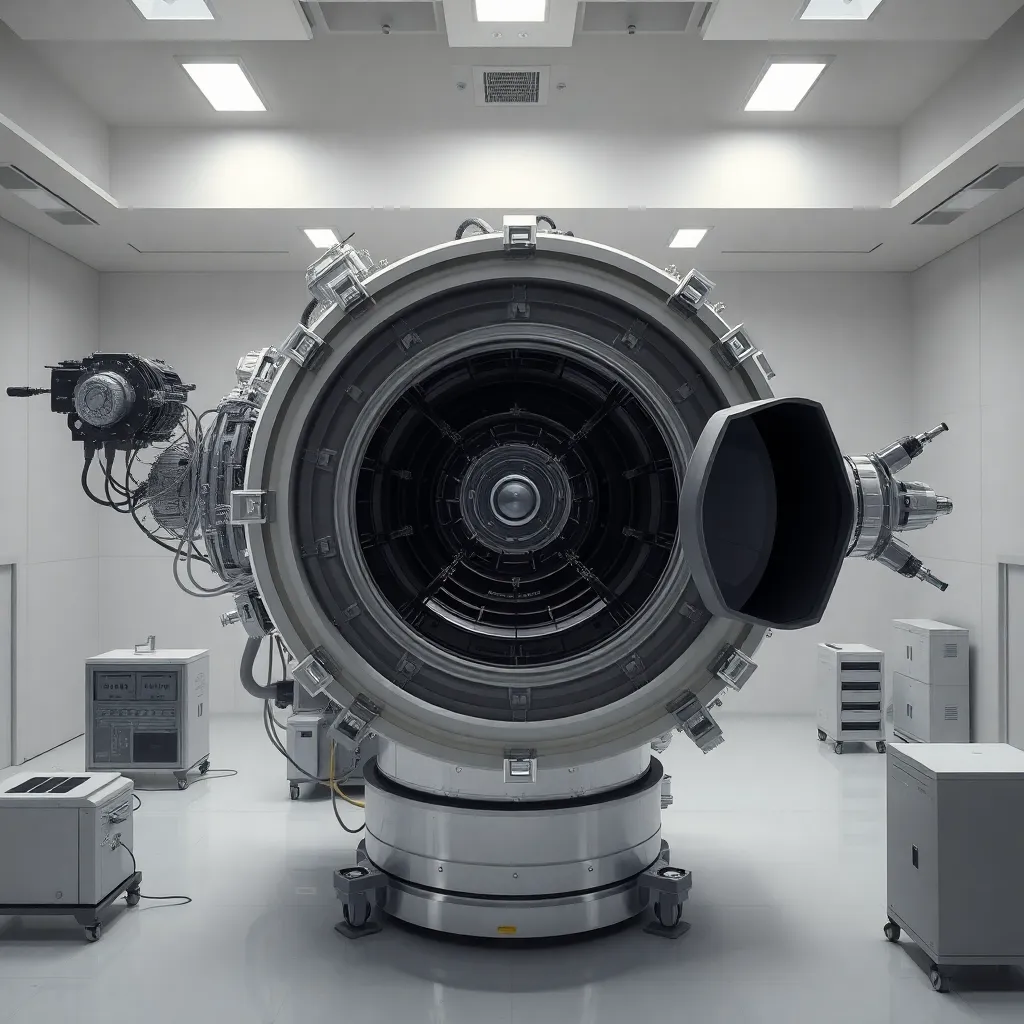
NASA has completed final assembly of the Nancy Grace Roman Space Telescope at Goddard Space Flight Center, aiming for launch in 2026. The observatory has a 2.4-meter mirror like Hubble, but with a field of view nearly 100 times larger, allowing it to survey the cosmos up to 1,000 times faster. It will study dark energy, dark matter, galaxy formation, and exoplanets, equipped with a wide-field instrument and coronagraph for direct exoplanet imaging, operating at the Sun–Earth L2 point.
On this page
Key Facts
- The Nancy Grace Roman Space Telescope (Roman) is a NASA mission designed to survey the universe in visible and near-infrared wavelengths.
- Assembly was completed at NASA’s Goddard Space Flight Center in Maryland.
- Launch is planned for 2026, aboard a SpaceX Falcon Heavy rocket, from Kennedy Space Center.
- The telescope features a 2.4-meter primary mirror, identical in size to the Hubble Space Telescope's mirror.
- Its field of view is nearly 100 times larger than Hubble's, enabling it to collect data approximately 1,000 times faster.
- It will operate at the Sun–Earth Lagrange Point 2 (L2), roughly one million miles from Earth, which is also the operating location of the James Webb Space Telescope.
- Primary instruments include the Wide Field Instrument, a 300-megapixel visible and near-infrared imager, and a Coronagraph Instrument designed to directly image exoplanets by blocking out starlight.
- A major scientific focus is improving the understanding of dark energy and dark matter, which together constitute most of the universe’s mass-energy content.
- The telescope will create large three-dimensional maps of galaxies, tracing cosmic structure over time and aiding in refining cosmological models.
- It is designed to repeatedly scan the same sky areas to detect transient events such as thousands of supernovae, providing crucial data on cosmic expansion.
- Named after Nancy Grace Roman, NASA’s first chief astronomer, known as the “Mother of Hubble”.
Background & Context
Roman builds upon the legacy of the Hubble and James Webb Space Telescopes to revolutionize wide-field astronomical surveys. While Hubble offers high-resolution but narrow views, Roman’s wide field of view will allow cosmic surveys on unprecedented scales. The telescope’s design and instruments suit it for studying fundamental questions in physics and astronomy, including the nature of dark energy driving the universe's accelerated expansion and the distribution of dark matter influencing galaxy movements. The coronagraph will advance direct imaging of exoplanets, enabling study of giant planets around nearby stars.
Why This Matters for Exams / Exam Relevance
The Nancy Grace Roman Space Telescope is a crucial upcoming NASA astrophysics mission, often featured in exam syllabi focused on current space technology, astronomy, and cosmology. Knowledge of its technical specifications, scientific objectives (dark energy, dark matter, exoplanets), launch plans, and orbit position is relevant for explanations of space telescope developments following Hubble and James Webb missions. Understanding Roman’s capabilities enhances comprehension of modern astrophysical survey methods and observational cosmology.
Points to Remember
- Roman has a 2.4-meter primary mirror, the same size as Hubble's.
- It offers a field of view almost 100 times wider than Hubble’s, leading to much faster sky surveys—up to 1,000 times faster data collection.
- Launch expected in 2026 on SpaceX Falcon Heavy from Kennedy Space Center.
- Will orbit Sun–Earth Lagrange point 2 (L2), ~1 million miles from Earth.
- Focuses on dark energy and dark matter studies, galaxy formation, and exoplanet detection.
- Equipped with a Wide Field Instrument and Coronagraph Instrument for imaging and exoplanet study.
- Named after Nancy Grace Roman, NASA's first chief astronomer, known as the “Mother of Hubble.”
Sources & Further Reading
| Document / Website | Link |
|---|---|
| NASA article on Roman Space Telescope assembly | Open NASA article on Roman Space Telescope assembly ↗www.gktoday.in |
| Roman Space Telescope Mission - NASA Science | Open Roman Space Telescope Mission - NASA Science ↗science.nasa.gov |
| Nancy Grace Roman Space Telescope - Wikipedia | Open Nancy Grace Roman Space Telescope - Wikipedia ↗en.wikipedia.org |