
New 'Ballista Spider' Discovered in Queensland Rainforests
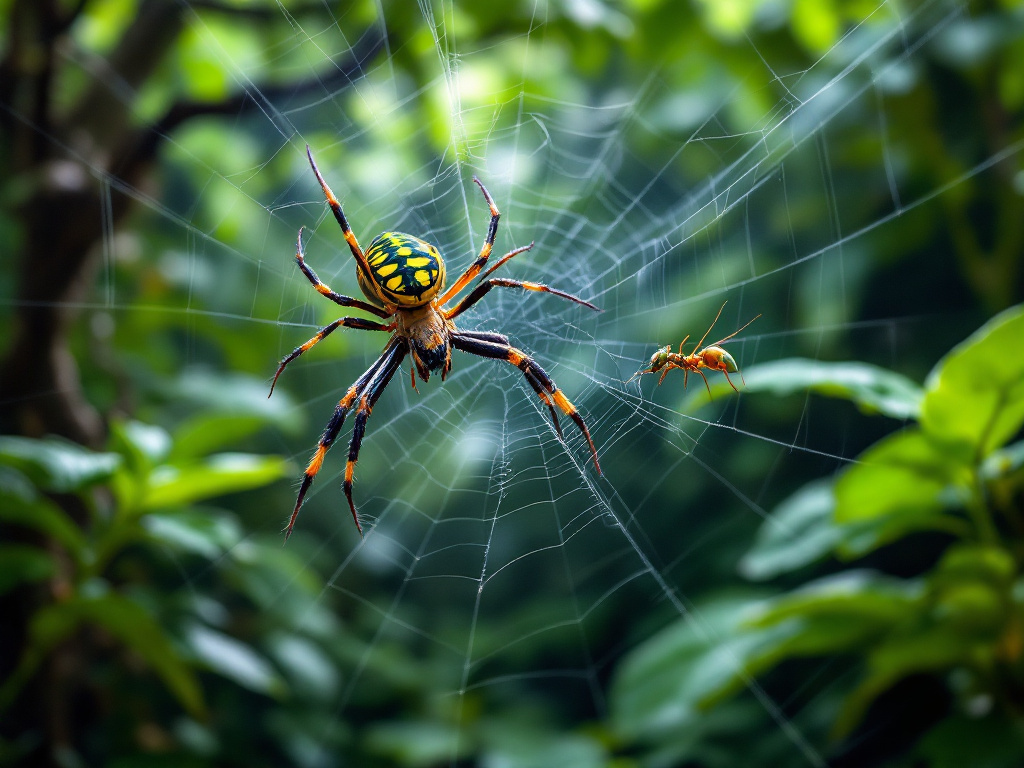
A newly discovered spider species named the Ballista Spider has been found in the rainforests of far north Queensland, Australia. It belongs to the genus Propostira within the cobweb spider family Theridiidae and currently has no formal scientific name. This spider employs a unique hunting method involving a spring-loaded silk trap that catapults its prey—the green tree ant (Oecophylla smaragdina)—into its web at high acceleration.
On this page
Key Facts
- Name: Ballista Spider (no formal scientific name yet)
- Location: Far north Queensland rainforests, Australia
- Family: Theridiidae (cobweb spiders)
- Genus: Propostira
- Unique hunting method: Uses a spring-loaded silk cone to catapult green tree ants (Oecophylla smaragdina) into its web
- Prey species: Green tree ant (Oecophylla smaragdina)
- First observed: 2022
- Research conducted by: Prof. Greg Anderson, Prof. Ajay Narendra, postgraduate student Pranav Joshi
- Research published: Current Biology, 2023
- Acceleration of prey during launch: Approximately 1,367 m/s² (~140 times gravity)
Background & Context
The Ballista Spider is named after the ancient Roman ballista weapon, which used a spring mechanism to launch projectiles. This spider specializes in hunting a single prey species—territorial and aggressive green tree ants. It uses a fragrant pheromone to lure ants to bite a silk cone made by the spider. Upon biting, the cone is released and catapults the ant about 30 centimeters into the spider’s core web. This hunting technique is unique among spiders, where the trap is triggered by the prey rather than the predator. The method allows the spider to capture dangerous prey safely and selectively.
The family Theridiidae (cobweb spiders) is known for building irregular, sticky webs utilizing silk’s elastic properties to capture prey. The genus Propostira includes spiders that spin these irregular webs and utilize silk-based hunting strategies.
High-speed and infrared cameras were used by researchers in 2023 to document this rapid and nocturnal hunting behavior in detail, highlighting the novel biomechanics of the web trap.
Why This Matters for Exams / Exam Relevance
This discovery is significant for topics in biodiversity, animal behavior, ecology, and arachnology. Understanding the adaptations of the Theridiidae family, the genus Propostira, and the unique species-specific hunting method enhances comprehension of prey-predator interactions and evolutionary biology.
Exam questions may address the spider’s taxonomic classification, ecological niche, biomechanical innovations in prey capture, or details about its discovery and research methods (such as use of high-speed/infrared filming).
Points to Remember
- The Ballista Spider uses a spring-loaded silk cone to launch its prey (green tree ants) into its web.
- Its prey, Oecophylla smaragdina, is a chemically-defensive and aggressive ant species.
- The acceleration experienced by the ant during launch is around 1,367 m/s², about 140 times the force of gravity and much higher than forces experienced by fighter pilots.
- The spider’s hunting method is species-specific and relies on pheromones to lure prey.
- Research was first observed in 2022 and video-documented in early 2023 by professors and students from Macquarie University and University of Greifswald, with findings published in Current Biology.
- This is a rare example where the prey triggers the trap actively.
Sources & Further Reading
| Document / Website | Link |
|---|---|
| Ballista Spider Discovered in Queensland Rainforests | Open Ballista Spider Discovered in Queensland Rainforests ↗www.gktoday.in |
| Newly discovered spider spins a spring-loaded trap | Open Newly discovered spider spins a spring-loaded trap ↗www.1news.co.nz |
| Spider which uses spring trap to capture prey discovered in Australia | Open Spider which uses spring trap to capture prey discovered in Australia ↗www.bbc.com |