
Rajya Sabha Passes Bill Criminalising Insult to Vande Mataram
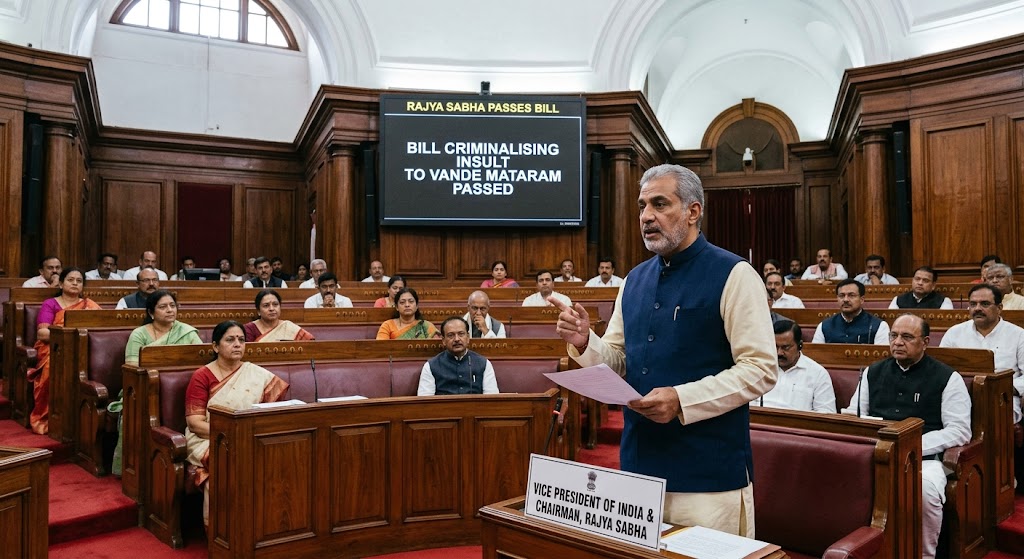
On 29 July 2026, Rajya Sabha passed the Prevention of Insults to National Honour (Amendment) Bill, 2026, which amends the Prevention of Insults to National Honour Act, 1971. The amendment extends legal protection to the national song Vande Mataram alongside the national anthem Jana Gana Mana. It criminalises intentional disruption or prevention of singing Vande Mataram, with penalties including imprisonment up to three years, a fine, or both. Additionally, the Bill mandates the playing of Vande Mataram during official events of state assemblies, elevating its legal recognition and cultural status.
On this page
Key Facts
- The Prevention of Insults to National Honour (Amendment) Bill, 2026 was passed in the Rajya Sabha on 29 July 2026.
- The Bill amends the Prevention of Insults to National Honour Act, 1971 to extend legal protection to the national song Vande Mataram alongside the national anthem Jana Gana Mana.
- Intentional disruption or prevention of the singing of Vande Mataram is punishable with imprisonment up to three years, a fine, or both.
- Vande Mataram is mandated to be played at official events in state assemblies.
- The Bill was introduced by Minister of State for Home Affairs, Nityanand Rai, on 24 July 2026.
- The Bill was passed by voice vote after opposition members walked out during the Rajya Sabha session.
Background & Context
Vande Mataram was composed by Bankim Chandra Chattopadhyay and first appeared in his 1882 novel Anandamath. It has deep cultural and historical significance in India's freedom movement. While Jana Gana Mana was adopted as the national anthem on 24 January 1950, Vande Mataram holds the status of the national song. Prior to the 2026 amendment, the Prevention of Insults to National Honour Act, 1971 only protected the national flag, the Constitution, and the national anthem from insult or disrespect. The amendment was introduced during the 150th anniversary of Vande Mataram to legally recognize and protect the song on par with the national anthem. It also makes playing Vande Mataram mandatory in state assemblies during official functions, further institutionalizing its importance.
Why This Matters for Exams / Exam Relevance
This legislative amendment marks an important recent change in laws concerning national symbols of India and reflects the ongoing significance of Vande Mataram in Indian culture and identity. Competitive exams often test knowledge of Indian national symbols, related laws, and their historical background. Understanding the distinctions between national anthem and national song, their origins, and legal protections is essential. This amendment, its dates, associated penalties, and governmental process are relevant factual details for examinations in public administration, polity, and current affairs.
Points to Remember
- Vande Mataram was composed by Bankim Chandra Chattopadhyay in 1882 as part of Anandamath.
- Jana Gana Mana was adopted as the national anthem on 24 January 1950.
- The Prevention of Insults to National Honour Act was originally enacted in 1971.
- The 2026 Amendment Bill was introduced on 24 July 2026 and passed on 29 July 2026 in the Rajya Sabha.
- The amendment criminalises intentional disruption of singing Vande Mataram with punishment of imprisonment up to 3 years and/or fine.
- The Bill mandates playing Vande Mataram during official events in state assemblies.
Sources & Further Reading
| Document / Website | Link |
|---|---|
| GKToday: Rajya Sabha passes bill criminalising insult to Vande Mataram | Open GKToday: Rajya Sabha passes bill criminalising insult to Vande Mataram ↗www.gktoday.in |
| Bankim Chandra Chattopadhyay and Vande Mataram | Open Bankim Chandra Chattopadhyay and Vande Mataram ↗www.britannica.com |
| Official National Symbols of India | Open Official National Symbols of India ↗www.india.gov.in |