
World Elephant Day 2026 and India's Elephant Conservation Initiatives
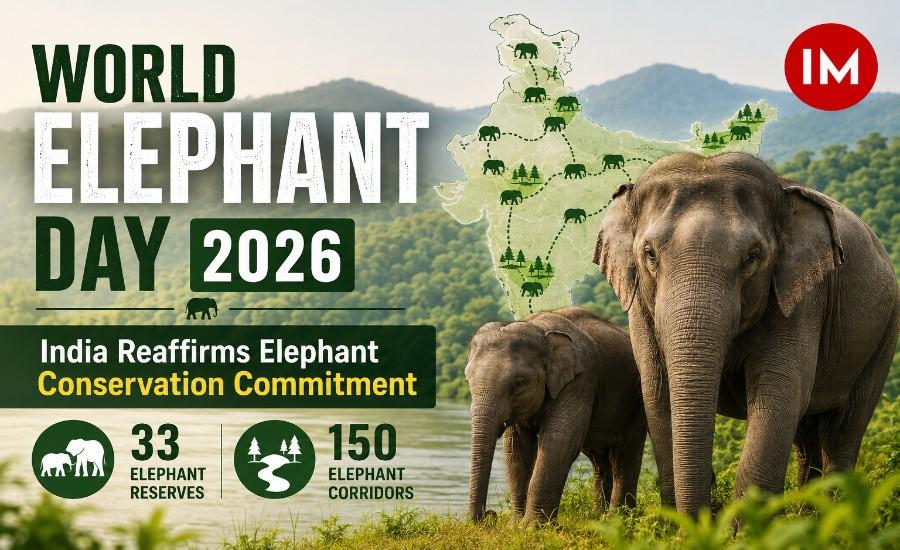
India observes World Elephant Day every year on August 12 to raise awareness about elephant conservation, habitat protection, and human-elephant conflict management. The country is home to nearly 60% of the global wild Asian elephant population and has designated 33 Elephant Reserves across 14 states, alongside 150 scientifically validated elephant corridors to maintain habitat connectivity.
On this page
Key Facts
- World Elephant Day is celebrated annually on August 12 since its international launch in 2012.
- India harbors nearly 60% of the global wild Asian elephant population.
- There are 33 designated Elephant Reserves across 14 Indian states, covering about 80,777 sq km.
- India has identified and scientifically validated 150 elephant corridors that facilitate safe elephant movement between habitats.
- Project Elephant, a centrally sponsored scheme launched in 1992 by the Ministry of Environment, Forest and Climate Change, supports elephant conservation and conflict mitigation efforts.
- The Asian elephant is classified as Endangered on the IUCN Red List and is protected under Schedule I of the Wildlife (Protection) Act, 1972.
Background & Context
World Elephant Day was established in 2012 to raise global consciousness about the threats elephants face, such as poaching, habitat loss, and human-elephant conflict. As a keystone species, Asian elephants play a crucial ecological role in forest ecosystems and biodiversity.
Elephant Reserves in India constitute landscape-level areas aimed at conserving elephant populations and their habitats. Elephant corridors are narrow strips of habitat linking these reserves, allowing elephants to migrate, breed, and feed safely, thus reducing conflicts with humans.
Project Elephant provides financial and technical support to Indian states for population monitoring, habitat management, protection of corridors, veterinary care, and strategies to reduce human-elephant conflicts. For example, Andhra Pradesh employs trained kumki elephants and specialized HANUMAN teams to manage conflict situations.
Why This Matters for Exams / Exam Relevance
Topics related to World Elephant Day, elephant conservation efforts in India, Project Elephant, and human-elephant conflict are common in Indian competitive exams, including UPSC and state public service commissions. These topics intersect with syllabus areas such as environmental conservation, biodiversity, wildlife protection laws, and sustainable human-wildlife coexistence strategies.
Points to Remember
- World Elephant Day date: August 12 annually.
- Project Elephant launch year: 1992.
- Number of Elephant Reserves: 33 across 14 states.
- Number of validated elephant corridors: 150.
- Asian elephant status: Endangered (IUCN Red List).
- India has about 60% of the wild Asian elephant population globally.
- Main human-elephant conflict management strategies include population monitoring, habitat management, use of trained kumki elephants, local response teams, and maintaining elephant corridors.
Sources & Further Reading
| Document / Website | Link |
|---|---|
| India Reaffirms Elephant Conservation on World Elephant Day | Open India Reaffirms Elephant Conservation on World Elephant Day ↗www.gktoday.in |
| World Elephant Day 2024, History, Significance, India’s Conservation Efforts | Open World Elephant Day 2024, History, Significance, India’s Conservation Efforts ↗www.pw.live |
| Project Elephant in India | Open Project Elephant in India ↗www.nextias.com |
| Best Practices of Human Elephant Conflict Management in India | Open Best Practices of Human Elephant Conflict Management in India ↗static.pib.gov.in |
| Human-Elephant Conflict: Current Management Strategies and Future Directions | Open Human-Elephant Conflict: Current Management Strategies and Future Directions ↗www.frontiersin.org |