
Astronomers Identify Unusual Solar System With Two Earth-like Planets 120 Light-Years Away
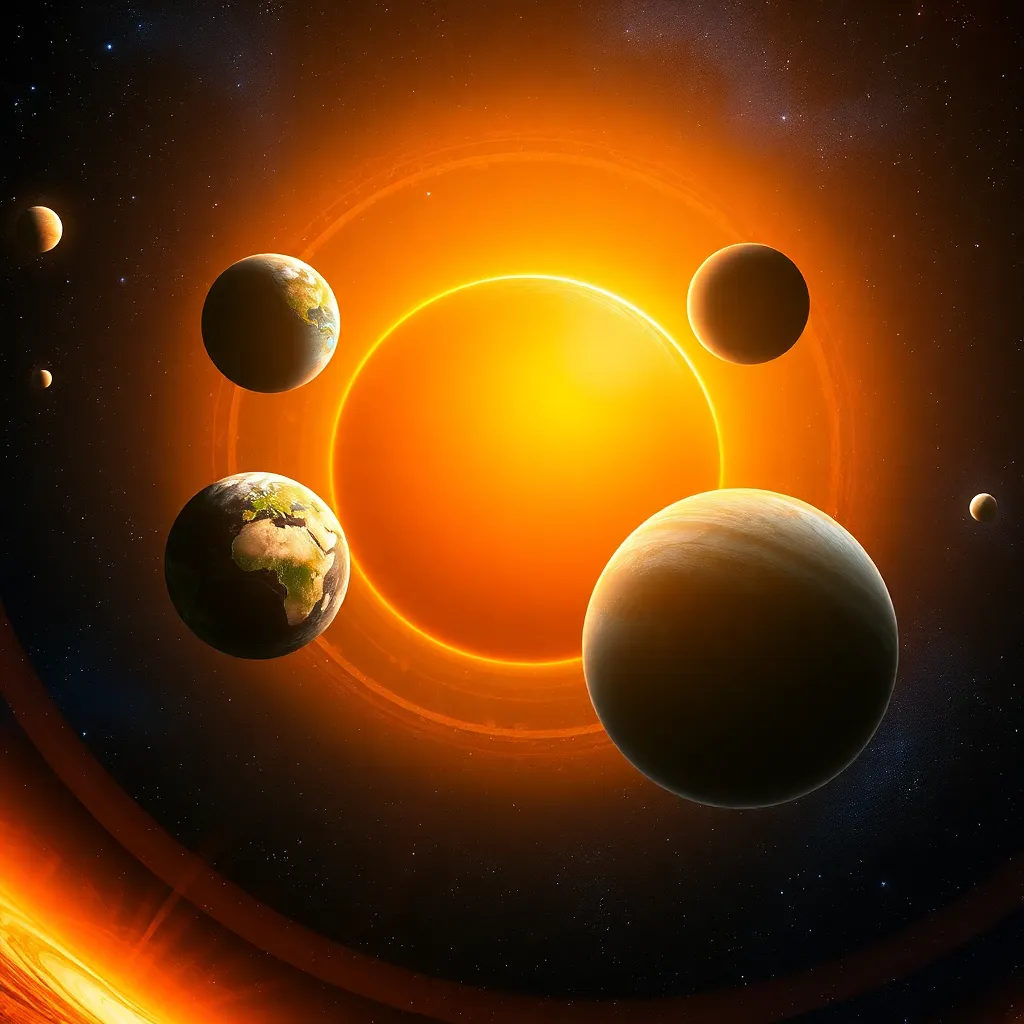
Astronomers have discovered a unique planetary system named LHS 1903, located approximately 116 light-years from Earth, containing two super-Earths—rocky planets similar to Earth but larger in mass and size—and two mini-Neptune gas-rich planets. This system challenges traditional planetary formation theories as it features an unusual planet order: rocky–gas–gas–rocky, with the outermost planet being a rocky super-Earth beyond two gaseous planets, contrary to the expected order observed in our Solar System. The discovery, made using data from NASA’s TESS and ESA’s CHEOPS space telescopes, indicates that planet formation and migration may be more complex than previously believed, necessitating revisions to existing planetary formation models.
On this page
Key Facts
LHS 1903 is a planetary system located approximately 116 light-years away in the Lynx constellation.
The system hosts four planets: two rocky super-Earths (LHS 1903 b, the innermost, and LHS 1903 e, the outermost) and two intermediate-sized gas-rich mini-Neptunes (LHS 1903 c and d).
LHS 1903 e orbits its host red dwarf star in 29.3 days, has a mass of approximately 5.79 Earth masses, and a radius about 1.732 times that of Earth, indicating a rocky composition despite its position farther from the star than the gas-rich planets.
The planet order in the system is unusual—rocky planet, gas planet, gas planet, then rocky planet again—contradicting the common planetary formation model where rocky planets are closer to the star and gaseous planets farther away.
The discovery utilized data from NASA’s Transiting Exoplanet Survey Satellite (TESS), which detected the first three inner planets, and ESA’s CHEOPS telescope, which later revealed the unexpected fourth, outermost rocky planet.
Background & Context
Standard planetary formation models predict that rocky terrestrial planets form close to their stars where temperatures are higher and it is difficult for volatile gases to accumulate, while gas giants typically form farther away where cooler conditions allow substantial gaseous envelopes. The LHS 1903 system defies this canonical model by hosting a significant rocky planet beyond two gas-rich neighbors. This atypical arrangement suggests alternative formation scenarios such as inside-out growth, planetary migration, or planet formation in a gas-depleted disk. It challenges the prior assumptions of uniform planetary system architecture and implies a diverse range of evolutionary pathways influenced by local disc properties, gravity, and stellar activity.
Why This Matters for Exams / Exam Relevance
This discovery is relevant for students preparing for competitive exams covering astrophysics, planetary science, or general science and technology themes. It illustrates key concepts related to exoplanet discovery methods, characteristics of super-Earths, planetary formation theories, and the role of missions like TESS and CHEOPS in advancing our understanding of planetary systems beyond our own. Understanding such paradigm-challenging findings enriches knowledge about the universe's complexity and the ongoing evolution of scientific models, making it pertinent for questions on space science advancements.
Points to Remember
Exoplanets: Planets orbiting stars outside the Solar System, detected via transit photometry through missions like TESS and CHEOPS.
Super-Earths: Rocky planets larger than Earth but smaller than Neptune, with varied compositions and internal structures.
The typical planetary formation model positions rocky planets nearer to the star and gas giants farther out; LHS 1903 breaks this pattern.
LHS 1903 e’s unique position and composition suggest alternative formation or migration pathways for planets.
The entire LHS 1903 system resides close enough that all planets orbit within an area smaller than Mercury’s orbit in our Solar System.
Collaborative observations from NASA’s TESS (initial detections between 2019–2023) and ESA’s CHEOPS (discovery in 2026) were critical in revealing this system’s structure.
Sources & Further Reading
| Document / Website | Link |
|---|---|
| Astronomers Find Unusual Solar System With Two Earth-like Planets | Open Astronomers Find Unusual Solar System With Two Earth-like Planets ↗www.gktoday.in |
| Astronomers discover a solar system 120 light-years away with two “Earths” | Open Astronomers discover a solar system 120 light-years away with two “Earths” ↗www.ecoticias.com |
| CHEOPS discovery defies planetary formation rules | Open CHEOPS discovery defies planetary formation rules ↗phys.org |