
Paranal Solar ESPRESSO Telescope (PoET) Achieves First Light at ESO's Paranal Observatory
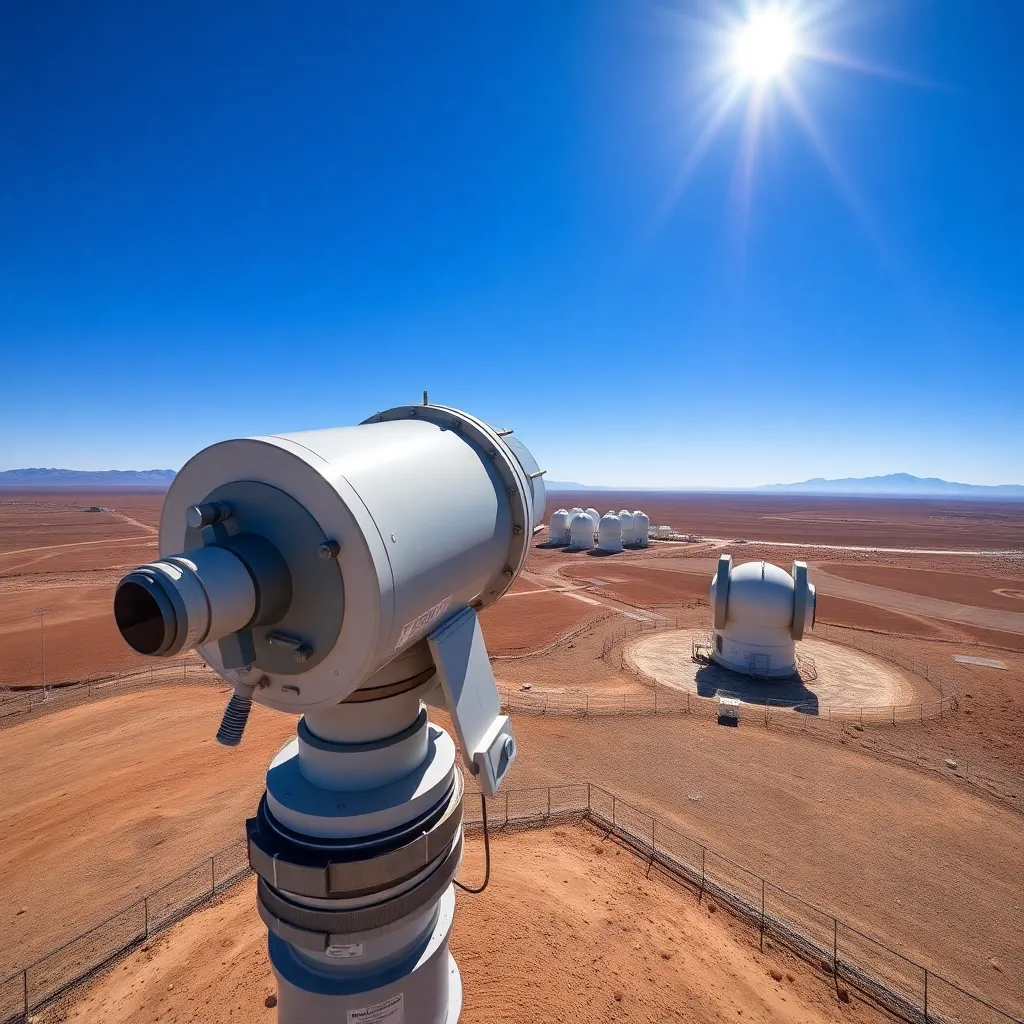
The Paranal solar ESPRESSO Telescope (PoET), installed at the European Southern Observatory's (ESO) Paranal site in Chile's Atacama Desert, achieved first light in April 2026. PoET employs ESO's high-resolution ESPRESSO spectrograph, originally designed for the Very Large Telescope (VLT), adapted for daytime solar observations. It aims to study the Sun in unprecedented detail to understand how solar activity such as sunspots affects stellar spectra, which often mask or mimic exoplanet signals, thus enhancing detection and characterization of exoplanets orbiting solar-type stars.
On this page
Key Facts
- PoET features a 60-centimetre main telescope mirror to observe specific solar regions such as sunspots, along with a smaller telescope dedicated to collecting light from the entire solar disc.
- It is installed at the ESO's Paranal Observatory located in Chile's Atacama Desert.
- PoET uses the ESPRESSO instrument, a high-resolution, ultra-stable echelle spectrograph, initially mounted on the Very Large Telescope (VLT), enabling spectroscopic observations of the Sun during the day and distant stars at night.
- PoET achieved "first light"—its first successful observation—in April 2026, followed by test spectroscopy of the solar disc and selected solar regions.
- The telescope system is remotely operated from the Centre for Astrophysics of the University of Porto in Portugal.
- PoET was designed and developed in Portugal with funding from the European Research Council.
Background & Context
Exoplanet detection using spectroscopy relies on measuring tiny variations and Doppler shifts in a star's spectrum caused by orbiting planets. However, stellar activity — including oscillations, granulation, and magnetic activity such as sunspots — introduces astrophysical noise that distorts these spectra, complicating planet detection and characterization. PoET provides high-resolution, simultaneous disk-integrated ("Sun-as-a-star") and disk-resolved solar observations with the ESPRESSO spectrograph at a spectral resolution around R~200,000. By studying the Sun as a proxy, scientists aim to model and remove stellar noise effects on spectral measurements, improving the accuracy of exoplanet detection techniques around other stars.
The ESPRESSO instrument is capable of combining light from up to four VLT telescopes in incoherent mode to form a virtual 16-meter telescope aimed at ultra-precise radial velocity measurements, essential for finding rocky exoplanets. PoET uniquely adapts this instrument for daytime solar observations, leveraging the Sun's proximity for detailed study.
Why This Matters for Exams / Exam Relevance
PoET exemplifies cutting-edge astronomical instrumentation and international collaboration aimed at advancing exoplanet science by combining solar physics and stellar astrophysics. Exam questions may focus on the instrument’s purpose, location, technical capabilities, and the significance of studying the Sun to improve exoplanet detection methods. Understanding how PoET uses ESPRESSO and its novel approach to disentangling stellar activity signals is important for astrophysics and space science studies.
Points to Remember
- PoET stands for Paranal solar ESPRESSO Telescope.
- Achieved first light in April 2026 at the European Southern Observatory’s Paranal Observatory, Chile.
- Uses the ESPRESSO spectrograph, designed for high-resolution, stable spectroscopic observations, originally for ESO's Very Large Telescope (VLT).
- Provides both disk-integrated and disk-resolved solar spectra to study the effects of stellar activity such as sunspots on spectral variability.
- Its solar observations help model and remove stellar noise that obscures exoplanet signals around other stars, improving detection accuracy.
- The system is remotely operated from the Centre for Astrophysics at the University of Porto, Portugal.
- Funded by the European Research Council and uniquely designed to connect solar physics and exoplanet research.
Sources & Further Reading
| Document / Website | Link |
|---|---|
| First light for PoET: shining (sun)light on exoplanet research | ESO | Open First light for PoET: shining (sun)light on exoplanet research | ESO ↗www.eso.org |
| The Paranal solar ESPRESSO Telescope, a New Tool for Finding Exoplanets - Universe Today | Open The Paranal solar ESPRESSO Telescope, a New Tool for Finding Exoplanets - Universe Today ↗www.universetoday.com |
| The Paranal solar ESPRESSO telescope - Abstract on ADS | Open The Paranal solar ESPRESSO telescope - Abstract on ADS ↗ui.adsabs.harvard.edu |
| ESPRESSO instrument overview - ESO | Open ESPRESSO instrument overview - ESO ↗www.eso.org |