
Great Indian Bustard Chick Survives in Gujarat Using Innovative Conservation Techniques
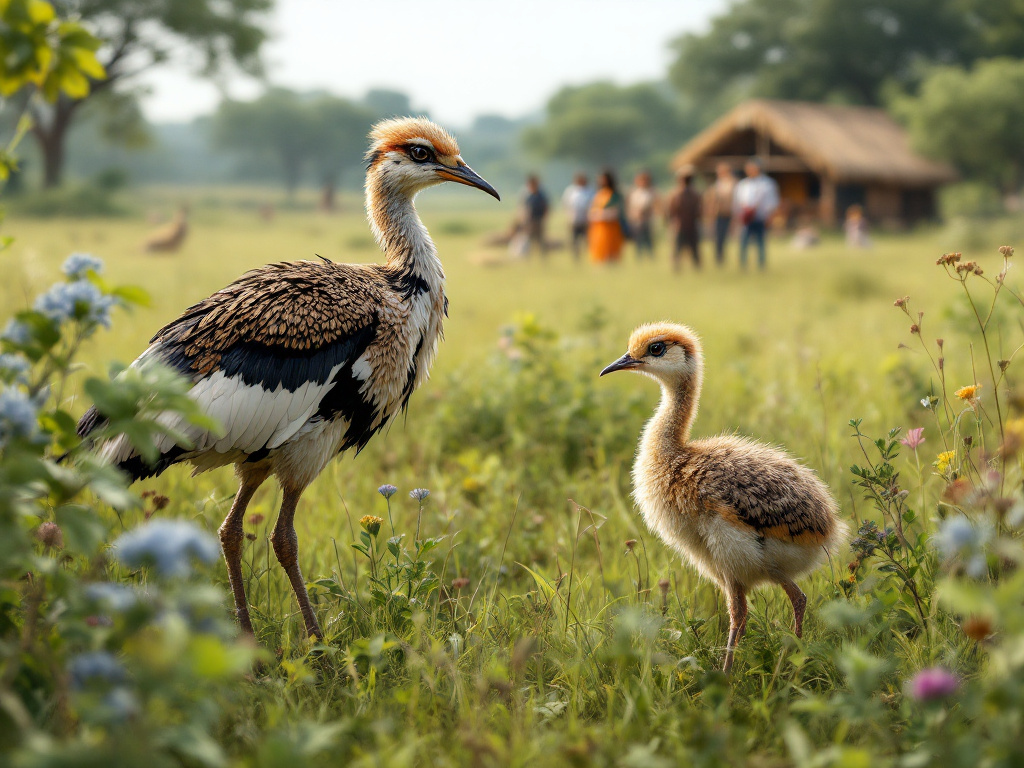
The critically endangered Great Indian Bustard, primarily found in Rajasthan, has seen a survival milestone in Gujarat where a chick hatched through the “jumpstart” technique survived beyond 40 days after hatching on 21 May 2026. This method involves incubating eggs from captive-bred birds under wild females to overcome infertility issues. The species, with fewer than 150 wild birds, is the state bird of Rajasthan and protected under Indian law. Conservation efforts include breeding centres, artificial insemination, and rewilding programs involving multiple government bodies, aiming to revive this endangered bird population.
On this page
Key Facts
- The Great Indian Bustard (Ardeotis nigriceps) is a critically endangered bird species with fewer than 150 individuals remaining in the wild.
- The species is predominantly found in the Thar desert region of Rajasthan, with smaller populations surviving in Gujarat.
- A second chick produced through the “jumpstart” technique hatched on 21 May 2026 in Naliya, Kutch district, Gujarat, and survived beyond the critical 40-day period after hatching.
- The "jumpstart" technique involves transferring a fertile captive-bred egg from Rajasthan to Gujarat, where it is incubated and reared by a wild female Great Indian Bustard—addressing the issue of infertile eggs laid by the remaining wild females in Gujarat.
- Conservation breeding centres at Sam and Ramdevra in Rajasthan held 98 Great Indian Bustards as of 9 July 2026.
- During the 2026 breeding season, 26 chicks hatched via artificial insemination, natural breeding, and wild-collected eggs.
- The Great Indian Bustard is the state bird of Rajasthan and is protected under the Wildlife (Protection) Act, 1972.
Background & Context
The Great Indian Bustard is one of India's heaviest flying birds, primarily inhabiting arid and semi-arid habitats such as desert grasslands and scrublands. Its population has drastically declined due to habitat loss, hunting, and reproductive challenges, including infertility among wild females. To address these threats, the "jumpstart" technique was implemented—allowing fertile eggs from captive breeding programmes to be incubated by wild females in Gujarat, promoting chick survival. Collaborative conservation initiatives involve the Union Environment Ministry, the Wildlife Institute of India, and the forest departments of Rajasthan and Gujarat. The project is now entering its rewilding phase, aiming to bolster wild populations further.
Why This Matters for Exams / Exam Relevance
Knowledge of the Great Indian Bustard highlights critical conservation challenges and governmental responses to preserving endangered species in India. Topics such as the bird's conservation status, habitat, legal protection, and innovative breeding techniques like the "jumpstart" method are relevant for competitive exams focusing on environment, biodiversity, and wildlife protection. Important points include dates such as 21 May 2026 (hatching of the chick), legislative frameworks like the Wildlife (Protection) Act, 1972, and the roles of national institutions and state forest departments in conservation.
Points to Remember
- Scientific name: Ardeotis nigriceps.
- Main distribution: Rajasthan (Thar desert) and Gujarat (notably Naliya, Kutch district).
- “Jumpstart” technique: transferring captive fertile eggs to be incubated by wild females to overcome infertility in wild populations.
- Conservation breeding centres located at Sam and Ramdevra in Rajasthan.
- Multiple breeding methods contribute to chick hatching: artificial insemination, natural breeding, and collection of wild eggs.
- Project involves collaboration between the Union Environment Ministry, Wildlife Institute of India, and state forest departments.
- Species is protected under the Wildlife (Protection) Act, 1972, and is the state bird of Rajasthan.
- Survival of chicks beyond the critical 40-day period marks progress in conservation efforts.
Sources & Further Reading
| Document / Website | Link |
|---|---|
| Great Indian Bustard Chick Survives in Gujarat | Open Great Indian Bustard Chick Survives in Gujarat ↗www.gktoday.in |
| Project Great Indian Bustard | Open Project Great Indian Bustard ↗wii.gov.in |
| Wildlife (Protection) Act, 1972 | Open Wildlife (Protection) Act, 1972 ↗legislative.gov.in |