
Indian Grey Hornbill Reintroduced to Gir Forests After Six Decades
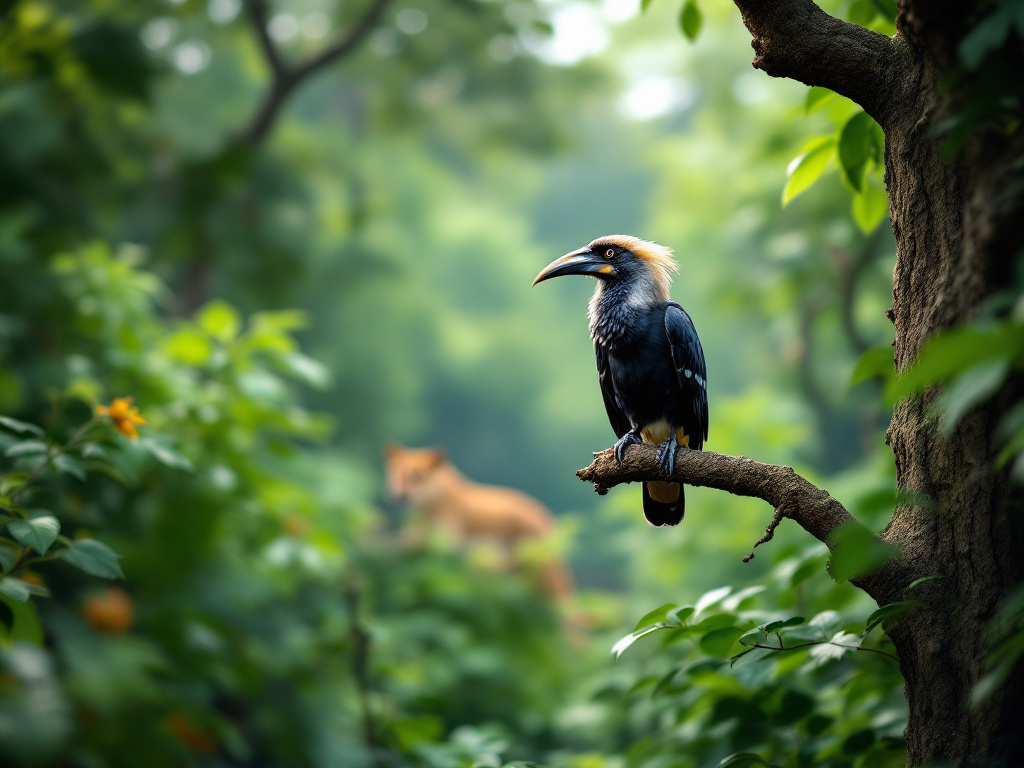
The Indian Grey Hornbill, locally known as Chilotro, has been successfully reintroduced into Gujarat's Gir forests after over 60 years. A scientific study published in the journal Birds confirms that the hornbills are surviving and breeding in the wild. The reintroduction involved releasing 40 birds in two phases during 2021-2023, with satellite transmitters used to monitor their movement and behavior. This initiative supports biodiversity restoration in the Gir landscape, known for the Asiatic lion's only natural habitat in India.
On this page
Key Facts
- The Indian Grey Hornbill (locally called Chilotro) belongs to the family Bucerotidae, characterized by a large curved bill with a casque on the upper mandible.
- Gir National Park and Wildlife Sanctuary in Gujarat is the sole natural habitat of the Asiatic lion in India.
- The Indian Grey Hornbill had been absent from the Gir forests for over six decades before this reintroduction.
- A total of 40 hornbills were released during the reintroduction program in two phases: 28 birds in 2021-2022 and 12 birds in 2023.
- Eleven male hornbills were fitted with satellite transmitters to monitor their movement, habitat use, and breeding behavior.
- Two tagged male hornbills were named LK and RSD in memory of noted Indian ornithologists Lavkumar Khachar and R.S. Dharmakumarsinhji.
- One breeding pair nested in the first year following release, and three additional breeding pairs nested in the second year, indicating successful adaptation.
Background & Context
The Indian Grey Hornbill is a species native to parts of the Indian subcontinent, but it had become locally extinct in the Gir forests of Gujarat, likely due to habitat changes. Reintroduction is a conservation technique aimed at restoring species to their former ranges where they have become extinct or severely diminished. Gir National Park, famous as the only natural habitat of the Asiatic lion, now also serves as a restored ecosystem hosting the Indian Grey Hornbill, thus enhancing biodiversity.
Why This Matters for Exams / Exam Relevance
This reintroduction highlights important themes in environmental conservation such as species restoration, biodiversity maintenance, and the use of technology for wildlife monitoring like satellite telemetry. The involvement of renowned ornithologists and the ecological significance of the Gir landscape are key points often relevant in competitive exams related to Environment, Ecology, and Biodiversity sections. Mastery of such case studies helps understand conservation strategies and regional biodiversity efforts.
Points to Remember
- Indian Grey Hornbill is also called Chilotro and belongs to the bird family Bucerotidae.
- The species was reintroduced into Gujarat’s Gir forests after being absent for over 60 years.
- Forty birds were released in two phases: 28 in 2021-22 and 12 in 2023.
- Eleven male birds were fitted with satellite transmitters to track behavior and movement; two were named LK and RSD after prominent Indian ornithologists Lavkumar Khachar and R.S. Dharmakumarsinhji.
- Breeding was observed with one pair in the first year and three pairs in the second year post-release.
- Gir National Park is the only natural habitat of the Asiatic lion in India, situated in Gujarat.
Sources & Further Reading
| Document / Website | Link |
|---|---|
| Grey Hornbill Returns to Gujarat's Gir Forests After Six Decades - GKToday | Open Grey Hornbill Returns to Gujarat's Gir Forests After Six Decades - GKToday ↗www.gktoday.in |
| Reintroduction of Indian Grey Hornbills in Gir, India | Open Reintroduction of Indian Grey Hornbills in Gir, India ↗academic.oup.com |
| Gir National Park and Wildlife Sanctuary | Open Gir National Park and Wildlife Sanctuary ↗www.wildlifegujarat.in |