
Russia's S8000 Banderol Air-Launched Cruise Missile Officially Acknowledged
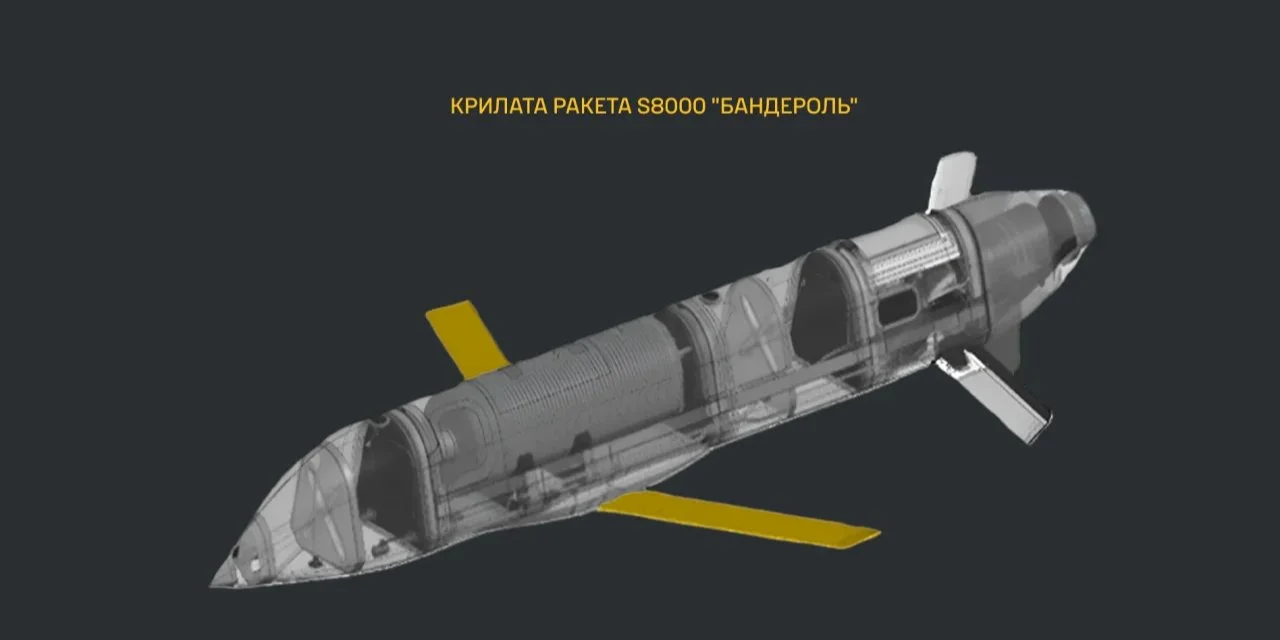
On 12 July 2026, Russian state media officially acknowledged the S8000 Banderol, a lightweight air-launched cruise missile designed for long-range precision strikes. By 29 July 2026, it had completed testing and entered serial production, with its design evolving from 2025 models. The missile can be launched from platforms including the Inokhodets (Orion) UAV, Mi-28 attack helicopters, and suspected ground launchers in temporarily occupied Crimea. Powered by a Chinese Swiwin turbojet engine and equipped with an OFBCh-150 high-explosive fragmentation warhead containing approximately 49.5 kilograms of explosives, the missile's range is assessed between 350 and 500 kilometers according to various sources. Its use has been linked to strikes on stationary infrastructure such as ports, logistics hubs, and food storage facilities.
On this page
Key Facts
- The S8000 Banderol is a lightweight air-launched cruise missile officially acknowledged by Russian state media on 12 July 2026.
- By 29 July 2026, it completed testing and entered serial production, with ongoing design evolution since 2025.
- Launch platforms include the Inokhodets (Orion) unmanned aerial vehicle, Mi-28 attack helicopters, and suspected ground-based launchers in temporarily occupied Crimea.
- The missile uses a commercially available Chinese Swiwin turbojet engine.
- It carries the OFBCh-150 warhead, a high-explosive fragmentation type with about 49.5 kg of explosive content.
- Reported range varies between 350 and 400 kilometers according to Ukrainian military intelligence, up to 500 kilometers in other accounts.
- The missile utilizes foreign-made electronic components from countries including the United States, Switzerland, Japan, China, and South Korea.
Background & Context
The S8000 Banderol reflects Russia's development of a low-cost, versatile cruise missile intended for precision long-range strikes against fixed targets such as ports, logistics and food storage facilities. Initially linked with the Inokhodets (Orion) drone, by late July 2026 the missile was also launched from Mi-28 attack helicopters and ground launchers in Crimea. The presence of foreign components suggests complex supply chains and potential vulnerabilities. Production and operational deployment details have not been officially confirmed by Russia’s Defence Ministry or the manufacturer Kronstadt as of early August 2026. Operating in contested Crimea highlights its role in ongoing regional conflicts.
Why This Matters for Exams
Knowledge of the S8000 Banderol missile development is significant for competitive exams covering defense technology, geopolitics, and security studies focusing on Russia and Eastern Europe. Important details include the dates of official acknowledgment, testing completion, launch platforms, engine origin, warhead specifics, and range. Understanding the missile’s operational roles and technological features informs questions on modern warfare concepts and international relations, especially regarding the Ukraine conflict and Russia's military modernization efforts.
Points to Remember
- Official acknowledgment date: 12 July 2026
- Testing completion and serial production entry: 29 July 2026
- Launch platforms: Inokhodets (Orion) UAV, Mi-28 attack helicopter, suspected ground launchers in Crimea
- Engine: Chinese Swiwin turbojet
- Warhead: OFBCh-150 high-explosive fragmentation, approximately 49.5 kilograms of explosives
- Range: 350–400 km by Ukrainian estimates, up to 500 km in other reports
- Use: Strikes against stationary infrastructure including ports, logistics hubs, and food storage facilities
- Foreign electronic components incorporated, sourced from the US, Switzerland, Japan, China, and South Korea
Sources & Further Reading
| Document / Website | Link |
|---|---|
| Russia's S8000 Banderol Cruise Missile Details - GKToday | Open Russia's S8000 Banderol Cruise Missile Details - GKToday ↗www.gktoday.in |
| Introduction to Cruise Missiles | Open Introduction to Cruise Missiles ↗www.britannica.com |
| Orion (Inokhodets) UAV Overview | Open Orion (Inokhodets) UAV Overview ↗www.army-technology.com |