
Vision Document on Drug Control (2026–2029) Launched in India
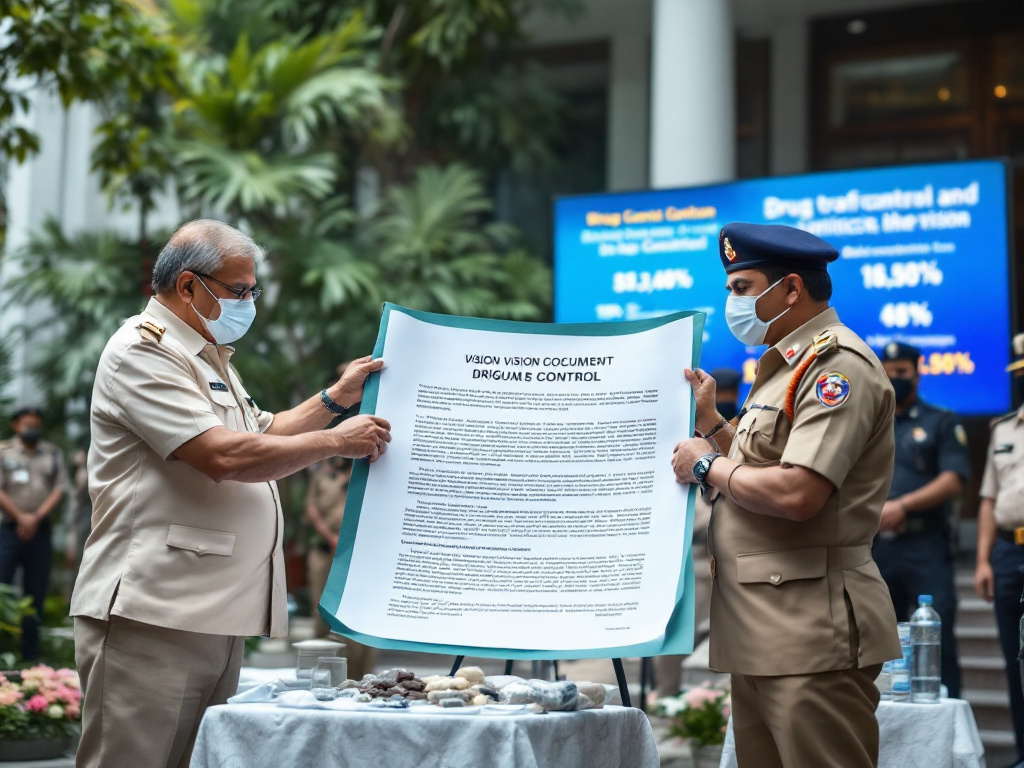
On 26 June 2026, the Indian government launched the Vision Document on Drug Control (2026-2029) in New Delhi, outlining a comprehensive national roadmap for narcotics control focused on enforcement, intelligence, precursor and synthetic drug control, demand reduction, rehabilitation, and inter-agency coordination based on four strategic pillars. The launch included the Online Drugs Disposal Fortnight Campaign to destroy over 2.09 lakh kilograms of seized narcotics worth approximately ₹6,000 crore. The document emphasizes dismantling drug networks rather than targeting individual carriers, addresses emerging challenges such as synthetic drugs and darknet trafficking, and proposes amendments to the Narcotic Drugs and Psychotropic Substances Act, 1985 to close legal loopholes and adopt a reformative approach towards addiction.
On this page
Key Facts
- Launch Date and Venue: 26 June 2026, New Delhi, at the 10th Apex-Level Meeting of the Narco-Coordination Centre (NCORD).
- Document Name: Vision Document on Drug Control (2026–2029).
- Strategic Focus: National roadmap to combat narcotics through four pillars: Enforcement, Intelligence and Operations; Precursor and Synthetic Drug Control; Demand Reduction and Rehabilitation; Capacity Building and Coordination.
- Campaign Initiated: Online Drugs Disposal Fortnight Campaign aimed to destroy over 209,500 kilograms of seized narcotic substances valued about ₹6,000 crore.
- Government and Agencies Involved: Narcotics Control Bureau (NCB), Narco-Coordination Centre, Department of Revenue, multiple central and state agencies.
- Legal Framework: Narcotic Drugs and Psychotropic Substances Act, 1985 (NDPS Act) with planned amendments to address regulatory loopholes and introduce a reformative approach towards addiction.
- New Infrastructure: Virtual inauguration of new zonal offices of the Narcotics Control Bureau in Jammu and Guwahati.
- Emerging Challenges: Synthetic drugs proliferation and darknet-enabled trafficking.
- Operational Tools: Use of human intelligence, technical intelligence, and community policing to disrupt narcotics networks.
Background & Context
The NDPS Act, 1985, is India's principal legislation governing narcotic drugs and psychotropic substances, with the Narcotics Control Bureau (NCB) established in 1986 to enforce the Act. The drug threat in India has evolved to include synthetic drugs and complex trafficking networks, often exploiting darknet marketplaces. The Vision Document 2026–2029 responds to these challenges by shifting the strategic focus from targeting individual drug carriers to dismantling entire interstate and transnational drug cartels through intelligence-led enforcement and coordinated operations. The approach employs a 'whole-of-government' and 'whole-of-society' model involving over 40 ministries, state governments, agencies, educational institutions, and civil society organizations working under a unified framework.
Why This Matters for Exams / Exam Relevance
The Vision Document represents a significant development in India’s drug control policy and internal security framework. It is relevant for competitive exams in current affairs, governance, polity, and law by covering topics such as the NDPS Act, functions and initiatives of the Narcotics Control Bureau, challenges posed by synthetic drugs, darknet trafficking, inter-agency coordination, and government campaigns targeting narcotics control. Understanding the document’s strategic pillars, operational tools, and legal reforms is essential for answering descriptive and multiple-choice questions in examinations like UPSC and other state and central service exams.
Points to Remember
- The Vision Document was unveiled on 26 June 2026 during the 10th Apex-Level Meeting of the Narco-Coordination Centre.
- It is based on four pillars: Enforcement, Intelligence and Operations; Precursor and Synthetic Drug Control; Demand Reduction and Rehabilitation; Capacity Building and Coordination.
- The Online Drugs Disposal Fortnight Campaign targets the destruction of over 2.09 lakh kilograms of seized narcotics worth about ₹6,000 crore.
- The approach shifts from targeting individual drug carriers to dismantling entire drug cartels and syndicates, including their financial sources.
- Legal amendments to the NDPS Act are planned to close loopholes and promote a reformative, rather than purely punitive, approach toward persons affected by addiction.
- New zonal offices of the NCB were inaugurated virtually in Jammu and Guwahati to strengthen regional enforcement capacity.
- The document emphasizes intelligence tools—human intelligence, technical intelligence, and community policing—to disrupt narcotic networks effectively.
- Emerging drug trafficking threats include synthetic drugs and darknet-enabled trafficking networks.
Sources & Further Reading
| Document / Website | Link |
|---|---|
| Vision Document on Drug Control (2026-2029) - GKToday | Open Vision Document on Drug Control (2026-2029) - GKToday ↗www.gktoday.in |
| Drug Control in India: Vision Document 2026–2029 and NCB Annual Report 2025 Explained | Open Drug Control in India: Vision Document 2026–2029 and NCB Annual Report 2025 Explained ↗vajiramandravi.com |