
Germany’s Lake Laach Volcano Magma Reservoir Mapped in 3D Using Largest Seismological Experiment
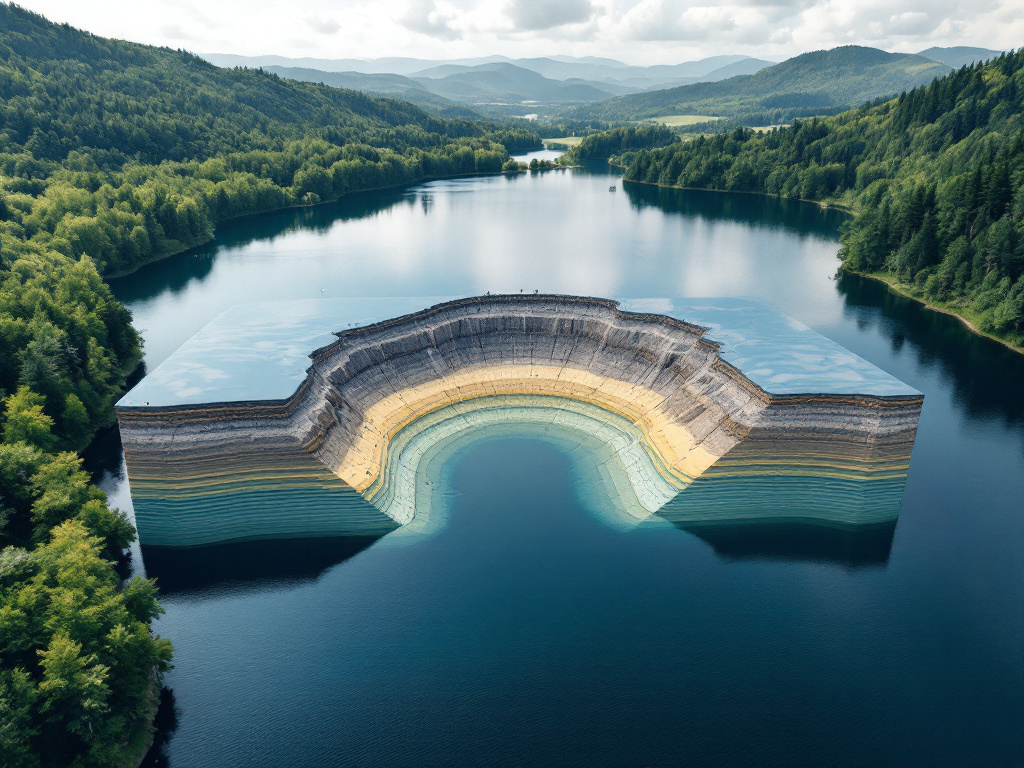
A German scientific team conducted the largest passive seismological experiment in Central Europe from September 2022 to August 2023. Utilizing over 494 seismic stations alongside a 64 km fibre-optic cable, researchers obtained a high-resolution three-dimensional image of the magma reservoir beneath Lake Laach in the Eifel volcanic region of western Germany. The reservoir extends from about 2 km to 10 km in depth, has an estimated volume of approximately 75 cubic kilometers, and is tilted roughly 53° towards the southeast. Over 1,000 microearthquakes were detected, primarily between 10 km and 16 km depths, indicating active magmatic and fluid processes beneath the region. These findings illustrate that the Eifel volcanic field remains active, necessitating continued volcanic surveillance.
On this page
Key Facts
- Lake Laach (Laacher See) is a volcanic lake in the Eifel volcanic region, western Germany.
- The Eifel volcanic field is a distributed volcanic field comprising many dormant volcanoes and maars spread over thousands of square kilometers.
- Between September 2022 and August 2023, the GFZ German Research Centre for Geosciences and the University of Potsdam executed the Large-N experiment, deploying over 494 seismic stations and a 64 km fibre-optic cable to obtain densely spaced seismic data, enabling high-resolution imaging.
- The experiment captured more than 1,000 microearthquakes, many clustered along buried fault zones between 10 km and 16 km depth.
- By late 2025, researchers produced the first detailed 3D image of the magma reservoir beneath Lake Laach, finding it deeper and tilted (~53° southeast) compared to previous models, with an estimated volume of ~75 km³ at depths of 2 to 10 km beneath the surface.
- Seismic patterns and reflections point to fluid movements and overpressure within the magmatic system, consistent with an active, though dormant, volcanic field.
Background & Context
Distributed volcanic fields are characterized by numerous monogenetic volcanoes and maars that typically erupt once at different locations within the field. The Eifel region formed via Quaternary volcanism and remains thermally and mechanically active beneath the surface despite long dormancy periods. Lake Laach erupted approximately 13,000 years ago and is one of the most recent volcanic events in the region.
Previous knowledge about the magma reservoir's shape and extent beneath Lake Laach was limited. The Large-N passive seismic experiment using dense seismic arrays and fibre-optic sensing advances understanding of subterranean magmatic structures and ongoing volcanic processes.
Why This Matters for Exams / Exam Relevance
- This study exemplifies modern geophysical methods (passive seismology and fibre-optic sensing) to image volcanic magma reservoirs, relevant for earth science topics in competitive exams.
- Lake Laach and the Eifel volcanic field are notable examples of distributed volcanic fields, often asked about in physical geography and geology portions of exams.
- Microearthquake monitoring and magma reservoir imaging highlight the concepts of volcanic hazards, magma dynamics, and seismicity, which are key for applied geology and environmental science syllabi.
- Understanding volcanic systems’ monitoring techniques aids in disaster preparedness and risk assessment, common themes in general studies exams.
Points to Remember
- Lake Laach is situated in the western German Eifel volcanic region.
- The last major eruption occurred about 13,000 years ago.
- Large-N experiment (2022–2023) incorporated over 494 seismic stations and a 64 km fibre-optic cable, marking the largest passive seismic deployment in Central Europe.
- The magma reservoir beneath Lake Laach spans 2 to 10 km depth, is roughly 75 km³ in volume, and tilted about 53° southeast toward the Neuwied Basin.
- More than 1,000 microearthquakes, mainly between 10 and 16 km depth, indicate fluid movement and ongoing magmatic activity underground.
- Eifel is an active distributed volcanic field with no signs of extinction, requiring ongoing monitoring for volcanic hazards.
Sources & Further Reading
| Document / Website | Link |
|---|---|
| Lake Laach magma reservoir mapped in 3D | Open Lake Laach magma reservoir mapped in 3D ↗www.gktoday.in |
| Surprising findings on the structure of the Eifel volcanoes: GFZ | Open Surprising findings on the structure of the Eifel volcanoes: GFZ ↗www.gfz.de |
| Germany’s dormant Lake Laach volcano shows signs of activity - Earth.com | Open Germany’s dormant Lake Laach volcano shows signs of activity - Earth.com ↗www.earth.com |
| Large-N: A volcano seismology experiment in the Eifel - GFZ | Open Large-N: A volcano seismology experiment in the Eifel - GFZ ↗www.gfz.de |
| The Upper Crustal Structure of the Eifel Volcanic Region from Local Earthquake Tomography | Open The Upper Crustal Structure of the Eifel Volcanic Region from Local Earthquake Tomography ↗agupubs.onlinelibrary.wiley.com |