
KUFOS Researchers Discover New Thorny Seahorse Species in India
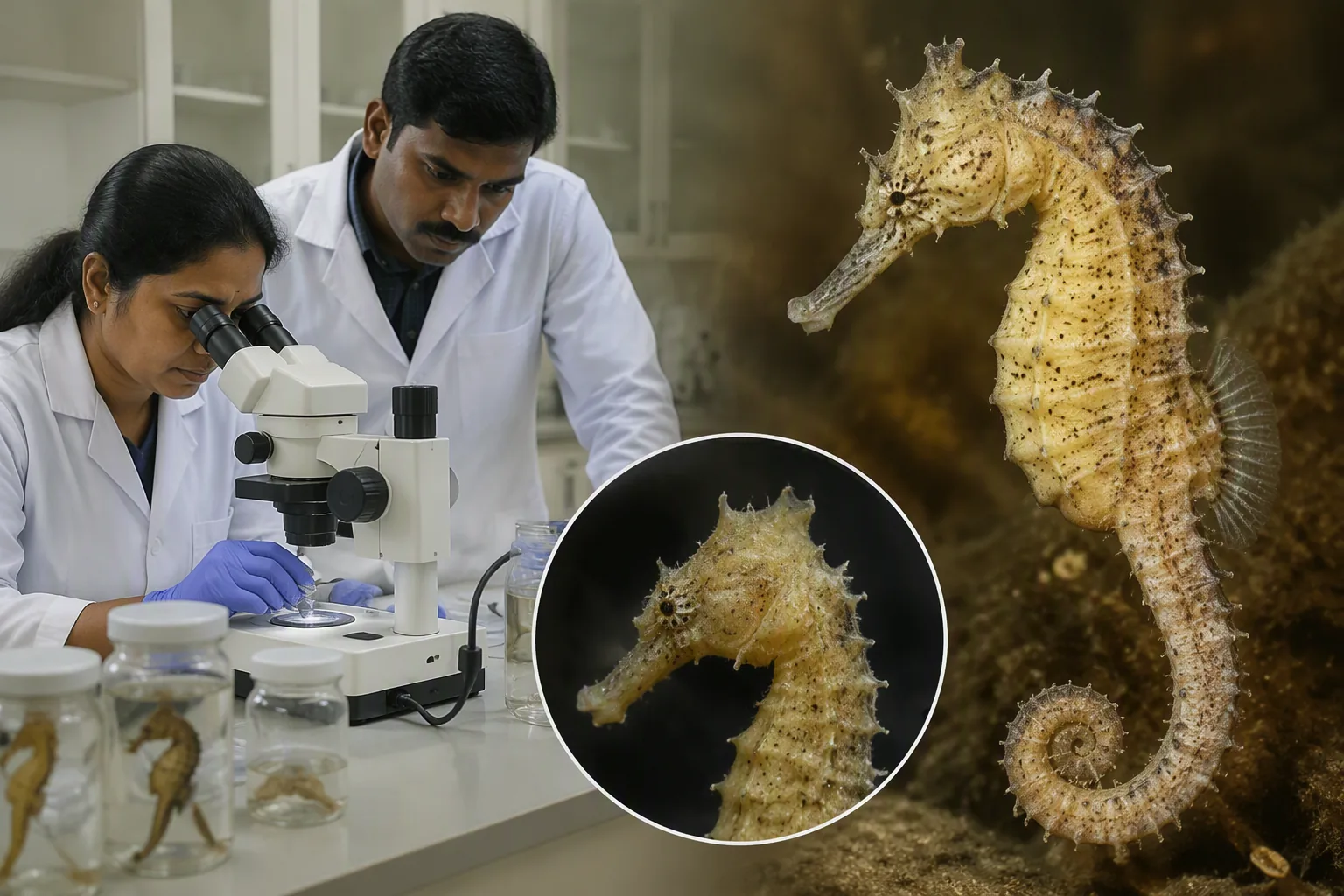
In August 2026, researchers from Kerala University of Fisheries and Ocean Studies (KUFOS) identified a new species of thorny seahorse named Hippocampus amandavincentae, honoring marine biologist Amanda Vincent. This discovery clarified that the thorny seahorse complex previously grouped under Hippocampus histrix for about 150 years actually comprises three distinct species. The specimen was initially collected as fish bycatch near Tuticorin fisheries harbour in Tamil Nadu. This finding increases the known seahorse diversity along the Kerala coast to five species, emphasizing the ongoing importance of taxonomy in marine biodiversity studies in the Indian Ocean region.
On this page
Key Facts
- Hippocampus amandavincentae, a new species of thorny seahorse, was identified in August 2026 by researchers from Kerala University of Fisheries and Ocean Studies (KUFOS).
- The species is named in honor of Canadian marine biologist Amanda Vincent, renowned for her work on seahorses.
- The specimen was initially collected from fish bycatch at Tuticorin fisheries harbour in Tamil Nadu, India.
- Findings were published in the peer-reviewed taxonomy journal Zootaxa in August 2026.
- The study revealed that what was previously known as the thorny seahorse (Hippocampus histrix) actually comprises three distinct species.
- Hippocampus jayakari from the northwestern Indian Ocean was also confirmed as a valid separate species.
- This taxonomic revision increases the number of known seahorse species along the Kerala coast to five.
- Seahorses belong to the genus Hippocampus within the family Syngnathidae.
Background & Context
Seahorses are marine fishes categorized under the genus Hippocampus, part of the Syngnathidae family that includes pipefish and seadragons. For approximately 150 years, the thorny seahorse complex was treated as a single species known as Hippocampus histrix. Through integrative taxonomic approaches—using external morphology assessments, comparisons with historical museum specimens, and genetic analyses—researchers have clarified species boundaries within this group. This work notably assigns specimens from the Indian Ocean previously identified as Hippocampus histrix to distinct species.
Marine biodiversity along the Indian coast, specifically across the Arabian Sea and Bay of Bengal, remains an active area of research, with taxonomic revisions periodically updating species-level knowledge. The identification of new species contributes critical information for understanding regional biodiversity, biogeography, and conservation.
Why This Matters for Exams / Exam Relevance
Competitive exams in biology, environmental science, and general studies often focus on recent scientific discoveries, biodiversity hotspots, and notable Indian research institutions. The discovery of Hippocampus amandavincentae by KUFOS highlights India's contribution to global marine taxonomy and biodiversity research. Key concepts such as taxonomy, the importance of peer-reviewed journals like Zootaxa, fish bycatch as a source of new specimens, and significant biodiversity in the Indian Ocean region are frequently included in exam syllabi. Geographical locations like the Kerala coast and Tuticorin fisheries harbour also appear in questions related to India's natural resources and research achievements.
Points to Remember
- Hippocampus amandavincentae is a newly described thorny seahorse species identified in 2026 by KUFOS researchers.
- The species honors Amanda Vincent, a prominent marine biologist specializing in seahorses.
- The specimen was collected as fish bycatch in Tuticorin fisheries harbour, Tamil Nadu.
- Results were published in the scientific journal Zootaxa, emphasizing the role of taxonomy in marine biology.
- The thorny seahorse complex consists of at least three distinct species after revision.
- Kerala's marine ecosystem now hosts five confirmed seahorse species, reflecting rich biodiversity.
- Seahorses belong to the genus Hippocampus and the family Syngnathidae, important groups within marine fish taxonomy.
Sources & Further Reading
| Document / Website | Link |
|---|---|
| KUFOS team discovers new thorny seahorse species | Open KUFOS team discovers new thorny seahorse species ↗www.gktoday.in |
| Zootaxa journal | Open Zootaxa journal ↗www.mapress.com |
| Kerala University of Fisheries and Ocean Studies Official Site | Open Kerala University of Fisheries and Ocean Studies Official Site ↗kufos.ac.in |